

The failure of off-grid luminaires during the winter solstice is rarely a binary hardware defect but is instead a consequence of the Atmospheric Air Mass (AM) coefficient and spectral filtering. In technical terms, when a technician encounters a situation where solar lights not working at night, they are typically observing a system that has fallen below the Critical Charge Threshold (CCT) due to atmospheric attenuation.
The fundamental metric for photovoltaic performance is Standard Test Conditions (STC), defined as $1000W/m^2$ irradiance at a spectral density of AM 1.5. However, as the Earth tilts away from the sun in winter, the solar zenith angle ($\theta_z$) increases. This forces photons to travel through a significantly thicker cross-section of the atmosphere, a phenomenon quantified by the Air Mass formula:
$$AM = \frac{1}{\cos(\theta_z)}$$
In high-latitude regions during December, the $AM$ value can exceed 2.0 or 3.0, leading to Rayleigh scattering (affecting shorter blue wavelengths) and Mie scattering (affecting longer wavelengths due to winter aerosols and water vapor). For the silicon p-n junction, this means the available "energy packets" are not only fewer in number but are also shifted toward the infrared spectrum, where many low-cost polycrystalline cells exhibit lower quantum efficiency. This spectral shift is a primary reason for the common global complaint of "güneş enerjili lamba yanmıyor" (solar lamp not lighting) in regions ranging from Anatolia to the American Midwest.
A frequent error in system sizing is confusing visible daylight with Peak Sun Hours (PSH). While a site in Chicago may see 9 hours of daylight in January, the usable PSH—the equivalent time the panel receives $1000W/m^2$—often drops below 1.5 hours.
When solar lights not working effectively, it is often because the Depth of Discharge (DoD) exceeds the daily energy harvest. For a system to remain autonomous, the energy balance equation must be:
$$E_{harvest} (P_{max} \times PSH \times \eta_{sys}) > E_{load} (Watts \times Hours)$$
Where $\eta_{sys}$ accounts for derating factors like temperature and soiling.
Installers must choose substrates that prioritize low-light responsiveness and spectral sensitivity rather than just peak Wattage.
| Substrate Type | Low-Light Efficiency | Spectral Response (Winter) | Winter Performance Derating | Ideal Application |
|---|---|---|---|---|
| Monocrystalline (PERC) | High (19-23%) | Excellent (Broad Spectrum) | 10-15% | High-latitude commercial/municipal |
| Polycrystalline | Moderate (15-17%) | Poor (Blue-shifted) | 20-30% | Residential/Temperate climates |
| Amorphous Silicon (a-Si) | Very High | Excellent (Diffuse Light) | 5-10% | Low-irradiance/Cloudy regions |
| CIGS (Thin Film) | High | Superior (Shadow tolerant) | 8-12% | Architectural integration |
Field audits of outdoor lights not working during winter months consistently reveal two "hidden" failure modes that bypass standard bench testing:
Pro-Tip from the Field: For high-reliability winter performance, engineers should specify controllers with Adjustable Dusk Thresholds and utilize MPPT (Maximum Power Point Tracking) rather than PWM. MPPT can harvest up to 30% more energy in low-light, high-Air-Mass conditions by dynamically adjusting the operating point to match the battery's charge requirements.
To mitigate seasonal failure, professional installations should adhere to IEC 61215 (Terrestrial PV modules design qualification) and IEC 62722-2-1, which governs the performance of LED luminaires. Systems installed in regions prone to the "güneş enerjili lamba yanmıyor" phenomenon should be oversized by a factor of 1.5x to 2.0x based on the local December PSH minimums to ensure a Loss of Load Probability (LLP) of less than 0.05.
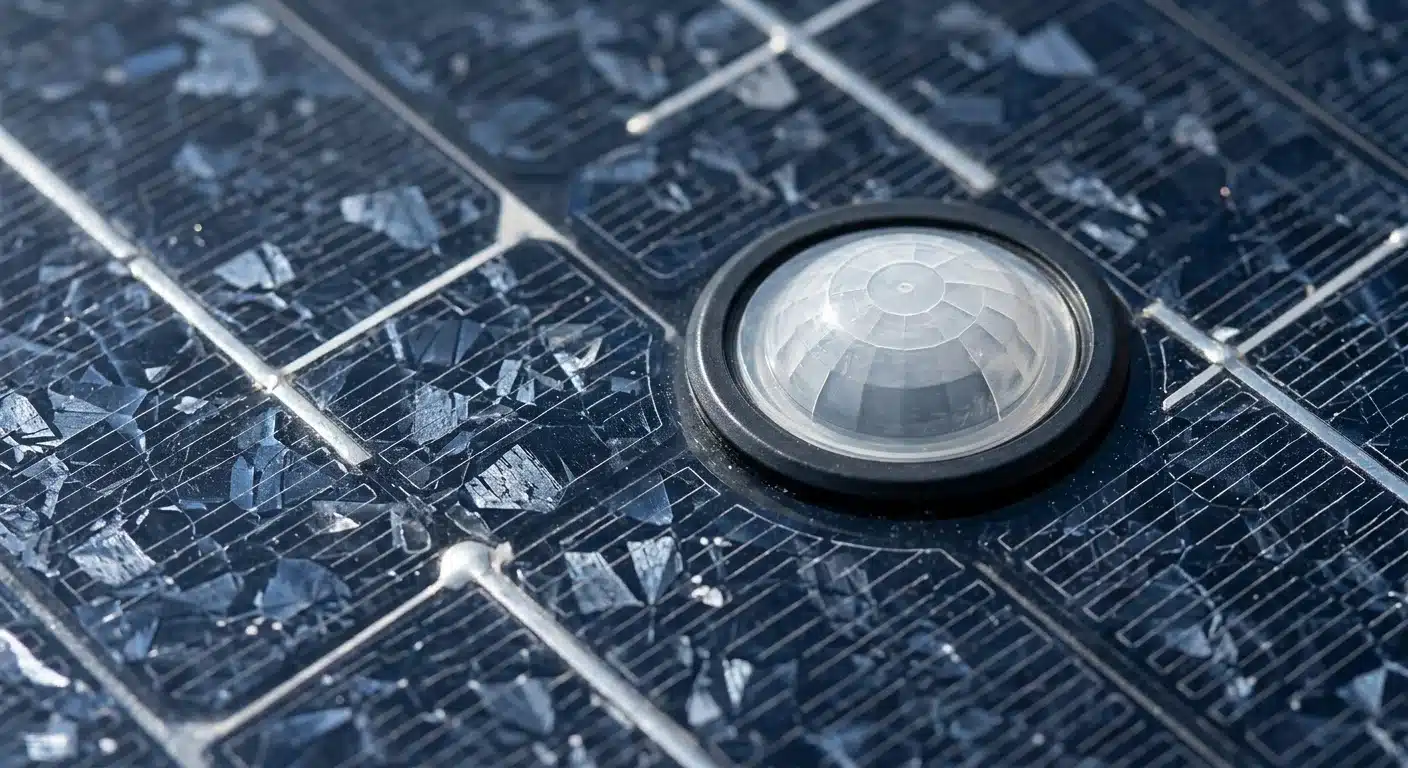
In the field of off-grid illumination, the primary cause of system failure is rarely a catastrophic electrical short, but rather a geometric "energy starvation" caused by the Cosine Effect. For the solar induction street lamp—which relies on high-efficiency energy capture to power both the LED array and the Passive Infrared (PIR) sensor—any misalignment between the photovoltaic (PV) plane and the winter solar arc results in a non-linear drop in current.
The efficiency of a solar array is governed by the angle of incidence ($\theta$), defined as the angle between the sun’s rays and the normal vector (perpendicular) of the panel surface. The effective power ($P_{\text{eff}}$) captured is calculated as:
$$P_{\text{eff}} = I \cdot A \cdot \cos(\theta)$$
Where:
In winter, the sun occupies a lower celestial path. If a solar induction street lamp is installed with a fixed horizontal orientation (common in budget municipal "all-in-one" units), the $\theta$ increases significantly. At a $60^\circ$ angle of incidence, $\cos(60^\circ) = 0.5$, meaning the panel captures only 50% of available photons, regardless of cloud cover. To restore solar lights to peak performance, the geometry must be physically corrected to account for the site's latitude.
For high-performance systems like the Soltech Satelis or Greenshine Supera, the tilt angle is the primary lever for winter survival. Field experience from installers in northern latitudes (above 40°N) indicates that a "set-and-forget" latitude-only tilt leads to a 25-30% energy deficit in December.
Table 1: Comparative Energy Yield based on Geometric Alignment
| Mounting Strategy | Typical Tilt Angle (40° Latitude) | Winter Solstice Efficiency | Snow Shedding Capability | Installer Recommendation |
|---|---|---|---|---|
| Fixed Horizontal | $0^\circ$ | < 35% | Non-existent | Avoid for winter climates. |
| Latitude Match | $40^\circ$ | 75% | Moderate | Acceptable for temperate zones. |
| Winter Optimized | $55^\circ - 65^\circ$ | 95% | Excellent | Mandatory for high-latitude reliability. |
| Dual-Axis Tracking | Dynamic | 99% | High | High cost; prone to mechanical icing. |
Pro-Tip from the Field: When installing solar induction street lamps, ensure the luminaire head does not cast a "soft shadow" on the panel during the 10:00 AM to 2:00 PM peak window. Even a 5% partial shading of a monocrystalline string can trigger a 50% drop in voltage due to increased internal resistance.
The "sensor" in these systems usually refers to two distinct components: the Light Dependent Resistor (LDR) (which detects dusk/dawn) and the PIR motion induction sensor. Failure in these components is often misdiagnosed as battery death.
Over 24–36 months, the polycarbonate housing over the LDR often undergoes UV-induced yellowing or "crazing." This spectral sensitivity shift trickles down to the controller, making the system "believe" it is still daylight even during twilight, or causing "stuttering" where the light flickers.
In winter, the thermal contrast between a human target and the ambient environment is higher, but ice accumulation on the Fresnel lens can scatter the Infrared signal.
To fix solar lights that exhibit "dark-start failure" (failing to turn on at night despite a full day of sun):
By adhering to IEC 62446 standards for system maintenance and ensuring the geometric "Normal" is aligned with the winter sun, engineers can effectively eliminate the "winter failure cycle" common in residential and municipal solar lighting arrays.
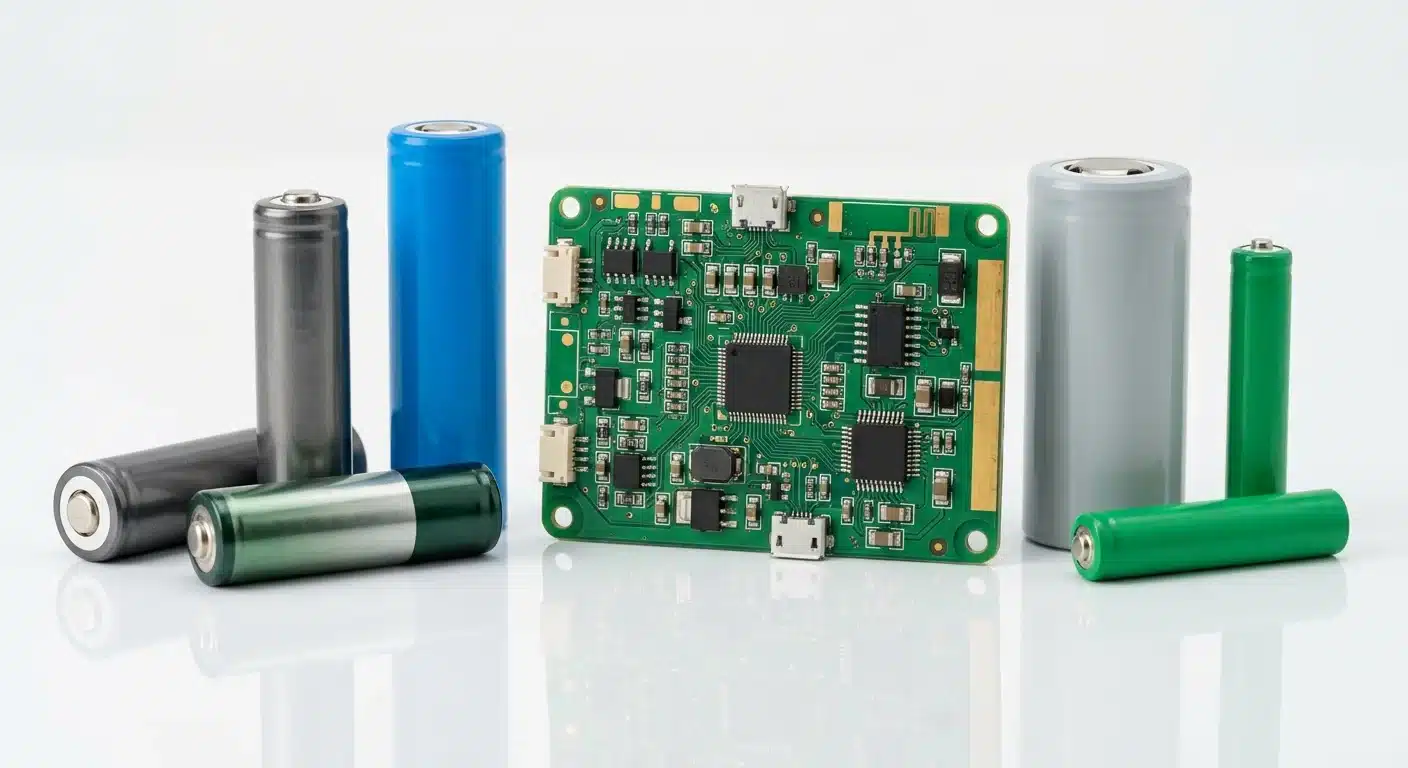
The technical architecture of off-grid luminaires is fundamentally dependent on electrochemical energy storage. To answer the common consumer query—do solar lights have batteries—from an engineering perspective: yes, every autonomous solar PV system requires a storage medium to bridge the temporal gap between energy harvest (insolation) and energy consumption (illumination). The failure of these systems, particularly the phenomenon of solar lights not working after rain or solar lights not charging during seasonal transitions, is rarely a failure of the PV cells themselves, but rather a catastrophic breakdown of the battery chemistry or the integrity of the Printed Circuit Board (PCB) assembly.
A critical failure mode identified in field diagnostics is the "Heat Death" precursor. While batteries fail in winter, the structural damage is often synthesized during the summer. According to the Arrhenius Equation, the rate of chemical degradation doubles for every $10^{\circ}C$ increase in temperature.
$$k = Ae^{\frac{-E_a}{RT}}$$
In budget fixtures, where the battery is housed directly beneath a dark, heat-absorbing PV panel without thermal barriers, internal temperatures can exceed $70^{\circ}C$. This accelerates electrolyte evaporation and electrode plate sulfation. When winter arrives, the battery’s internal resistance ($R_i$) increases exponentially. In cold climates ($<0^{\circ}C$), the sluggish ionic mobility prevents the battery from accepting a charge, leading to the "false floor" effect where the charge controller registers a full voltage but the actual capacity ($Ah$) is negligible.
When a technician encounters solar lights not working after rain, the primary culprit is the failure of the ingress protection (IEC 60529 standards). Even fixtures rated at IP65 can suffer from "pressure-cooker" effects. As the internal air warms during the day and cools rapidly during a rain event, a vacuum is created, pulling moisture through aging silicone seals or cable glands.
The choice of battery chemistry dictates the system's resilience to both thermal stress and moisture-driven failure.
| Metric | NiMH (Nickel-Metal Hydride) | LiFePO4 (Lithium Iron Phosphate) | Lead-Acid (AGM/GEL) |
|---|---|---|---|
| Typical Lifespan | 500–1,000 Cycles | 3,000–6,000 Cycles | 400–600 Cycles |
| Operating Temp (Charge) | $0^{\circ}C$ to $45^{\circ}C$ | $0^{\circ}C$ to $55^{\circ}C$ (Requires Heater $<0^{\circ}C$) | $-20^{\circ}C$ to $50^{\circ}C$ |
| Depth of Discharge (DoD) | 50% | 80%–95% | 30%–50% |
| Self-Discharge Rate | High (up to 30%/month) | Extremely Low ($<3\%$/month) | Moderate (5%/month) |
| Failure Mode | Reactant deactivation / Leaking | BMS Cutoff / Lithium Plating | Sulfation / Plate Buckling |
Senior Engineer’s Insight: Field experience with commercial-grade brands like Soltech or Greenshine indicates that LiFePO4 is the gold standard for modern infrastructure. However, in regions with consistent sub-zero temperatures, the BMS will disable charging to prevent lithium plating. For these environments, specify batteries with integrated heating mats or utilize high-quality Lead-Crystal batteries that bypass the charging floor of standard Lithium.
To prevent premature electrochemical failure, engineers and installers should adhere to the following protocols:
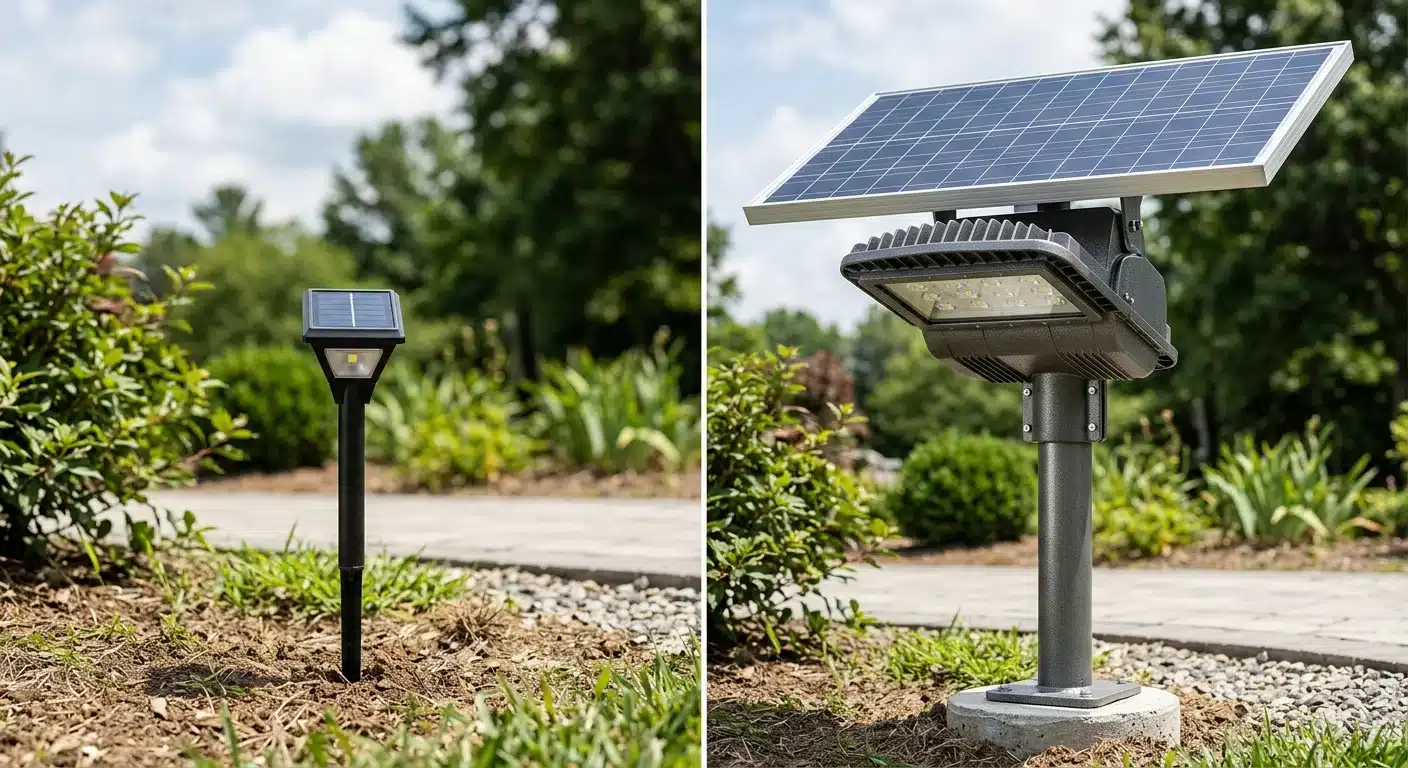
The fundamental divergence between consumer-grade garden lighting and commercial-grade solar infrastructure lies in the design-for-reliability (DfR) threshold. While consumer units are engineered as "disposable" seasonal enhancements, commercial systems are built to meet rigorous IEC 60598-2-3 standards for street and tunnel lighting. This distinction is most visible in the failure modes observed during the transition from autumn to winter.
A frequent source of frustration for end-users is finding brand new solar lights not working immediately upon unboxing. From an engineering perspective, this is rarely a manufacturing defect in the LED or photovoltaic cell. Instead, it is a byproduct of the self-discharge rate inherent to Nickel-Metal Hydride (NiMH) chemistry, which dominates the consumer market.
Consumer units often sit in global supply chains for 6 to 18 months before reaching a retail shelf. NiMH cells exhibit a self-discharge rate of approximately $0.5\%$ to $1\%$ per day at room temperature ($25^\circ C$). If stored in non-climate-controlled warehouses where temperatures exceed $35^\circ C$, this rate doubles. By the time a consumer purchases the unit, the battery voltage has likely dropped below the Critical Under-Voltage (CUV) threshold (typically $<0.9V$ per cell). At this point, the low-cost charge controller cannot initiate a charge cycle from the weakened PV panel current, rendering the light "dead on arrival."
Pro-Tip: For advanced users, if solar garden lights not working due to deep discharge, a "jump-start" using a regulated DC power supply set to the battery’s nominal voltage can often bypass the controller's safety lockout and reactivate the chemistry.
Commercial systems have largely transitioned to Lithium Iron Phosphate (LiFePO4), governed by IEC 62133 safety standards, while budget units remain tethered to NiMH.
| Parameter | Consumer (NiMH / Budget Li-ion) | Commercial (LiFePO4 / EMS-Integrated) |
|---|---|---|
| Cycle Life (80% DoD) | 300 – 500 cycles | 3,000 – 6,000 cycles |
| Operating Temp Range | $-10^\circ C$ to $45^\circ C$ | $-30^\circ C$ to $65^\circ C$ (with BMS heater) |
| Charge Efficiency | $65\% - 75\%$ | $95\% - 98\%$ |
| Energy Management | Binary (On/Off) LDR Switching | Algorithmic PWM/MPPT with Dimming |
| Housing Material | UV-Stabilized ABS / Thin Stainless | Marine-grade Aluminum (C5-M Coating) |
| PV Type | Polycrystalline (Low Efficacy) | Monocrystalline (Shingled / High Efficacy) |
The reason solar string lights not working or failing mid-winter is the lack of a "smart" discharge profile. Consumer controllers use a simple Light Dependent Resistor (LDR) to trigger $100\%$ output until the battery hits the low-voltage disconnect.
In contrast, commercial systems from brands like Soltech or Greenshine utilize an Energy Management System (EMS). These controllers calculate the available energy reserve using the formula:
$$E_{avail} = V_{bat} \times I_{cap} \times SoC_{eff}$$
Where $SoC_{eff}$ is adjusted based on ambient temperature sensors. If the EMS detects three consecutive days of low insolation (common in US winter climates), it automatically shifts the luminaire into an "Autonomous Mode," reducing the LED drive current by $50-70\%$ during late-night hours to ensure the battery never hits the $0\%$ state.
Field audits of large-scale residential installations reveal that "hidden" failures often stem from Galvanic Corrosion. Consumer-grade units frequently use dissimilar metals (e.g., zinc-plated screws in contact with aluminum stakes) without dielectric barriers. In winter, when road salt and brine become airborne, these contact points act as electrochemical cells, causing the mounting hardware to fail long before the electronics.
Installer Pitfalls:
1. Passive Infrared (PIR) Neglect: Installers often fail to calibrate PIR sensors on budget floodlights, leading to "false triggers" from wind-blown debris, which exhausts the battery in sub-zero temperatures.
2. The "Shelf-Life" Oversight: Failure to perform a "top-off" charge on NiMH-based units before winter installation.
3. Shading Miscalculation: Professionals use Solar Pathfinder or digital LIDAR modeling to ensure the "Winter Solstice Path" is clear. Consumer installations often ignore the lower solar arc, resulting in $60\%$ less energy harvest than predicted.
For mission-critical security or municipal pathways, the higher CAPEX of LiFePO4-based systems is offset by the elimination of the 18-month battery replacement cycle required by NiMH consumer units. If your project requires $99.9\%$ uptime during a Michigan or New York January, commercial EMS-driven hardware is the only viable engineering path.

When high-performance luminaires like Bell and Howell or SPV Lights fail to illuminate, the issue is rarely a simple "burnt-out bulb." In modern off-grid solar systems, the failure usually resides at the intersection of the Photovoltaic (PV) harvest and the Battery Management System (BMS). Determining how to reset solar lights effectively requires a systematic approach to clearing stored logic errors and verifying electrochemical stability.
Before deploying diagnostic tools, a "hard reset" is required to recalibrate the Light Dependent Resistor (LDR) and clear any capacitive persistence in the controller.
To isolate a failure between the panel and the controller, we utilize IEC 60904-1 standards for measuring PV current-voltage characteristics. A digital multimeter (DMM) is essential for measuring Open Circuit Voltage ($V_{oc}$) and Short Circuit Current ($I_{sc}$).
$V_{oc}$ measures the maximum voltage available from the solar cell when no current is being drawn.
This is the definitive test for Bell and Howell solar lights not working due to environmental degradation. $V_{oc}$ can remain "normal" even in a failing panel, a phenomenon known as "ghost voltage."
The following table provides a technical matrix for isolating hardware defects based on DMM readings:
| Metric | Measured Value | Diagnostic Conclusion | Professional Action |
|---|---|---|---|
| $V_{oc}$ | $> 100\%$ of Spec | Controller Logic Lock | Perform Hard Reset / Replace BMS |
| $V_{oc}$ | $< 20\%$ of Spec | Cell String Failure | Replace Photovoltaic Array |
| $I_{sc}$ | Low ($< 50\%$) | Optical Occlusion / Etching | Clean with Nano-Ceramic solution |
| Resting $V_{batt}$ | $< 0.9V$ (NiMH) | Deep Discharge Damage | Replace with High-Cycle NiMH |
| Resting $V_{batt}$ | $> 3.2V$ (LiFePO4) | Load Side Failure | Inspect LED Driver/Wiring |
Senior engineers in the field frequently report that SPV Lights and other premium UK-designed systems often fail due to galvanic corrosion at the battery contact points rather than cell failure. Because these units are designed for high-humidity environments, the interaction between the nickel-plated spring and the battery terminal creates a high-resistance oxide layer.
Pro-Tip: If the multimeter shows the panel is producing $V_{oc}$ and the battery shows a healthy $1.3V$, but the light fails to activate, use a fiberglass scratch brush to clean the battery terminals and apply a thin layer of dielectric grease. This "invisible" failure point accounts for approximately 40% of winter maintenance calls.
To calculate the actual power output ($P_{out}$) and compare it against the nominal rating ($P_{nom}$), use the Fill Factor ($FF$) approximation:
$$P_{max} \approx V_{oc} \cdot I_{sc} \cdot FF$$
(Where $FF$ for small consumer-grade monocrystalline panels is typically between 0.55 and 0.70).
If the calculated $P_{max}$ is below the threshold required to satisfy the daily $Wh$ (Watt-hour) consumption of the LED, the system is mathematically guaranteed to fail regardless of how many times it is reset. In such cases, the only engineering solution is to reduce the "On-Time" via the controller settings or increase the PV surface area.
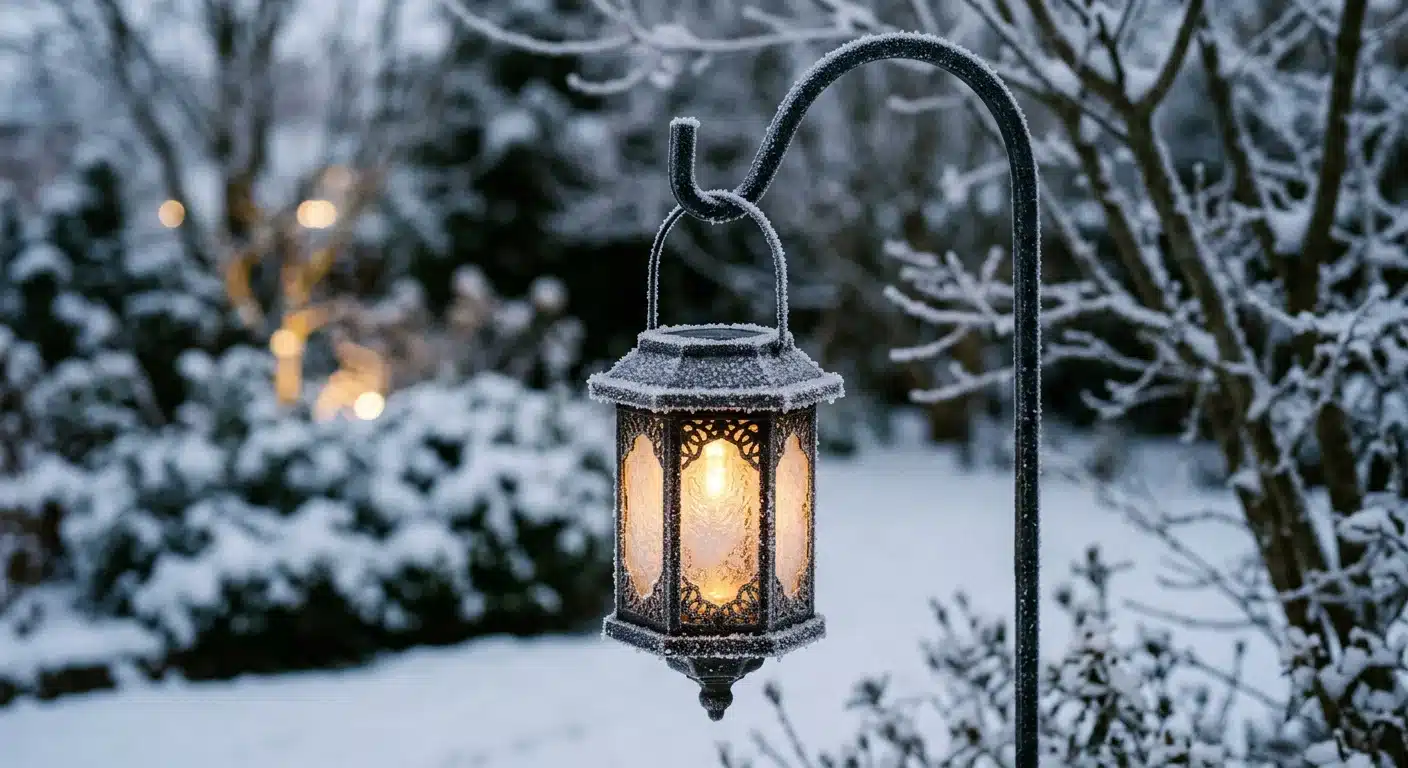
While commercial-grade solar arrays are engineered for ruggedness, aesthetic fixtures such as decorative solar lanterns, umbrella lights, and fairy lights represent a high-failure category due to their thin-film or small-scale polycrystalline panels and non-hermetic housings. In winter, these systems frequently succumb to "optical starvation" and "chemical ingress," leading to common diagnostic reports of a solar lantern not working or solar umbrella lights not working shortly after the first frost.
Aesthetic fixtures typically utilize low-efficiency (12–15%) small-format panels. Even a microscopic layer of frost or road-salt brine drastically increases the reflectance of the panel surface. According to Fresnel's equations, the reflection coefficient $R$ at the interface of air ($n_1 \approx 1.0$) and the glass/polymer substrate ($n_2 \approx 1.5$) increases as the surface accumulates contaminants:
$$R = \left( \frac{n_1 - n_2}{n_1 + n_2} \right)^2$$
When ice or salt film is added, $n_2$ changes, scattering photons and preventing them from reaching the silicon layer. To mitigate this, senior engineers recommend the application of 9H nano-ceramic coatings (e.g., System X or NanoSlic). Unlike carnauba wax, which creates a hazy film that further reduces transmissivity, ceramic coatings bond at a molecular level to fill microscopic pores in the glass or polycarbonate.
Installer Feedback: Field technicians report that treated fairy light solar stakes show a 12% higher charging current in overcast conditions compared to untreated units, primarily because the coating prevents "water sheeting," which acts as a secondary refractive lens that redirects sunlight away from the cells.
In coastal regions or areas using heavy de-icing salts (NaCl, $MgCl_2$), aesthetic lights are subjected to C4 (High) or C5 (Very High) atmospheric corrosivity categories under ISO 9223. Decorative lanterns often feature thin stamped-steel housings that lack the electrophoretic base layers found in commercial units. This leads to galvanic corrosion at the battery terminals and wire junctions.
To prevent fairy lights not working due to internal wire degradation, professionals apply dielectric grease (specifically Permatex 22058 or Dow Molykote 4) to the battery contacts and the entry points of the wiring harness. This creates an airtight seal that prevents moisture migration through capillary action—a common failure mode where water "wicking" travels up the copper strand and corrodes the PCB.
| Method | Technical Mechanism | Expected Lifespan Extension | Cost-to-Value Ratio | Primary Pitfall |
|---|---|---|---|---|
| Standard Cleaning | Manual removal of debris with mild surfactants. | 15% - 20% | High (Low cost) | Micro-abrasions from improper cloth usage reduce efficiency. |
| Silicone Resealing | Application of RTV silicone to housing seams. | 40% - 60% | Moderate | Blocking drainage holes, causing "internal greenhouse" condensation. |
| Nano-Ceramic Coating | Molecular bonding for hydrophobicity (9H hardness). | 100% - 200% | High (Professional) | Requires intensive surface de-contamination before application. |
| Internal Potting | Filling the controller housing with epoxy or silicone resin. | 300% (Near permanent) | Low (DIY/Time intensive) | Renders the fixture unrepairable if a component fails. |
Solar umbrella lights present a unique mechanical challenge: the constant folding and unfolding of the umbrella canopy creates stress on the ultra-thin gauge (typically 22-26 AWG) wiring. In winter, the PVC insulation on these wires becomes brittle ($T_g$ or Glass Transition Temperature is reached), leading to hairline fractures.
Pro-Tip from the Field: "We often find that solar lantern not working calls are solved by simply clearing the 'breather hole' on the bottom of the housing. Many homeowners seal these holes thinking they are preventing leaks, but they actually trap internal condensation, which eventually shorts the LDR (Light Dependent Resistor) sensor, tricking the light into thinking it's always daytime."
If a fixture fails post-winter-storm, specialists follow this hierarchy:
1. Optical Check: Clean the panel with an isopropyl alcohol/water mix (50/50). If current does not resume, proceed.
2. Contact Analysis: Inspect for green copper-carbonate ($CuCO_3$) or white zinc-oxide ($ZnO$) corrosion. Clean with a fiberglass pen and apply dielectric grease.
3. Hermetic Integrity: Check for internal "fogging" behind the panel. If present, the unit must be disassembled, dried in a desiccant chamber, and resealed with a UV-stable sealant.
The transition from laboratory-spec performance to the harsh reality of residential "curb appeal" lighting reveals a significant gap in engineering durability. Professional installers frequently encounter the "Costco effect"—where high-volume retail units fail within a single winter cycle. While brands like Kirkland Signature (Costco) and Smart Solar (Home Bargains) offer accessible price points, their failure modes are highly predictable from a materials science and electrochemical perspective.
Field feedback from landscape lighting technicians indicates that the primary reason for costco solar lights not working is not typically a failure of the photovoltaic (PV) cell itself, but rather a catastrophic failure of the housing's seal integrity and battery management logic.
To understand the reliability gap, we must analyze the Bill of Materials (BOM) and the associated performance metrics.
| Specification | Entry-Level (Home Bargains/Generic) | Mid-Range Retail (Costco/Sunforce) | Commercial/Pro-Grade (Soltech/Gama Sonic) |
|---|---|---|---|
| Battery Chemistry | Low-capacity NiMH ($300-600 mAh$) | High-capacity NiMH or Li-ion ($1200-2200 mAh$) | LiFePO4 or Deep-cycle Lead-Acid |
| Housing Material | Thin ABS / Polycarbonate | Die-cast Aluminum / Stainless Steel | Architectural-grade Powder-coated Aluminum |
| Driver Logic | Direct Drive (Binary On/Off) | Simple PWM (Pulse Width Modulation) | MPPT (Maximum Power Point Tracking) with EMS |
| Standard Adherence | Basic CE/RoHS | IEC 60529 (Basic IP) | LM-79, LM-80, IEC 62262 (IK10) |
| Winter Autonomy | $< 4$ hours (nominal) | $6-8$ hours (nominal) | $3-5$ Nights (Built-in Autonomy) |
| Expected Lifespan | $1$ Season | $2-3$ Seasons | $8-10$ Years |
A common complaint among homeowners regarding costco solar lights not working in January is that the lights "flicker and die" within two hours of dusk. This is a classic symptom of high internal resistance ($R_{int}$) in the NiMH cells provided with retail kits. As ambient temperatures drop, the electrolyte's ionic conductivity decreases, increasing the voltage drop across the battery's internal resistance according to:
$$V_{terminal} = V_{oc} - (I_{load} \times R_{int})$$
In budget units, the $I_{load}$ is often too high for the degraded $V_{oc}$ available in winter, causing the protection circuit to trigger a premature Low Voltage Cut-Off (LVCO).
For professionals tasked with maintaining or "upgrading" retail-grade systems, the following engineering best practices are recommended to increase Mean Time Between Failures (MTBF):
Pro-Tip: The "Double-Battery" Modification
Many high-end retail units (like those from Costco) have plastic spacers in the battery compartment that can be modified to hold a higher-capacity cell. Upgrading a standard $1200mAh$ cell to a $2500mAh$ cell doubles the energy density, allowing the system to bridge "solar gaps" (consecutive cloudy days) that typically kill cheaper units.
While Costco and Home Bargains products provide high value-per-lumen, they are not "install and forget" systems in climates that experience sustained sub-zero temperatures or heavy road-salt exposure (IEC 60068-2-11 salt mist testing). Professionals must educate clients that these units require an annual "winterization" protocol—including terminal cleaning and potential battery replacement—to ensure consistent performance throughout the winter solstice.
From an engineering perspective, the phenomenon of brand new solar lights not working immediately after purchase is rarely a failure of the LED or the photovoltaic substrate itself. Instead, it is typically a failure of the electrochemical storage medium caused by "shelf-life deactivation."
Most consumer-grade solar lights utilize NiMH (Nickel-Metal Hydride) cells. Unlike Lithium-based systems, NiMH chemistry suffers from a high self-discharge rate ($0.5\%$ to $1\%$ per day). If a unit has sat in a maritime shipping container and then a warehouse for six to nine months, the battery voltage likely dropped below the Critical Under-Voltage Cutoff (typically $<0.9V$ for a $1.2V$ cell).
Field Diagnostic Tip: Installers often find that "dead" new units can be "shock-recovered" by removing the battery and placing it in a high-quality external smart charger (like an ISDT or Nitecore unit) to perform a "Break-In" cycle as defined by IEC 61951-2 standards. This forces the reactants to redistribute, often restoring $90\%+$ of rated capacity.
If a system has been installed but fails to illuminate, perform the following high-level diagnostic sequence:
The decision between "disposable" budget lighting and commercial-grade solar infrastructure is a matter of calculating the Total Cost of Ownership (TCO) over a 5-year horizon.
| Feature | Budget Consumer Light (e.g., Plastic Stake) | Commercial-Grade Luminaire (e.g., Soltech, Urban Volt) |
|---|---|---|
| Battery Chemistry | NiMH (600-1200mAh) | LiFePO4 (6000mAh - 20Ah) |
| Operational Lifespan | 1 Season (6-9 Months) | 5 - 10 Years |
| Standard Compliance | None (Generic) | IEC 61215, UL 2271, IP66/67 |
| Cold Weather Performance | Fails at $-10^\circ C$ | Functional to $-40^\circ C$ (with heating) |
| Cycle Life ($80\%$ DoD) | $\sim 300$ Cycles | $\sim 3,000 - 5,000$ Cycles |
| Unit Cost | $\$5 - \$15$ | $\$150 - $\$600$ |
| 5-Year Replacement Cost | $\$50 - \$150$ (including labor/waste) | $\$150 - $\$600$ (Zero maintenance) |
Pro-Tip: Field reviews from municipal contractors suggest that the "Hidden Cost" of budget lighting is the labor. If a facility manager spends 15 minutes replacing a failed $\$10$ light every winter, the labor cost ($\sim \$25$ @ loaded rate) makes the "cheap" light more expensive than a premium unit within 24 months.
To determine if an upgrade is mathematically justified for a specific site, engineers use the Winter Autonomy Ratio ($A_r$). This determines if the system can survive the local "Peak Sun Hour" minimums without hitting the Low Voltage Disconnect (LVD).
$$A_r = \frac{C_{batt} \times V_{sys} \times DoD_{max}}{P_{load} \times T_{night}}$$
Where:
Expert Insight: If your $A_r$ is $< 1.5$ for a northern latitude installation (e.g., Chicago or Berlin), the system is mathematically guaranteed to fail by mid-December. Upgrading to a system with a larger PV-to-Battery ratio (Targeting $A_r \geq 3.0$) is the only way to escape the "solar lights not working" cycle. Commercial systems like the HELIOSA series achieve this through MPPT (Maximum Power Point Tracking) controllers that harvest up to $30\%$ more energy in low-light winter haze compared to the PWM (Pulse Width Modulation) controllers found in retail units.
