
The global adoption of gas-discharge lighting—specifically linear fluorescent tubes and Compact Fluorescent Lamps (CFLs)—represented a critical milestone in macro-level energy conservation. Designed as highly efficient alternatives to standard incandescent filament bulbs, which function as inherently inefficient blackbody radiators, fluorescent technology fundamentally altered commercial and residential power loads.
While a traditional incandescent bulb wastes over $90\%$ of its energy input as radiant heat, generating roughly $15\text{ lumens per watt (lm/W)}$, fluorescent lamps achieve luminous efficacies of $50$ to $100\text{ lm/W}$. This efficiency extends the operational lifespan from a mere $1,000\text{ hours}$ for standard tungsten filaments to upwards of $10,000$ to $20,000\text{ hours}$ for fluorescent arrays operating under IEC 60081 compliance standards.
To quantify this technological shift, the table below outlines the comparative operating parameters between baseline incandescent technology and standard linear fluorescent (T8) implementations:
| Operational Parameter | Traditional Incandescent (60W) | Linear Fluorescent (T8 - 32W) | Engineering / Regulatory Standard |
|---|---|---|---|
| Luminous Efficacy | $\approx 10 - 15\text{ lm/W}$ | $\approx 80 - 95\text{ lm/W}$ | IES LM-9 (Electrical/Photometric) |
| Lifespan (Average) | $1,000\text{ hours}$ | $15,000 - 24,000\text{ hours}$ | IEC 60081 (Double-capped lamps) |
| Energy Conversion | $<5\%$ visible light, $>95\%$ heat | $\approx 25-30\%$ visible light | Thermodynamics baseline |
| Chemical Toxicity | Negligible (Tungsten, Glass, Argon) | High (Elemental Mercury, Phosphor) | EPA RCRA (40 CFR Part 261/273) |
| Disposal Protocol | Municipal Solid Waste (MSW) | Universal / Hazardous Waste | TCLP (Toxicity Characteristic test) |
Despite the undeniable reductions in greenhouse gas emissions achieved by lowering grid demand, this efficiency relies upon a highly specific, environmentally hazardous chemical mechanism. Facility managers and end-users alike frequently ask: do fluorescent tubes have mercury? The answer is an unequivocal yes; the technology is completely dependent on it.
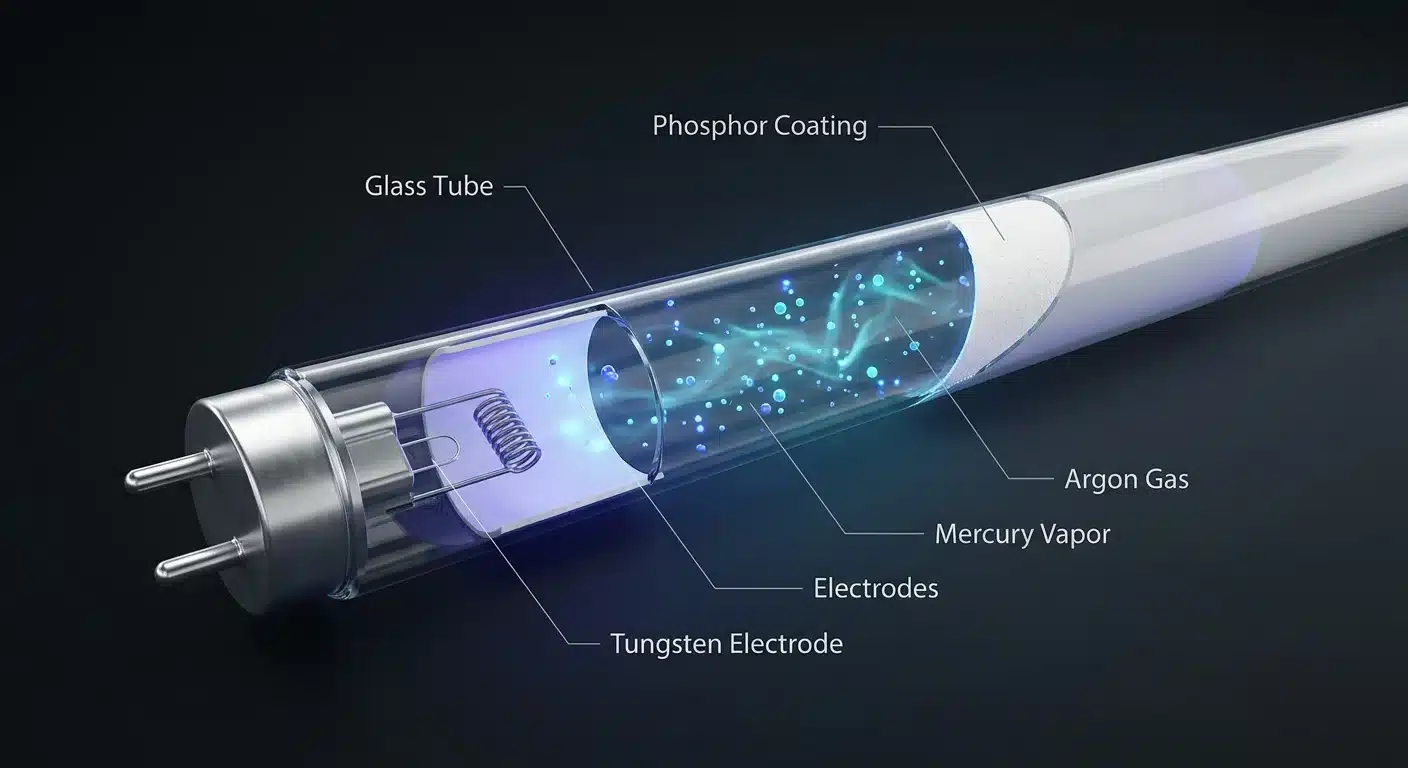
Fluorescent lamps are hermetically sealed borosilicate glass vessels containing an inert buffer gas—typically argon or krypton at a low pressure of approximately $300\text{ Pa}$—and a precise, micro-dosed droplet of elemental mercury ($\text{Hg}^0$). A standard T8 or CFL contains between $4\text{ milligrams}$ and $6\text{ milligrams}$ of mercury.
When an alternating current is applied across the barium, strontium, and calcium oxide-coated tungsten electrodes at the tube's base, thermionic emission releases electrons into the vacuum. These electrons collide with the vaporized mercury atoms, displacing orbital electrons. As the mercury electrons return to their ground state, they release energy in the form of ultraviolet (UV) photons, predominantly at wavelengths of $253.7\text{ nm}$ and $185\text{ nm}$. Because this UV radiation is invisible and hazardous to the human eye, the interior of the glass tube is coated with a rare-earth triphosphor or halophosphate powder. This powder absorbs the UV radiation and fluoresces, undergoing a Stokes shift to emit visible white light.
The presence of elemental mercury creates a profound environmental paradox. While operational fluorescent lamps decrease indirect atmospheric carbon pollution, their end-of-life disposal introduces a severe, localized contamination vector. This toxicological profile precisely explains why are fluorescent bulbs considered hazardous waste under global environmental statutes, such as the EPA's Resource Conservation and Recovery Act (RCRA).
If a fluorescent lamp is mechanically crushed in a standard municipal dumpster or compactor, the internal vacuum is breached, and the volatile mercury vapor immediately aerosolizes into the breathing zone. If the residual heavy-metal-laden phosphor powder is deposited in unlined municipal landfills, elemental mercury leaches into the subterranean substrate. Within the anaerobic conditions of a landfill or aquatic ecosystem, sulfate-reducing bacteria (SRB) metabolize the elemental mercury, converting it into methylmercury ($\text{[CH}_3\text{Hg]}^+$).
Methylmercury is an incredibly potent, highly bioavailable organic neurotoxin. Unlike elemental mercury, methylmercury readily crosses the blood-brain barrier and undergoes severe biomagnification. As it ascends the trophic levels of the food web—from benthic microorganisms to apex predatory fish, and ultimately to human populations—it poses catastrophic neurological and developmental threats.
Field Experience & Installer Feedback:
Consequently, managing the lifecycle of these lamps requires moving away from the paradigm of treating them as disposable commodities. Instead, they must be handled as highly regulated, chemically hazardous vessels requiring strict containment, specialized transportation manifests, and highly engineered vacuum-distillation recycling networks.
Navigating modern fluorescent tube disposal regulations requires a rigorous understanding of the U.S. Environmental Protection Agency’s (EPA) Resource Conservation and Recovery Act (RCRA). Because standard linear fluorescent tubes and compact fluorescent lamps (CFLs) contain between $4\text{ mg}$ and $6\text{ mg}$ of highly toxic elemental mercury, they consistently fail the Toxicity Characteristic Leaching Procedure (TCLP) limit of $0.2\text{ mg/L}$, triggering strict regulatory oversight.
To prevent the administrative paralysis of managing millions of discarded lamps as standard hazardous waste, the EPA established the Universal Waste Rule under 40 CFR Part 273. This framework significantly streamlines the recycling pipeline for commercial, industrial, and institutional entities. By officially classifying spent lamps as "Universal Waste," facility managers bypass the most onerous RCRA mandates: they are exempt from utilizing formal hazardous waste manifests for transport, they bypass costly TCLP chemical testing, and lamp mass does not count toward the facility’s monthly hazardous waste generation threshold.
However, retaining this operational exemption requires absolute, uncompromising adherence to several facility-level mandates:
For smaller operations, the EPA enforces a volume-based regulatory tier. Commercial entities generating less than $100\text{ kg}$ (approximately $220\text{ lbs}$) of total hazardous waste per calendar month classify as Conditionally Exempt Small Quantity Generators (CESQG) under 40 CFR 261.5. Given the mass of standard borosilicate glass tubes, a facility must dispose of roughly $350$ standard $4\text{-foot}$ T8 or T12 lamps in a single month to breach this $100\text{ kg}$ threshold.
While federal statutes technically permit CESQGs to legally deposit their low-volume hazardous waste into permitted Municipal Solid Waste Landfills (MSWLF), environmental engineering best practices heavily discourage this. Discarding mercury-laden lamps in landfills does not absolve the generator of downstream environmental contamination liability under the Comprehensive Environmental Response, Compensation, and Liability Act (CERCLA), colloquially known as Superfund.
When addressing the frequently asked consumer question—"can you throw fluorescent tubes in the normal bin"—the answer diverges sharply depending on the generator's regulatory class and geopolitical jurisdiction.
Under federal EPA guidelines, private residential households are granted a blanket exemption from RCRA regulations regarding household hazardous waste (HHW). Federally, an individual can discard a fluorescent bulb into standard curbside refuse. However, this federal leniency is frequently superseded by aggressive, state-level environmental statutes. States such as California, Massachusetts, Maine, New Hampshire, Vermont, and Washington have enacted strict legislative MSW landfill bans. In these jurisdictions, discarding a fluorescent tube into the normal bin is illegal for both commercial entities and private households, legally mandating the utilization of municipal HHW recycling centers or retail drop-off networks. For commercial operations globally, dumping lamps into the normal bin constitutes an immediate, heavily penalized environmental violation.
The following table analytically contrasts the compliance landscapes across different operational tiers:
| Regulatory Classification | Generation Threshold / Limit | Manifesting / Tracking Required | Legal to Landfill (Federal) | Administrative Burden & Cost Profile |
|---|---|---|---|---|
| Fully Regulated RCRA Hazardous Waste | $> 1,000\text{ kg/mo}$ total hazardous waste | Yes (Strict EPA Manifest tracking system) | No (Strictly prohibited) | Severe. Requires TCLP testing, generator fees, maximum compliance auditing. |
| Universal Waste Rule (40 CFR 273) | Any volume (often large commercial) | No (Standard Bill of Lading acceptable) | No (Must be recycled) | Moderate. Requires DOT-rated packaging, specific labeling, $1\text{-year}$ limit tracking. |
| CESQG (40 CFR 261.5) | $< 100\text{ kg/mo}$ total hazardous waste | No | Yes (But highly discouraged due to CERCLA liability) | Low to Moderate. Recycling via mail-back kits strongly recommended. |
| Household Consumer (Exempt) | N/A (Residential use only) | No | Yes (Unless prohibited by explicit State-level bans) | Zero. Responsibility shifted to municipal HHW collection networks. |
Field Experience & Installer Feedback:

The mechanical fragility of a standard linear fluorescent lamp—featuring a borosilicate glass envelope with a wall thickness typically ranging between $1.0\text{ mm}$ and $1.5\text{ mm}$—demands uncompromising adherence to structural containment engineering. Because a single fracture instantly releases highly volatile elemental mercury vapor, understanding exactly how to store old fluorescent tubes safely is not merely a best practice; it is a strict statutory requirement governed by the EPA's Universal Waste Rule (40 CFR § 273.13) and enforced through Department of Transportation (DOT) Hazmat regulations (49 CFR § 173.197).
Effective facility management requires preemptive isolation of waste lamps prior to final transport.
Field Experience & Installer Feedback:
When preparing a shipment for a commercial mail-back program or industrial transport, understanding how to pack fluorescent tubes for disposal utilizing multi-stage vapor barriers is critical to mitigating in-transit liability.
The linear dimension of the lamp drastically alters its structural vulnerability during handling. The logistical complexities of disposing of 4ft vs 8ft fluorescent tubes dictate distinct structural requirements, as the extended $8\text{-foot}$ span introduces significant bending moments and fulcrum risks.
| Engineering Parameter | 4-Foot Fluorescent Tubes (T8/T12) | 8-Foot Fluorescent Tubes (T8/T12) |
|---|---|---|
| Bending Moment / Deflection | Minimal. Tubes maintain rigidity when handled by a single end. | High. The $96\text{-inch}$ span creates a severe "bowing" effect, risking spontaneous center fracture. |
| Recommended Container Rigidity | Single-wall or double-wall corrugated (ECT-44). | Strict double-wall or triple-wall corrugated (ECT-71 or higher). |
| Vapor Barrier Requirement | Single $5.5\text{ mil}$ HDPE liner. | Extended-length $6.0\text{ mil}$ liner; dual-ziptie closure strongly recommended. |
| Max UN-Rated Weight Capacity | Typically maxes out at $66\text{ lbs}$ (approx. $68\text{ T12}$ or $146\text{ T8}$). | Typically restricted to $50\text{ lbs}$ due to structural torsion risks in longer boxes. |
| Handling Methodology | Single technician lift is acceptable. | Two-technician team lift highly recommended; always support the exact center of the box to prevent buckling. |
| Typical Shipping Kit Cost | Moderate ($\approx \$70 - \$100$ per prepaid mail-back box). | High ($\approx \$140 - \$180+$ per box) due to oversized freight surcharges and structural reinforcement. |
Pro-Tip for 8-Foot Lamp Remediation:
When an $8\text{-foot}$ T12 lamp breaks, the vapor dispersion radius is effectively doubled. Environmental health and safety (EHS) specialists recommend that facilities phasing out $8\text{-foot}$ fixtures transition directly to $4\text{-foot}$ tandem LED retrofits. This immediately eliminates the localized fulcrum breakage risk and reduces future hazardous disposal costs by over $40\%$.
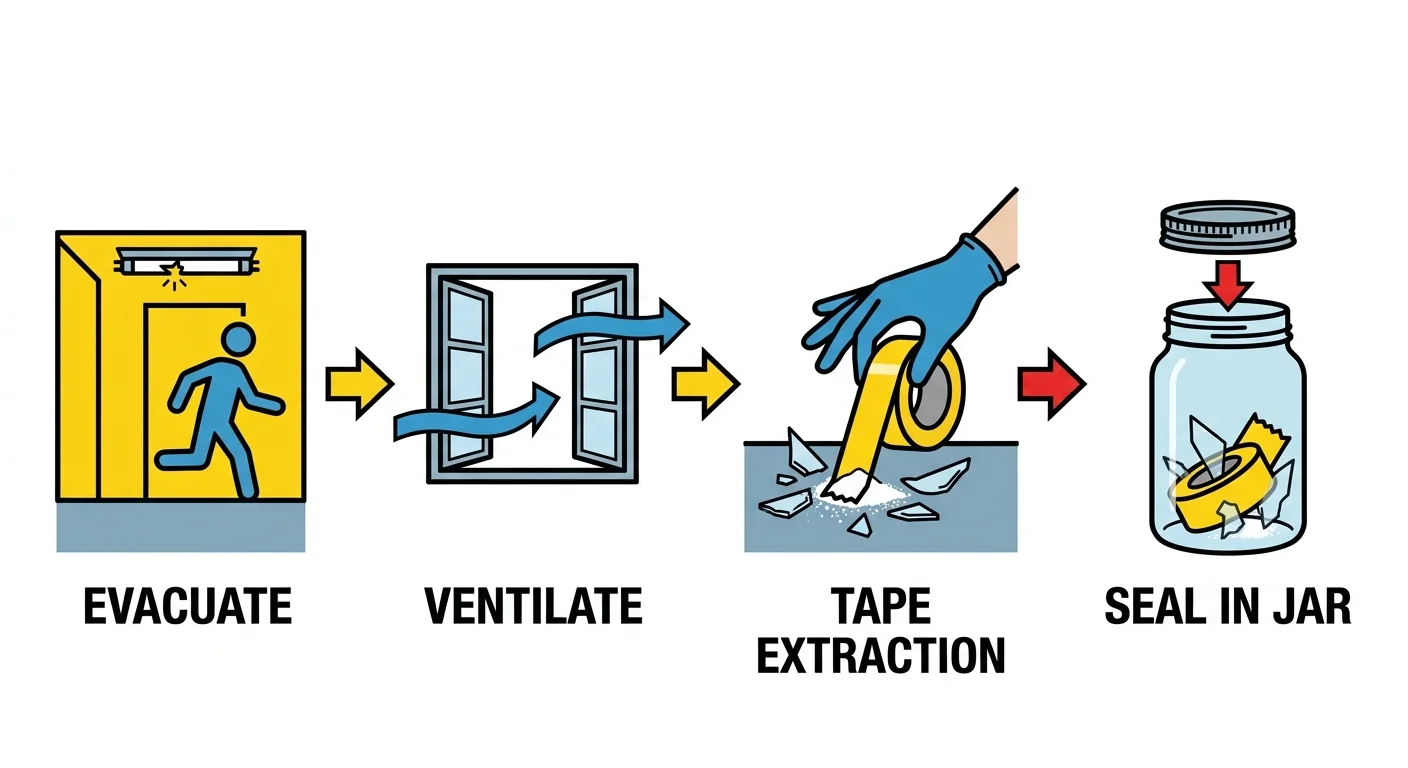
Understanding exactly what happens if you break a fluorescent tube requires a fundamental grasp of gas dynamics and inorganic chemistry. Fluorescent lamps operate by passing an electrical arc through inert argon gas and a precise micro-dose ($4\text{ mg}$ to $6\text{ mg}$) of elemental mercury ($\text{Hg}^0$) contained within a vacuum. When the structural integrity of the borosilicate glass envelope is compromised at standard ambient room temperature (approximately $20^\circ\text{C}$), the vacuum is breached. This causes the instantaneous volatilization of the elemental mercury, projecting a plume of invisible, neurotoxic mercury vapor and heavy-metal-laden phosphor powder directly into the local atmosphere.
Given that the OSHA Permissible Exposure Limit (PEL) for mercury vapor is remarkably low at $0.1\text{ mg/m}^3$, a single broken tube in an unventilated room can quickly breach safe occupational thresholds. Consequently, facility managers, electrical contractors, and residential consumers must rigidly adhere to authorized EPA and HAZMAT protocols detailing how to clean up and dispose of a broken fluorescent tube to prevent acute localized inhalation and systemic structural contamination.
Upon fracture, physical remediation must be delayed to allow for atmospheric dilution.
1. Total Evacuation: Clear all personnel, domestic pets, and vulnerable individuals from the immediate vicinity. Ensure no one traverses the breakage zone to prevent mechanical tracking of microscopic, mercury-coated glass shards.
2. HVAC Interruption: Instantaneously disable all central forced-air Heating, Ventilation, and Air Conditioning (HVAC) systems. Operating an HVAC system during a mercury release acts as a mechanical aspiration vector, drawing volatile toxins into the return vents and permanently contaminating the structural ductwork.
3. Aggressive Aeration: Open all exterior windows and doors leading to the outside environment. The room must undergo passive natural ventilation for a minimum of $15\text{ minutes}$.
Field Engineering Pro-Tip: In commercial facility management, failure to immediately shut down the HVAC unit is the single most expensive error during a breakage incident. What is normally a localized $\$50$ manual cleanup can instantly escalate into a $\$5,000+$ specialized duct-remediation contract if the phosphor powder is distributed systemically.
Under strict EPA protocols, the use of a standard household or commercial vacuum cleaner, as well as sweeping with a standard broom, is universally prohibited. Standard vacuum filtration matrices are structurally incapable of capturing sub-micron particulate matter or chemical vapors. Applying a vacuum to a broken lamp generates immense mechanical shear forces that violently agitate the phosphor powder, effectively functioning as a high-velocity aerosolizer. The machine strips the vaporized mercury from the dust and broadcasts it through the exhaust port directly into the operator's breathing zone, while simultaneously contaminating the vacuum's internal housing.
Extraction must rely entirely on disposable, non-agitating implements. Don disposable nitrile or rubber gloves prior to approaching the substrate.
| Implement / Method | Optimal Substrate | Remediation Function | Engineering Assessment & Efficiency |
|---|---|---|---|
| Stiff Cardboard / Heavy Paper | Hard Surfaces & Porous Carpets | Bulk extraction of macro-borosilicate glass shards and localized phosphor piles. | High. Facilitates zero-agitation scooping. Far superior to brooms which statically retain mercury powder. |
| High-Tack Duct Tape | Hard Surfaces & Porous Carpets | Micro-particulate lifting; extraction of invisible glass splinters from carpet matrices. | Critical. The adhesive effectively binds microscopic toxins without aerosolization. Mandatory for deep pile carpets. |
| Damp Paper Towels / Wet Wipes | Hard Non-Porous Surfaces (Tile, Concrete, Wood) | Final residue capture and surface decontamination. | Moderate. The moisture traps fine dust. Strictly forbidden on carpets, as capillary action will drive mercury deep into the backing. |
| Standard Filtration Vacuums | None (Prohibited) | Mechanical suction of debris. | Catastrophic Hazard. Triggers massive secondary aerosolization of $\text{Hg}^0$ vapor. |
| Industrial Mercury HEPA Vacuums (e.g., Nilfisk or Tiger-Vac) | Institutional / Industrial spills only | Specially engineered vapor adsorption via activated carbon beds. | Professional Grade. Safe, but highly expensive and generally restricted to HAZMAT contractor use. |
Commercial lighting retrofitters frequently report that the most persistent challenge in remediation is dealing with carpeted environments. Installers routinely note that while wet wipes are highly effective on sealed concrete or VCT (Vinyl Composition Tile) flooring, applying any moisture to a carpeted spill permanently embeds the phosphor powder. The consensus in the field is to rely exclusively on the exhaustive, repeated patting of the affected textile with 3M or similar industrial-grade duct tape until no visible debris remains.

When an independent contractor, facility manager, or proactive homeowner queries where to dispose of fluorescent tubes near me, they immediately encounter a bifurcated waste architecture. The logistical pathways for neutralizing compact fluorescent lamps (CFLs) versus standard linear tubes—such as $4\text{-foot}$ T8 or $8\text{-foot}$ T12 lamps—differ drastically due to their volumetric footprint, borosilicate glass fragility, and localized hazardous materials (HAZMAT) regulations. Navigating this infrastructure requires understanding the strict operational thresholds between retail take-back programs and dedicated municipal waste facilities.
A pervasive misconception in residential waste management involves the capability of big-box hardware stores. Many consumers default to utilizing fluorescent bulb recycling Home Depot or Lowe's collection kiosks. While these retail programs serve as highly accessible nexus points for household recycling, they are engineered under strict risk-mitigation parameters.
Retail kiosks universally accept CFLs but explicitly prohibit linear fluorescent tubes. This prohibition is grounded in liability and physics. The spatial constraints of the retail collection bins cannot safely accommodate long tubes, and the probability of mechanical fracture is unacceptably high when untrained retail personnel or consumers attempt to deposit them. A shattered linear tube in a retail vestibule triggers an immediate OSHA/EPA hazardous materials response protocol due to the rapid volatilization of elemental mercury. Therefore, attempting to force linear tubes into these retail streams is both a regulatory violation and a severe localized health hazard.
To solve the critical logistical hurdle of where can I recycle long fluorescent tubes, generators must bypass retail environments and utilize dedicated municipal infrastructure. The definitive solution is locating a local hazardous waste drop-off for light bulbs operated by a county Environmental Services department.
These Household Hazardous Waste (HHW) facilities operate under stringent Resource Conservation and Recovery Act (RCRA) guidelines. They are structurally equipped with negative-pressure handling zones and trained personnel capable of safely receiving, cataloging, and staging fragile linear tubes into UN-rated vapor-barrier drums for downstream transport to specialized thermal-retort recycling plants (such as those operated by Veolia or AERC).
To optimize disposal logistics, engineers and facility managers must evaluate the available pathways based on capacity, cost, and regulatory compliance.
| Infrastructure Tier | Accepted Form Factors | Generator Cost | Regulatory Mechanism | Logistics & Breakage Risk Profile |
|---|---|---|---|---|
| Retail Take-Back (e.g., Home Depot) | CFLs, small solid-state LEDs | Free (Corporate Subsidized) | Unregulated HHW Drop-off | High if misused; zero capacity for long tubes. Relies on consumer compliance. |
| Municipal HHW Facility | All linear (T5/T8/T12), U-bend, CFLs, HID | Free or Nominal Fee (Taxpayer-funded) | RCRA CESQG / HHW Exemption | Moderate risk during private transport. Requires checking municipal intake schedules (often limited to specific weekends). |
| Commercial Mail-Back (e.g., EasyPak) | All form factors, high volume batches | Premium Upfront Cost (e.g., $\$100-\$200$/box) | Universal Waste Rule (Provides auditable Certificate) | Minimal risk. Utilizes heavy-duty $5.5\text{ mil}$ vapor barrier liners and DOT-compliant logistics. |
Electrical contractors executing high-volume LED retrofits frequently highlight the hidden complexities of transporting waste linear tubes to municipal HHW sites. A common failure point in the field is vehicular transit.
Field Pro-Tip: Do not bind loose linear fluorescent tubes together using high-tack adhesives like duct tape. When the tubes arrive at the recycling facility, the intense adhesive residue damages the automated cyclonic crushers and contaminates the glass cullet recovery stream.
Installers strongly recommend packing waste tubes back into their original corrugated cardboard sleeves immediately upon removal. If transporting multiple loose tubes in a fleet vehicle or personal truck bed, the ambient vibration frequency frequently induces micro-fractures in unprotected borosilicate glass. The environmental math of a vehicular fracture is concerning: if a single $4\text{-foot}$ tube containing $m = 5\text{ mg}$ of mercury shatters inside a typical commercial van cabin with a volume $V_{cabin} \approx 5\text{ m}^3$, the immediate theoretical vapor concentration reaches $1.0\text{ mg/m}^3$—vastly exceeding the OSHA Permissible Exposure Limit (PEL) of $0.1\text{ mg/m}^3$.
Therefore, structural isolation is mandatory. Professionals utilize stretch wrap bundled in tightly bound increments of $10$, or deploy heavy-duty PVC transport sleeves capped at both ends, ensuring that the journey to the HHW facility does not inadvertently result in an acute, confined-space mercury exposure incident.
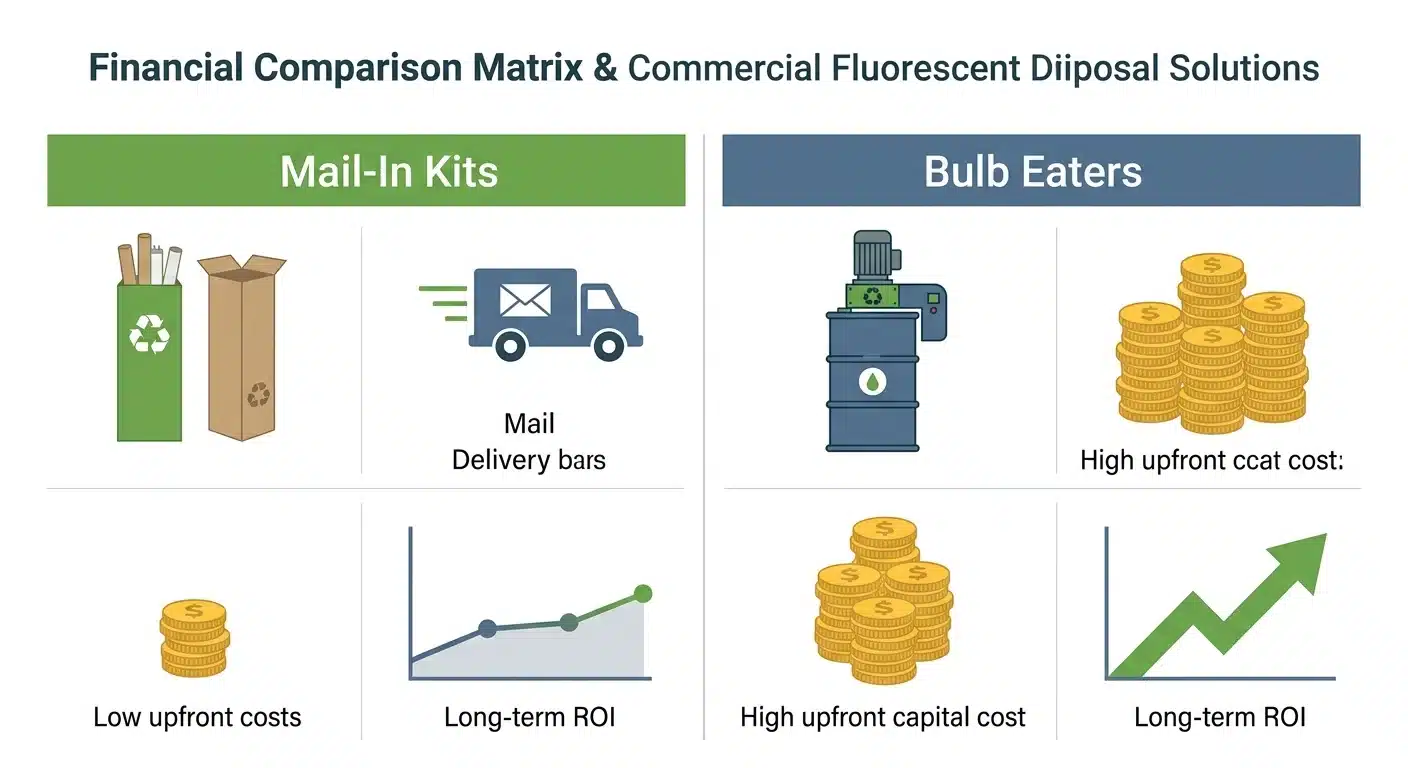
Enterprise-level lifecycle management of mercury-containing lighting demands absolute adherence to the EPA’s Universal Waste Rule (40 CFR Part 273) to mitigate profound legal and environmental liabilities. For high-volume generators, routing end-of-life lamps through certified fluorescent tube recycling services is not merely a best practice; it is a statutory imperative. The industrial neutralization process executed by facilities like Veolia Environmental Services and Lighting Resources LLC relies on a heavily engineered, closed-loop recovery architecture.
Lamps are introduced into industrial crushers operating under continuous negative atmospheric pressure, utilizing proprietary vapor-lock feeders to prevent the escape of volatile elemental mercury. A cyclonic separation system isolates the benign borosilicate glass and tungsten filaments from the highly toxic phosphor powder. This toxic matrix is subjected to high-temperature thermal retorting in furnaces exceeding $800^\circ\text{C}$, volatizing the mercury. The vapor is drawn through chilled condensation columns, distilling into highly purified, medical-grade elemental mercury ($99.99\%$ purity) ready for secondary commodity markets.
To bridge the logistical gap between the facility ceiling and the recycling plant, enterprise operations typically deploy one of two primary engineered solutions: prepaid logistics or on-site mechanical reduction.
For distributed retail footprints, commercial offices, and medium-scale industrial sites, the standardized approach utilizes a mail in fluorescent bulb recycling kit. These kits provide DOT-compliant fluorescent tube disposal boxes (e.g., the Veolia Supply-065CH), constructed from heavily corrugated, UN-rated cardboard and equipped with $5.5\text{ mil}$ vapor-barrier zip-tie liners. Conversely, massive high-density facilities (like sprawling university campuses or massive manufacturing plants) frequently invest in on-site drum crushers, such as the Air Cycle Bulb Eater 3. Mounted atop standard $55\text{-gallon}$ steel drums, these machines pulverize the glass envelopes, utilizing a multi-stage HEPA and activated carbon filtration matrix to capture the resulting toxic dust and adsorb the volatilized mercury vapor.
| Parameter | Mail-In Fluorescent Tube Disposal Boxes | On-Site Drum Crushers (Bulb Eater) |
|---|---|---|
| Initial CapEx | Low ($\approx \$100 - \$200$ per pre-paid box kit) | High ($\approx \$3,500 - \$5,000$ per unit) |
| Volumetric Capacity | $68$ straight T12s or $146$ T8 lamps (per $4\text{-foot}$ box) | Up to $1,350$ T8 lamps per $55\text{-gallon}$ drum |
| Facility Footprint | High (Requires significant palletized storage for intact boxes) | Minimal ($80\%$ reduction in physical storage volume) |
| Regulatory Compliance | Universally accepted under federal/state Universal Waste rules | Banned in certain states (e.g., CA, ME); requires strict OSHA monitoring |
| Maintenance Burden | Zero (Boxes are sealed and shipped outbound via FedEx/UPS) | High (Requires rigorous tracking/replacement of carbon and HEPA filters) |
Pro-Tip from the Field: When utilizing mail-back kits, facility managers must strictly enforce the "sealed container" mandate. State environmental inspectors routinely issue severe citations during surprise audits if a disposal box is left unsealed between bulb deposits. Always utilize the Velcro or zip-tie closures on the inner vapor barrier after dropping in a burnt-out tube.
When establishing an enterprise OPEX budget, evaluating the cost to dispose of commercial fluorescent tubes requires a lifecycle financial model that factors in direct container costs, internal labor, and the ultimate issuance of the legally requisite Certificate of Recycling.
The Total Unit Disposal Cost ($C_{\text{total}}$) using mail-back logistics can be modeled as:
$$C_{\text{total}} = \frac{C_{\text{kit}} + (t_{\text{labor}} \times R_{\text{labor}})}{N_{\text{lamps}}}$$
Where:
Using the parameters above, $C_{\text{total}} = \frac{135 + (0.5 \times 45)}{146} = \$1.08 \text{ per lamp}$.
Installer Feedback & Field Reality: While on-site Bulb Eaters boast a theoretical per-lamp OPEX as low as $\$0.20$ to $\$0.30$, seasoned facility directors report hidden friction. Once the activated carbon filter approaches saturation, the adsorption efficiency of mercury vapor plummets exponentially. OSHA mandates require periodic ambient air quality monitoring around the crushing station to ensure permissible exposure limits (PEL) of $0.1\text{ mg/m}^3$ are not breached. If a machine malfunctions or a filter is improperly seated, the resulting localized HAZMAT event will instantly eclipse a decade's worth of projected mail-back savings. Consequently, unless a facility generates upward of $10,000$ waste lamps annually, the predictable, fixed-cost structure of DOT-compliant mail-back boxes remains the dominant, risk-averse engineering recommendation.
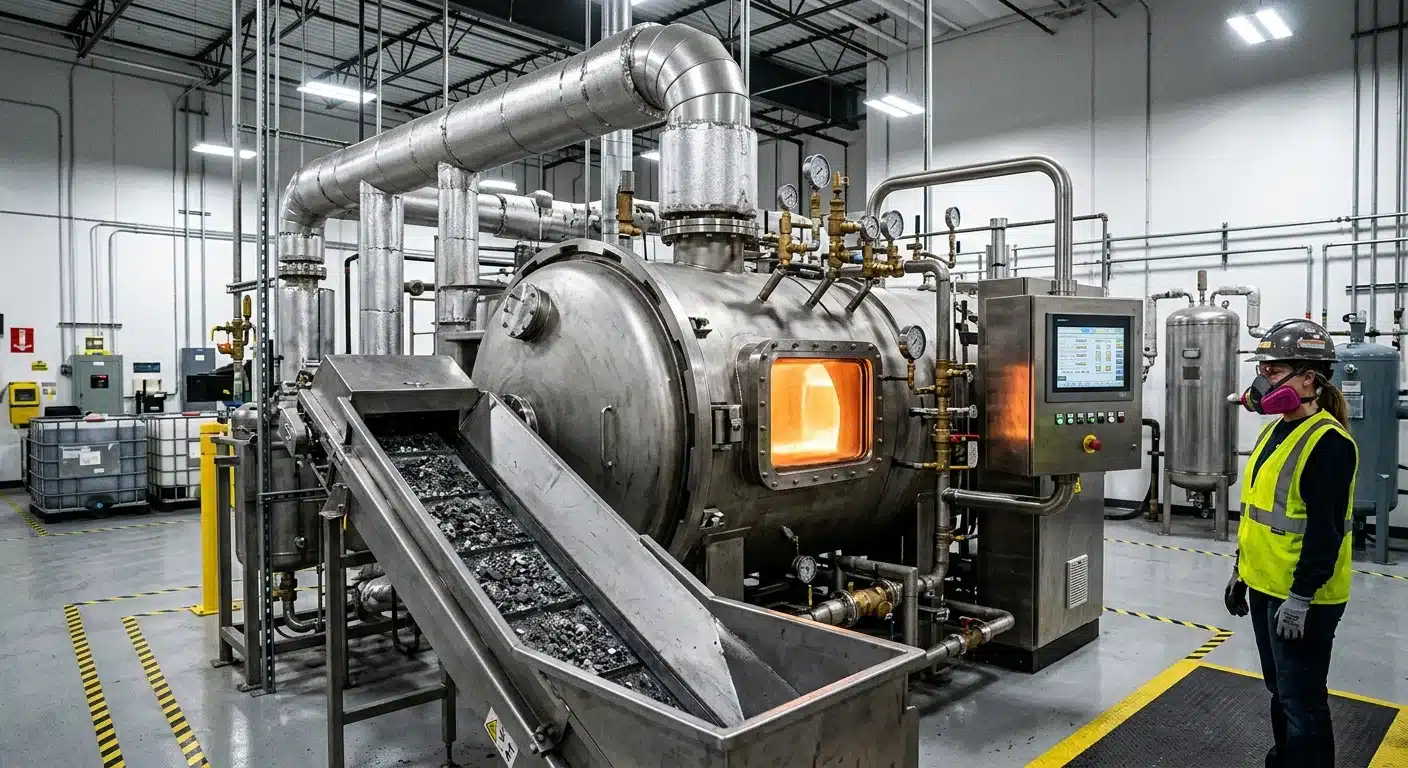
The operational friction inherent in Universal Waste compliance forces Environmental Health and Safety (EHS) managers to navigate a stark binary choice for high-volume lamp disposal: the logistical burden of mail-back logistics versus the acute maintenance liabilities of on-site mechanical crushing.
Field experience from facility managers and lighting retrofit installers reveals that while UN-rated Mail-Back Kits (such as the Veolia Supply-065CH or Waste Management RecyclePak) offer airtight regulatory compliance, they are profoundly labor-intensive. Installers frequently note that manually repacking thousands of fragile T8 or T5 linear tubes into corrugated sleeves leads to an incidental breakage rate of $2\%$ to $4\%$ during the packaging phase alone.
Conversely, on-site mechanical crushers like the TerraCycle Bulb Eater 3 or Dextrite Systems achieve a massive volume reduction ratio ($V_{crushed} \approx V_{intact} \times 0.02$), dramatically reducing storage footprint. However, EHS managers issue severe warnings regarding their deployment. If the multi-stage HEPA and activated carbon filtration systems are not rigorously maintained, the crusher transforms from a compliance tool into an active hazard, routinely violating the OSHA Permissible Exposure Limit (PEL) for elemental mercury ($0.1\text{ mg/m}^3$ as an 8-hour TWA).
| Operational Parameter | UN-Rated Mail-Back Kits (e.g., Veolia RecyclePak) | On-Site Drum Crushers (e.g., Bulb Eater 3) |
|---|---|---|
| Capital Expenditure (CapEx) | Low upfront ($\approx \$150 - \$250$ per kit) | High initial investment ($\approx \$3,500 - \$5,500$) |
| Operating Expenses (OpEx) | High recurring shipping/recycling fees per unit | Lower recurring fees; primarily filter replacement costs |
| Volume Efficiency | Extremely poor (Requires vast storage for intact boxes) | Exceptional ($>1,350$ T8 lamps per $55\text{-gal}$ drum) |
| Regulatory Burden | Minimal; pre-approved DOT/RCRA compliance | Severe; requires state-level permits & emission logging |
| Primary EHS Risk | Low; localized breakage during manual packing | High; acute vapor exposure via worn vacuum seals |
| Relevant Standards | DOT CFR 49, RCRA 40 CFR 273 | OSHA 29 CFR 1910.1000, NIOSH REL |
EHS Pro-Tip & Installer Feedback:
When utilizing on-site drum crushers, the primary failure point is not the motor, but the operator bypassing the carbon filter saturation alarms. Always implement a strict lock-out/tag-out (LOTO) protocol tied to the filter lifecycle. For mail-back programs, mandate that installers use a localized extraction vacuum (compliant with IEC 60335-2-69 Class H) during the packing phase to capture micro-shards from inevitable handling fractures.
While highly developed OECD nations debate the granular nuances of activated carbon saturation, emerging and transitional economies face catastrophic, systemic containment failures. The Republic of Georgia, specifically the coastal city of Batumi in the Adjara region, exemplifies the profound disconnect between ambitious legislative frameworks and localized infrastructural reality.
Following deep integration mandates via the EU-Georgia Association Agreement, Georgia is actively transitioning its environmental policies from antiquated, post-Soviet GOST legacy standards to modern EU WEEE Directives (2012/19/EU). The crown jewel of this transition is the EBRD-funded Tsetskhlauri sanitary landfill, engineered with state-of-the-art synthetic bottom liners and leachate treatment plants. However, as an end-of-pipe containment strategy, it fundamentally fails to address the upstream lifecycle management of mercury-containing equipment.
In Batumi, the municipal solid waste (MSW) stream managed by Sandasuptaveba is entirely undifferentiated. While specialized Extended Producer Responsibility (EPR) networks have been pioneered by dedicated NGOs, they explicitly exclude hazardous vapors. For example, Wasteless and Parki ar Minda run highly successful e-waste and solid-state LED collection networks through retail partners like Elit Electronics. Yet, due to the acute toxicity of $4\text{-}6\text{ mg}$ of mercury per tube and a lack of HAZMAT processing infrastructure, these organizations legally prohibit fluorescent lamps from their recycling streams.
This creates a critical "missing middle" in the waste ecosystem:
1. Institutional Scale: B2B contractors like Sanitari and Medical Technology possess the thermal retorting infrastructure to vaporize and distill mercury ($T_{retort} > 800^\circ\text{C}$), but they operate exclusively within siloed medical and industrial contracts.
2. Residential/Commercial Scale: The average citizen or small business has zero access to these processors.
Consequently, millions of legacy fluorescent tubes are inevitably deposited into curbside communal bins. Upon mechanical compaction in standard municipal packer trucks, the borosilicate envelopes fracture, instantly aerosolizing elemental mercury into the ambient urban air, while the toxic phosphor powder is driven directly into the Tsetskhlauri landfill's leachate collection system. To resolve this paradox, transitional governments must bypass the creation of fragile recycling networks entirely and aggressively mandate the deployment of IEC 62471 compliant solid-state LED illumination, systematically cutting the mercury hazard out of the supply chain at the point of origin.
Yes, the industry is approaching a global regulatory cliff. Under the accelerating mandates of the Minamata Convention on Mercury and the European Union’s RoHS Directive (Restriction of Hazardous Substances), exemptions that previously permitted the manufacture of mercury-containing general-purpose lighting are expiring. By 2026, the production and importation of most T5 and T8 linear fluorescent lamps, as well as compact fluorescent lamps (CFLs), will be effectively banned across Europe.
In the United States, states such as California, Vermont, and Rhode Island have passed aggressive legislation outright banning the sale of screw-based and linear fluorescent lamps between 2024 and 2026. This phase-out necessitates an immediate infrastructural shift toward Solid-State Lighting (SSL).
Field Experience & Installer Feedback:
"When facilities scramble to meet the 2026 compliance deadlines, they often attempt cheap plug-and-play UL Type A LED tubes that run off the existing fluorescent ballasts. This is an engineering pitfall. The legacy electronic ballasts will fail long before the new LEDs degrade. We universally advise operators to utilize UL Type B LED tubes (direct wire), bypassing and removing the ballast entirely. This eliminates the parasitic power draw of the ballast, permanently removes mercury from the facility's lifecycle, and drastically reduces future maintenance labor."
While elemental mercury ($m \approx 4\text{-}6\text{ mg}$) represents the primary ecological hazard during disposal, the operational phase of fluorescent lighting presents severe, well-documented photobiological risks regulated under standards like IEC 62471.
| Parameter | Traditional Linear Fluorescent (T8) | Solid-State LED Tube (Type B) |
|---|---|---|
| Toxic Material Content | Elemental Mercury ($4\text{-}6\text{ mg}$); Lead in glass frits. | None (Silicon, Aluminum, Polycarbonate). |
| Photobiological Risk | High UV leakage ($\lambda < 400\text{ nm}$); threatens photosensitive patients. | Near-zero UV emission; safe for SLE/autoimmune patients. |
| Flicker Index (IEEE 1789) | High risk (modulating at $120\text{ Hz}$ with magnetic ballasts). | Low risk (continuous DC operation via internal driver). |
| Disposal Classification | Universal Waste (Requires UN-rated containment). | General E-Waste (Benign standard recycling). |
| Operational Lifespan | $\approx 15,000 \text{ to } 20,000\text{ hours}$. | $\geq 50,000\text{ hours}$ ($L_{70}$ standard). |
From a rigorous environmental engineering perspective, no mercury-containing lamp should ever be deposited into a standard MSW receptacle, regardless of legal loopholes.
While federal US regulations (RCRA) technically permit Conditionally Exempt Small Quantity Generators (CESQG) and private households to discard minor amounts of hazardous waste into standard curbside bins, this practice guarantees structural containment failure. Modern municipal sanitation vehicles utilize hydraulic mechanical compactors exerting forces upwards of $P = 2,500\text{ psi}$. A standard borosilicate fluorescent tube will instantaneously shatter upon compaction, aggressively aerosolizing the volatile mercury vapor directly into the localized municipal atmosphere and permanently contaminating the truck's mechanical interior.
Definitive Engineering Protocol for Lamp Disposal:
1. Strict Prohibition: Never discard intact or broken lamps in standard dumpsters or curbside MSW bins.
2. Commercial Handlers: Must classify lamps strictly as Universal Waste. Lamps must be stored in structurally rigid, closed containers, correctly labeled, and shipped via DOT-compliant prepaid mail-back services (e.g., Veolia RecyclePak) to specialized thermal retort facilities.
3. Emergency Household Circumstances: If a homeowner is in a jurisdiction with absolute zero HHW recycling infrastructure, the EPA’s fallback directive dictates that the unbroken bulb must be double-sealed in heavy-duty polyethylene plastic bags to act as a rudimentary vapor barrier before placement in an outdoor, well-ventilated MSW bin—though this remains an ecologically detrimental last resort.
