
The first generation of solid-state lighting effectively conquered the brute-force challenge of luminous efficacy, displacing legacy halogen (20 lm/W) and compact fluorescent (50 lm/W) fixtures to capture a global lighting footprint that accounts for approximately 8% of total electricity demand (2,200 TWh annually). However, as these legacy installations near the end of their L70 lifespans, the industry is pivoting from passive lumen generation to active, intelligent photonic networks. Next-generation LED technology fundamentally diverges from traditional illumination, operating at the convergence of advanced material science, quantum confinement, and artificial intelligence to create hyper-functional cyber-physical nodes.
This transition mandates a rigorous shift in engineering frameworks. We are no longer simply calculating illuminance ($\text{E}_v$); we are simultaneously designing for high-speed data transmission (IEEE 802.11bb), precise photobiological stimulation, and extreme-density spatial computing. At the atomic level, this requires manipulating light at sub-wavelength scales, bridging the gap between traditional bandgap physics—where the energy of emitted photons strictly follows $E_g = \frac{hc}{\lambda}$—and complex heterostructure engineering that actively suppresses non-radiative recombination at nanoscale boundaries.
To fully grasp the deployment criteria for modern photonic infrastructure, engineers must differentiate between the operational envelopes of legacy luminaires and advanced optoelectronic nodes.
| Engineering Parameter | Gen 1 Solid-State (Standard GaN/Phosphor) | Next-Gen Display (Nano-PeLED / GaN-on-Si) | Cyber-Physical Nodes (Li-Fi / PBM Emitters) |
|---|---|---|---|
| Primary Base Material | Sapphire/Silicon Carbide (2D Epitaxy) | Metal Halide Perovskites ($ABX_3$) / Silicon (3D) | Multi-spectral arrays (InGaN + NIR/UVC) |
| Spectral Control | Static phosphor conversion | Dynamic sub-bandgap / photochemical tuning | Real-time AI-modulated spectral shifting |
| Modulation Bandwidth | < 1 MHz (Limited by phosphor decay) | > 1 GHz (Direct emission) | 2 GHz – 10+ GHz (Direct LOS optical) |
| Governing Standards | IEC 60598, GOST R 54350-2015 | IEC 61747 (Liquid crystal/solid state) | IEEE 802.11bb, IEC 62471 (Photobiological) |
| Peak Efficacy / PPE | 150 – 200 lm/W | ~24.5% PCE (Ultra-low driving voltage) | > 3.0 $\mu mol/J$ (Horticultural/Medical) |
| Installation CAPEX | Baseline ($) | High $$$) – 200mm Wafer Fab limits | Moderate ($$ – PoE/Cat6a integration required |
Transitioning from a traditional AC mains lighting topology to a digitally native, highly modulated DC photonic network introduces severe electrical and structural challenges. Modern smart nodes are no longer wired via traditional $3 \times 1.5$ mm² NM-B cables; they are treated as IT infrastructure powered by Power over Ethernet (PoE++ / IEEE 802.3bt), delivering up to 90W of combined power and multi-gigabit data directly to the luminaire.
Pro-Tip: When designing driving circuits for high-frequency Li-Fi nodes, legacy constant-current drivers are entirely inadequate. Engineers must specify ultra-fast switching topologies, utilizing low-capacitance, fast-recovery components such as the N-channel MOSFET IRF520 driven by local microcontrollers (e.g., NodeMCU ESP32). To prevent unacceptable electromagnetic interference (EMI) that violates CISPR 15 / EN 55015 standards, implement tight LC filtering precisely tuned to suppress harmonics above your primary modulation frequency (typically utilizing Pulse Position Modulation at > 2 KHz).
Field Experience & Installer Feedback:
Based on recent massive-scale pilot deployments (such as the O2 Slough headquarters and U.S. Army Kitefin arrays), contractors consistently report that the most critical failure point is not the LED diode itself, but thermal management at the network-switch and luminaire-driver interface.
By treating the luminaire as an advanced semiconductor junction rather than a mere electrical load, engineers can unlock the true potential of the photonic paradigm, dictating a future where lighting arrays serve as the backbone for localized cloud computing, zero-EMI telecommunications, and closed-loop biomedical therapies.
The commercial scalability of next-generation solid-state lighting relies fundamentally on manipulating the crystal lattice and interfacial dynamics of semiconducting materials. Traditional III-V semiconductors, while historically reliable, are rapidly approaching insurmountable quantum and physical limitations. Transitioning to metal halide perovskites (PeLEDs) demands a rigorous re-evaluation of charge transport mechanics, specifically targeting localized thermal degradation and sidewall recombination vulnerabilities.
Historically, achieving functional pure-blue emission inherently necessitated widening the optical bandgap ($E_g$) of the semiconductor. In conventional methodologies, this requires driving voltages that substantially exceed the bandgap voltage ($V > E_g / q$), a condition that introduces immense electrical stress. Advanced operando characterization has redefined our understanding of device failure under these conditions. Structural degradation does not occur uniformly across the bulk crystal lattice; rather, catastrophic failure is highly localized at the electron-injecting interface. Intense localized electric fields catalyze the formation of metallic lead ($Pb^0$) and highly mobile chlorine species, which act as deep-state electron traps and non-radiative recombination centers.
To achieve viable Deep-blue perovskite LED stability, engineering efforts must pivot toward sub-bandgap emission mechanics. By fabricating a highly complex 3D/0D-n heterostructure—strategically embedding an orange-red zero-dimensional (0D) perovskite phase within a sky-blue three-dimensional (3D) emissive layer—engineers can passivate shallow and deep-state defects. This configuration facilitates balanced charge injection at an ultralow turn-on voltage of just $1.9 \text{ V}$, well below the theoretical bandgap voltage.
Pro-Tip for Device Fab Engineers: When designing the electron transport layer (ETL) for deep-blue PeLEDs, avoid standard organic materials that react with volatile halide ions. Deploy chemically inert, ion-blocking interlayers such as optimized LiF/TPBi stacks or SnO$_2$ nanoparticles deposited via Kurt J. Lesker sputtering systems to mechanically sever the performance-chemical degradation loop.
In traditional InGaN or AlGaInP micro-LED architectures, pixel miniaturization fundamentally triggers "efficiency droop." As the characteristic pixel length decreases, the surface-to-volume ratio ($S/V$) increases exponentially. Plasma etching processes (like Inductively Coupled Plasma Reactive Ion Etching, ICP-RIE) shatter the crystal lattice at the mesa sidewalls, creating massive non-radiative recombination zones. Mitigating this traditionally requires complex, high-CAPEX Atomic Layer Deposition (ALD) using systems like the Oxford Instruments FlexAL to apply ultra-thin SiO$_2$ or Al$_2$O$_3$ passivation layers.
Conversely, the extreme structural defect-tolerance of halide perovskites has enabled the successful spatial confinement synthesis of Nano-perovskite LEDs. Fabricated without destructive top-down plasma etching, these nano-PeLEDs maintain a robust External Quantum Efficiency (EQE) of approximately 20% even at a characteristic length of 90 nanometers. This architectural shift entirely bypasses the need for ALD sidewall passivation, unlocking theoretical pixel densities of 127,000 PPI, which is an absolute requisite for holographic light-field projections.
| Parameter | Conventional Epitaxial InGaN | Spatial-Confined Nano-PeLEDs |
|---|---|---|
| Sidewall Recombination Velocity ($S$) | High ($> 10^4 \text{ cm/s}$ without ALD) | Negligible (Inherent defect tolerance) |
| Peak Defect-Free Density | ~3,000 - 5,000 PPI | Up to 127,000 PPI |
| Processing Requirements | MOCVD, ICP-RIE, High-Vacuum ALD | Solution Processing, Spatial Confinement |
| Turn-On Voltage ($V_{th}$) | $> 3.0 \text{ V}$ (Blue) | $< 2.0 \text{ V}$ (Sub-bandgap architecture) |
| Primary Failure Mode | Threading dislocations, Thermal Droop | Ion migration at the ETL interface |
| CAPEX Impact | Extremely High (Bespoke LED Fabs) | Moderate (Standard CMOS compatibility) |
Field data from pilot integration lines (such as AUO G4.5 fabrication facilities) and feedback from advanced display integrators reveal clear operational paradigms:

The commercialization of sub-10 $\mu m$ pixel architectures necessitates a complete departure from planar, multi-substrate manufacturing. Traditional pick-and-place mass transfer methodologies exhibit catastrophic yield loss when scaling down to ultra-high-density displays, failing strict IEC 62341 defect tolerance standards. The contemporary solution lies in deterministic, monolithic integration and the deployment of entirely inorganic, direct-emissive nanoscale structures.
The primary failure point of first-generation micro-LED fabrication is the lattice mismatch between epitaxial layers (e.g., AlGaInP for red, GaN for blue/green) and the necessity of mechanical transfer to a unified backplane. The GaN-on-silicon micro-LED architecture fundamentally bypasses this by executing 3D nanowire growth directly on standard 200 mm and 300 mm CMOS-compatible silicon wafers.
By engineering the nanowires with sub-wavelength physical dimensions, manufacturers like Aledia effectively relieve the severe epitaxy strain that traditionally causes fatal threading dislocations. Furthermore, localized diameter and height modulation of these nanowires during epitaxial growth alters the indium incorporation rates, enabling tunable RGB emission from a single monolithic substrate. This intrinsic optical waveguiding eliminates the need for secondary collimating micro-lenses.
Engineering Pro-Tip: When integrating monolithic GaN-on-Silicon modules into high-density wearables, thermal dissipation paths are highly localized. Utilize Through-Silicon Vias (TSVs) coupled with a copper-molybdenum (CuMo) heat spreader to prevent thermal throttling, keeping junction temperatures ($T_j$) strictly below $85^\circ C$ to maintain wavelength stability.
While commercial displays branded as "QLED" rely on a passive quantum dot enhancement film excited by a traditional blue LED backlight, true QDEL display technology (Quantum Dot Electroluminescent) directly injects charge carriers into the quantum dots. This eliminates both the organic degradation inherent to OLEDs and the bulky optical stack of traditional LCDs.
Operating strictly on quantum confinement laws where the optical bandgap energy relates to the particle radius ($E \propto 1/r^2$), QDEL achieves native Rec. 2020 color gamut saturation natively. Top-emitting QDEL architectures utilizing highly aligned in-plane dipoles and precise microcavity tuning now push outcoupling efficiencies ($\eta_{out}$) toward a theoretical 60%, drastically reducing the wall-plug power consumption for large-format displays.
| Technical Parameter | Legacy OLED | Legacy "QLED" (Passive) | Direct-Emissive QDEL |
|---|---|---|---|
| Emission Mechanism | Direct Organic Electroluminescence | Passive Photoluminescence (Backlit) | Direct Inorganic Electroluminescence |
| Material Stability | Low (Susceptible to oxidation/moisture) | High (Encapsulated film) | Extreme (Inorganic robust lattice) |
| Burn-in Risk | High (Differential pixel aging) | Zero | Zero |
| Sub-pixel Fabrication | FMM (Fine Metal Mask) Evaporation | Standard LCD Lithography | Slit-coating / Advanced Photolithography |
| Contrast Ratio | $\infty:1$ (True Black) | $\sim 5,000:1$ (Limited by local dimming zones) | $\infty:1$ (True Black) |
| Max Peak Luminance | $\sim 1,500$ nits | $\sim 3,000$ nits | $> 5,000$ nits (Estimated commercial) |
In architectural deployments and augmented reality, the physical volume of the optical stack is the limiting factor. The modern Holographic transparent LED screen addresses this by utilizing a hollow-design PCB array, typically achieving a profile thickness of 1.8 mm to 2.0 mm and structural transmittances exceeding 95%. Manufacturers like MUXWAVE utilize independent driver ICs bonded directly to discrete LED nodes, allowing the physical grid to become virtually invisible to the naked eye at viewing distances greater than 3 meters.
To further condense the optical pathways—especially in near-eye AR systems—bulky refractive optics are being replaced by metalenses. Fabricated via atomic layer deposition of silicon nanopillars, these 2D metasurfaces act as highly localized phase shifters. They alter the phase ($\phi(x,y)$), amplitude, and polarization of incident light at the sub-wavelength scale, effectively flattening the optical assembly to a sub-millimeter profile while maintaining a modulation transfer function (MTF) with $<2\%$ optical distortion.

The ratification of the IEEE 802.11bb Li-Fi standard fundamentally transitions Visible Light Communication (VLC) from isolated academic prototypes to scalable enterprise and tactical network infrastructures. By operating within the 380 nm to 5,000 nm optical band, 802.11bb explicitly aligns the Light Communications (LC) Physical (PHY) and Media Access Control (MAC) layers with existing 802.11 Wi-Fi ecosystems. This native interoperability allows enterprise routers to treat optical transceivers as standard network interfaces, seamlessly passing traffic between RF and optical domains without requiring proprietary dual-stack protocols.
Unlike Radio Frequency (RF) signaling, which utilizes complex-valued bipolar signals, optical communication requires real-valued, unipolar signals driven by Intensity Modulation and Direct Detection (IM/DD). This constraint mandates specialized modulation schemes at the PHY layer, predominantly direct-current biased optical OFDM (DCO-OFDM) or high-frequency $L$-ary Pulse Position Modulation ($L$-PPM).
For a standard VLC link utilizing a Lambertian radiation pattern, the DC optical channel gain $H(0)$ is calculated as:
$$ H(0) = \begin{cases} \frac{(m+1)A}{2\pi d^2} \cos^m(\phi) T_s(\psi) g(\psi) \cos(\psi), & 0 \le \psi \le \Psi_c \\ 0, & \psi > \Psi_c \end{cases} $$
Where $m = \frac{-\ln(2)}{\ln(\cos(\Phi_{1/2}))}$ is the Lambertian order defined by the transmitter's semi-angle at half power ($\Phi_{1/2}$), $A$ is the physical area of the photodetector, $d$ is the distance between transmitter and receiver, $\phi$ is the angle of irradiance, $\psi$ is the angle of incidence, and $\Psi_c$ is the field of view (FOV) of the receiver.
When deploying $L$-PPM to maximize power efficiency—a critical factor to maintain compliance with IEC 62471 photobiological safety standards while driving peak data rates—the bit rate $R_b$ is strictly governed by the slot duration $T_{slot}$:
$$ R_b = \frac{\log_2(L)}{L \cdot T_{slot}} $$
While high-order PPM requires substantial transmission bandwidth, it severely minimizes the duty cycle, thereby mitigating thermal degradation of the LED junction while strictly preventing human-perceptible flicker (operating well above the 2 kHz threshold).
When engineering high-density network environments, VLC circumvents the Shannon limit constraints currently suffocating the 6 GHz Wi-Fi band. The physical containment of the optical signal fundamentally alters the network's security posture and channel density.
| Parameter / Specification | Traditional RF (Wi-Fi 7 - IEEE 802.11be) | Visible Light Comm. (IEEE 802.11bb Li-Fi standard) |
|---|---|---|
| Operational Spectrum | 2.4 GHz, 5 GHz, 6 GHz | 400 THz – 800 THz (Visible / Near-IR) |
| Max PHY Data Rate (Practical) | ~5 to 10 Gbps (Multi-link) | ~10 to 40 Gbps (LED-based, per luminaire) |
| Modulation Requirement | Bipolar, Complex (QAM, OFDM) | Unipolar, Real (IM/DD, DCO-OFDM, $L$-PPM) |
| Signal Containment / Security | Low (Penetrates drywall, glass, concrete) | Absolute (Bounded by physical opaque geometry) |
| EMI / RFI Profile | High emission and susceptibility | Zero emission; Immune to RF jamming |
| Infrastructure Integration | Dedicated APs, coax/CAT6 drops | Integrates natively with PoE/PoE+ LED lighting grids |
Deploying an 802.11bb-compliant network demands a paradigm shift from traditional RF network planning. Field feedback from early enterprise rollouts (such as O2’s Slough headquarters) and tactical deployments emphasizes the following:
Pro-Tip from the Field: "Traditional RF heat-mapping software is useless for Li-Fi. You are designing a lighting plan first and a network second. You must account for dynamic shadowing—if an employee stands up, the optical line-of-sight (LOS) is broken. To solve this, always design with overlapping optical AP coverage (typically 3-to-1 redundancy in open offices) utilizing fast MAC-layer handover protocols, identical to cellular network roaming."
Installers routinely note that the integration of Power over Ethernet (PoE++) infrastructure is absolutely vital. Relying on retrofitted AC mains to power Li-Fi nodes introduces massive phase noise and severely limits the switching speed of the high-speed N-channel MOSFETs required for high-frequency PPM. Utilizing standard Cat6A cabling to simultaneously deliver data and clean DC power to the luminaires (e.g., platforms from pureLiFi or Signify Trulifi) ensures signal integrity and maximizes the Signal-to-Noise Ratio (SNR).
The inability of light to penetrate opaque structures is VLC's most potent capability in high-security operations. In defense applications, tactical operations centers emit massive RF signatures that are easily targeted by enemy Electronic Warfare (EW) and signals intelligence (SIGINT) triangulation. Systems like the pureLiFi Kitefin leverage the 802.11bb architecture to establish multi-gigabit localized networks inside mobile command tents with zero exterior emission. Because the signal physically degrades to absolute zero at the fabric boundary of the tent, network administrators completely bypass complex cryptographic VPN overheads that traditionally throttle tactical networks, relying instead on mathematically proven, physics-based air-gapping.

The active deployment of photonic arrays fundamentally shifts traditional clinical and agricultural paradigms from passive observation to active, cyber-physical intervention. In the biomedical sector, LED photobiomodulation therapy (PBM) leverages specific narrowband wavelengths—typically between $660 \text{ nm}$ and $850 \text{ nm}$—to manipulate cellular bioenergetics at the mitochondrial level. The foundational mechanism relies on the absorption of near-infrared (NIR) photons by cytochrome c oxidase (Complex IV), the terminal enzyme in the electron transport chain. Upon absorbing a photon where the energy equates to $E = \frac{hc}{\lambda}$ (yielding approximately $1.53 \text{ eV}$ at $808 \text{ nm}$), inhibitory nitric oxide (NO) is forcefully photodissociated from the enzyme's binuclear center. This catalytic unblocking drives a massive upregulation of adenosine triphosphate (ATP) synthesis, modulates reactive oxygen species (ROS), and initiates transcription factors critical for mitigating severe neuroinflammation, such as in clinical deployments treating mild Traumatic Brain Injury (mTBI) via deeply penetrative transcranial and intranasal arrays compliant with IEC 60601-2-57 standards.
In localized wound care, this biomodulation is now autonomously governed by the AI-powered smart bandage (e.g., the a-Heal architecture). This closed-loop system utilizes flexible bioelectronic layers embedded with micro-LEDs, biometric sensors, and an onboard machine-learning inference engine. When the system's Deep Mapper algorithm detects a negative divergence in the tissue healing trajectory, the AI autonomously triggers integrated bioelectronic pumps to deliver precise, localized dosages of topical fluoxetine (regulating serotonin-induced inflammation) while simultaneously pulsing micro-LED arrays and initiating galvanotactic electric fields to forcefully guide keratinocyte migration.
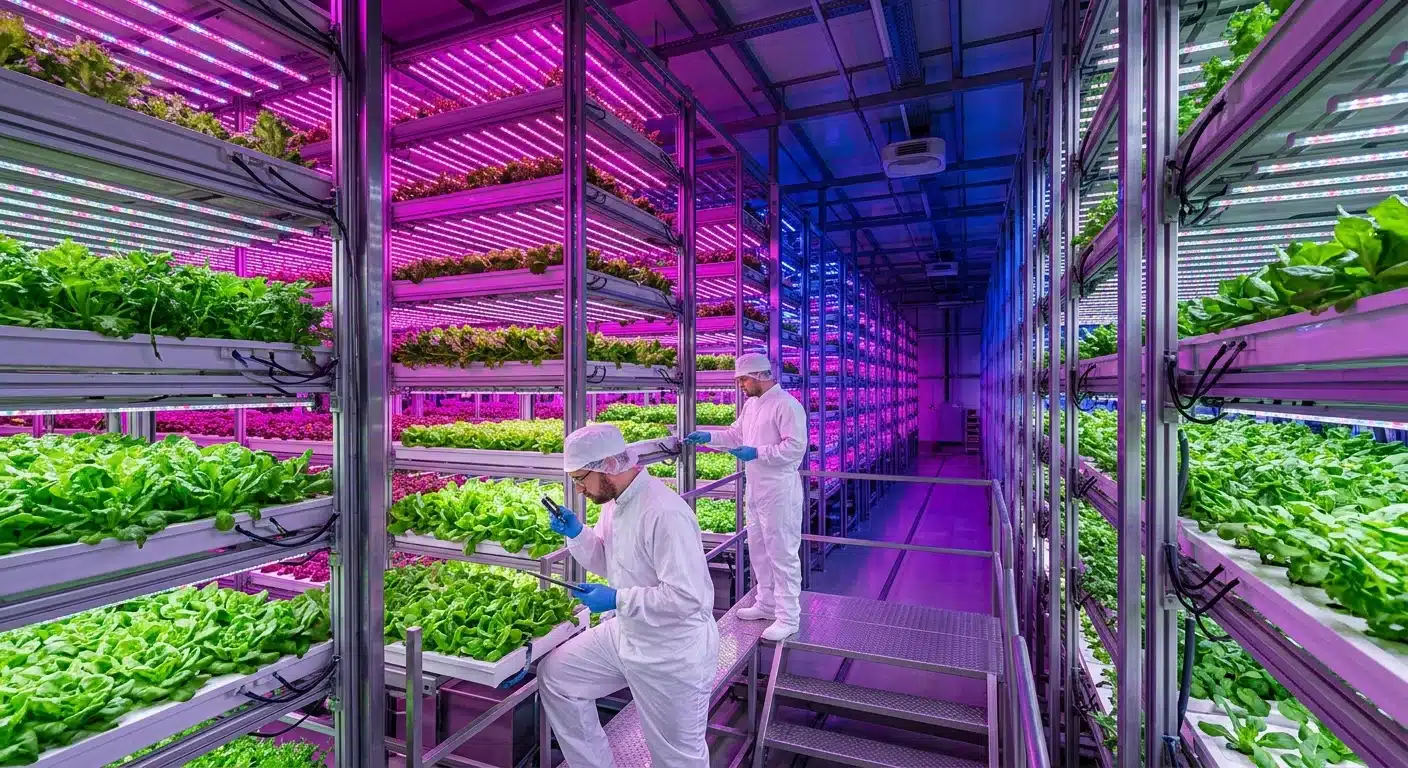
Parallel to medical photonics, Controlled Environment Agriculture (CEA) relies on the atomic-level efficiency of the High-efficiency horticultural LED array to render indoor vertical farming economically viable. System performance is dictated by Photosynthetic Photon Efficacy (PPE), calculated as the ratio of Photosynthetic Photon Flux (PPF) to input electrical power:
$$PPE = \frac{\Phi_{p}}{P_{in}} \quad \left[ \frac{\mu mol/s}{W} \equiv \frac{\mu mol}{J} \right]$$
Contemporary AI-driven cyber-physical systems process real-time leaf-level biometrics to dynamically alter the canopy's spectral composition via DALI-2 or Matter protocols. By precisely modulating the $660 \text{ nm}$ (Red) to $450 \text{ nm}$ (Blue) ratio, engineers can actively steer plant morphology—suppressing internodal elongation during vegetative phases or dosing specific UV-A/Far-Red ($730 \text{ nm}$) spectrums pre-harvest to radically accelerate secondary metabolite synthesis.
When engineering multi-tier vertical farming facilities adhering to UL 8800 safety standards, selecting the appropriate photonic architecture profoundly dictates HVAC sizing and overall CapEx.
| Specification | AC Infinity IONFRAME EVO8 (Samsung LM301H EVO) | Standard Commercial LED (Bridgelux/Epistar Mix) | Legacy HPS (Double-Ended High-Pressure Sodium) |
|---|---|---|---|
| System Efficacy (PPE) | $3.14 \text{ } \mu mol/J$ | $2.40 \text{ } \mu mol/J$ | $1.70 \text{ } \mu mol/J$ |
| Spectral Output | Full-Spectrum + $660 \text{ nm}$ + $730 \text{ nm}$ | Fixed Red/Blue (Purple) | Heavy Red/Yellow (Static) |
| L90 Lifespan | $> 100,000 \text{ Hours}$ | $\approx 50,000 \text{ Hours}$ | $\approx 10,000 \text{ Hours}$ |
| Thermal Load (BTU/hr per 1000W) | $\approx 1,150$ | $\approx 1,700$ | $\approx 3,412$ |
| Dynamic Dimmability | 0-100% via PWM / DALI-2 | 10-100% Stepped | Non-dimmable or highly limited |
| Est. CapEx / $m^2$ | High (\$250 - \$300) | Moderate (\$120 - \$180) | Low (\$50 - \$80) |
PRO-TIP: When calculating the total thermal load for HVAC sizing in CEA applications, never assume 100% of the LED's wattage translates purely to light. Even at an extreme PPE of $3.14 \text{ } \mu mol/J$, over 45% of the consumed energy is still dissipated as sensible heat. Always implement direct-to-driver liquid cooling or high-CFM exhaust systems located immediately above the luminaire chassis.
Field deployments of these advanced horticultural and medical cyber-physical systems reveal critical engineering realities often absent from standard spec sheets:
The transition of sub-wavelength photonics from laboratory prototypes to active field deployments has exposed critical realities regarding thermal management, spatial planning, and user compliance. Field reports from network architects, AV integrators, and clinical researchers provide a pragmatic counterweight to theoretical datasheets, highlighting the operational friction inherent in deploying next-generation LEDs.
For AV integrators, the shift toward monolithic GaN-on-silicon Micro-LED architectures has largely eliminated the microscopic alignment errors that plagued legacy pick-and-place matrixes. However, consolidating RGB emission onto a single high-density silicon backplane has aggressively localized the thermal envelope.
Integrator Pro-Tip: When deploying transparent LED glass facades, ensure compliance with IEC 62368-1 for structural and electrical safety. Utilize laser-aligned, vibration-dampened tensile cabling rather than rigid aluminum extrusions to mount the modules, preserving the "floating" visual aesthetic while nullifying HVAC resonance.
Enterprise network administrators deploying the IEEE 802.11bb standard (such as the pureLiFi Kitefin system) consistently validate the absolute security profile of line-of-sight confinement. However, they face distinct physical topology challenges.
In the clinical application of AI-driven smart bandages (e.g., the a-Heal system) and neuromodulation headsets, user compliance heavily depends on mitigating perceived thermal discomfort.
Deploying ultra-efficient fixtures like the AC Infinity IONFRAME EVO8 (featuring Samsung LM301H EVO diodes at 3.0 $\mu mol/J$) in large-scale vertical farms has revolutionized OPEX models, yet it demands rigorous spatial management.
| Deployment Domain | Legacy Technology | Next-Gen Architecture | Integrator/Field Challenge | Primary Advantage | CAPEX / OPEX Shift |
|---|---|---|---|---|---|
| High-Density Displays | Standard SMD LED Panels | Monolithic GaN-on-Si Micro-LED | Extreme localized thermal density ($T_j$ management); handling brittle Si-wafers. | Zero mass-transfer defects; infinite contrast; 127,000 PPI. | High initial CAPEX; low maintenance OPEX. |
| Enterprise Wireless | RF Wi-Fi 6 (IEEE 802.11ax) | Li-Fi (IEEE 802.11bb) | Requires dense AP overlap to combat shadow-fading; strict line-of-sight planning. | Absolute EMI immunity; mathematical security boundary; >100 Gbps. | Moderate CAPEX (dense fixtures); zero spectrum licensing cost. |
| Clinical Therapeutics | Low-Level Laser Therapy (LLLT) | AI-Driven Micro-LED PBM Bandages | Calibration of PWM duty cycles to balance required J/cm² with patient thermal comfort. | Wearable compliance; closed-loop autonomous dosing; high area coverage. | High R&D CAPEX; significantly reduced clinical labor OPEX. |
| Horticulture | High-Pressure Sodium (HPS) | Tunable High-PPE LED (>2.9 $\mu mol/J$) | Strict distance management to prevent PPFD bleaching; requires LiDAR automation. | Dynamic spectrum shifting for targeted metabolite synthesis; drastically reduced HVAC load. | High CAPEX; up to 60% reduction in OPEX (electricity/HVAC). |
The financial trajectory of solid-state lighting and advanced photonics is strictly defined by the eradication of legacy manufacturing bottlenecks and the optimization of operational expenditure (OPEX) in specialized deployments. The micro-LED sector alone is aggressively scaling toward a projected market valuation of $8 billion by 2032, underpinned by massive capital injections totaling approximately RMB 88 billion across 26 major global capacity-expansion projects in 2025. For industrial integrators and facility engineers, capitalizing on this transition requires a granular understanding of substrate economics and localized energy models.
The single greatest financial barrier to micro-LED commercialization has historically been the mass transfer process. Traditional pick-and-place mechanics for individual Aluminum Gallium Indium Phosphide (AlGaInP) and Gallium Nitride (GaN) dies yield astronomical defect rates when scaling to sub-10 $\mu m$ architectures required for high-density spatial computing arrays.
The industrial shift to monolithic GaN-on-silicon nanowire architectures—such as those pioneered by Aledia—on standard 200 mm silicon wafers represents a fundamental CAPEX deflation event. By synthesizing 3D nanowires directly onto silicon, manufacturers completely bypass the lattice mismatch constraints that previously necessitated expensive, bespoke sapphire or GaAs substrates. Crucially, this allows display manufacturers to utilize standard, fully depreciated CMOS fabrication lines.
$$ C_{display} = \sum \left( \frac{C_{wafer}}{N_{die} \times Y} + C_{transfer} + C_{bonding} \right) $$
In monolithic GaN-on-Si architectures, the $C_{transfer}$ variable is mathematically reduced to zero. RGB color tuning is achieved via strict physical geometry modifications (diameter/height) of the nanowires during a single epitaxial run, eliminating alignment complexities and drastically improving the functional yield ($Y$).
| Manufacturing Paradigm | Substrate Material | Transfer Methodology | Estimated Defect Rate | Scalability Limits | Relative CAPEX Burden |
|---|---|---|---|---|---|
| Traditional Micro-LED | Sapphire / GaAs | Mechanical / Laser Planar | $10^{-4}$ to $10^{-5}$ | < 500 PPI | Very High (Bespoke Fab) |
| Monolithic Nanowire | 200 mm Silicon | Zero-Transfer (In-situ) | $< 10^{-7}$ (wafer-level) | > 10,000 PPI | Low (Standard CMOS) |
| Nano-PeLEDs | Perovskite Films | Spatial Confinement Litho | Material Dependent | ~ 127,000 PPI | Moderate (Emerging) |
Pro-Tip for Fab Engineers: When evaluating silicon integration, standard thermal expansion coefficient (TEC) mismatch between GaN and standard Si must be managed via specific AlN buffer layers to prevent wafer bowing during the high-temperature MOCVD cooling phases, ensuring compliance with SEMI M1 standards for wafer flatness.
In Controlled Environment Agriculture (CEA), the financial equation centers heavily on Photosynthetic Photon Efficacy (PPE) and thermal load suppression. Premium horticultural arrays like the AC Infinity IONFRAME EVO8 and Active Grow T5 HO, equipped with Samsung LM301H EVO diodes, now routinely achieve efficacies of 2.9 to 3.0 $\mu mol/J$.
Upgrading from legacy High-Pressure Sodium (HPS) lighting (typically ~1.7 $\mu mol/J$) to advanced IoT-integrated LEDs fundamentally alters the facility's thermodynamic profile. A standard HPS fixture dissipates a massive amount of far-infrared heat, requiring approximately 0.35 tons of HVAC cooling capacity per 1,000W of lighting. Next-generation LEDs reduce this sensible heat load by up to 45%.
The ROI ($T_{payback}$) for retrofitting a high-density vertical farm is calculated by compounding direct electrical savings ($\Delta E_{light}$), HVAC electrical savings ($\Delta E_{HVAC}$), and the AI-driven yield premium ($\Delta Y_{premium}$) generated by dynamic photobiological manipulation:
$$ T_{payback} = \frac{\text{Total Integrated CAPEX}}{(\Delta E_{light} + \Delta E_{HVAC}) \times C_{kWh} + \Delta Y_{premium}} $$
Furthermore, aggressive utility rebate programs now hinge entirely on compliance with the DesignLights Consortium (DLC) Horticultural V3.0 and Solid-State Lighting (SSL) V6.0 standards. Facilities installing DLC-listed fixtures frequently recover 25% to 40% of their initial hardware CAPEX through customized localized utility incentives within the first operational quarter.
Q: What is the realistic timeline and engineering roadmap for lead-free Layered Double Perovskites (LDPs) to achieve commercial parity with legacy optoelectronics?
Achieving commercial parity for lead-free metal halide perovskites (LFMHPs) hinges entirely on mitigating the rapid thermodynamic oxidation of $Sn^{2+}$ to $Sn^{4+}$, which induces severe p-type self-doping and deep-level lattice vacancies. Current 2025 data places tin-based photovoltaics at a verified 16.65% power conversion efficiency (PCE). However, for emissive PeLED applications, isolating the volatile tin ions within a $Cs_4M(II)M(III)_2Cl_{12}$ double-perovskite matrix is required to geometrically restrict environmental oxidation.
From an engineering standpoint, industrial scaling is expected to reach early commercial viability between 2028 and 2030, strictly driven by regulatory compliance. Current lead-based PeLEDs exceed the 0.1% maximum concentration threshold dictated by the EU RoHS 3 (Directive 2015/863). LDPs utilizing self-trapped excitons (STEs) bypass these restrictions and provide broad-spectrum emission ideal for general high-CRI illumination, though they currently trail in absolute external quantum efficiency (EQE).
Q: How do commercial smartphones technically demodulate high-speed Li-Fi (IEEE 802.11bb) without relying on proprietary external USB dongles?
Standard smartphones natively bypass the need for external hardware through a combination of software-defined radio (SDR) paradigms applied to existing optical hardware: the Ambient Light Sensor (ALS) and the CMOS image sensor.
While dedicated Li-Fi access points (like the pureLiFi Kitefin) use highly sensitive Avalanche Photodiodes (APDs), modern smartphones leverage customized Android/iOS kernels to overclock the sampling rate of the ALS's integrated Analog-to-Digital Converter (ADC). By pushing the sampling frequency ($f_s$) well beyond the Nyquist limit ($f_s \ge 2f_{max}$) of the ambient flicker, the software can capture basic low-rate Pulse Position Modulation (PPM) telemetry. For high-bandwidth data, systems employ the CMOS camera's rolling shutter effect. As the sensor scans row by row, the high-frequency temporal modulation (>2 kHz) of the overhead LED is transformed into spatial bright and dark banding across the raw image frame. This spatial banding is then passed through a Fast Fourier Transform (FFT) algorithm on the device's neural processing unit (NPU) to retrieve the binary OFDM payload.
Analytical Comparison: Li-Fi Receiver Architectures
| Receiver Technology | Peak Data Rate | Hardware Requirement | Power Consumption | Ideal Application Scenario |
|---|---|---|---|---|
| External APD Dongle | >10 Gbps | Proprietary USB-C Rx/Tx module | High (~1.2W) | Secure military command posts, enterprise desktop arrays |
| Native CMOS Camera | 10 - 50 Mbps | Smartphone camera + NPU FFT software | High (Continuous active sensor) | Indoor navigation, retail beaconing, secure payment protocols |
| Native ALS Diode | <1 Mbps | Standard smartphone ALS + ADC overclock | Ultra-Low (<10mW) | IoT telemetry, smart home trigger events, basic beaconing |
Pro-Tip for Network Architects: When calculating link budgets for an 802.11bb Li-Fi deployment, do not rely solely on direct line-of-sight (LoS). The received optical power $P_r$ must account for the Lambertian emission of the LED and the specific responsivity of the photodetector:
$$ P_r = H_{LoS}(0) \cdot P_t + \int H_{NLoS}(t) * P_t $$
Relying on multi-path reflections ($H_{NLoS}$) is critical for maintaining the link when physical occlusion occurs.
Q: What are the environmental compliance and end-of-life disposal protocols for next-generation quantum dots and cyber-physical smart bandages?
The integration of nanoscale semiconductors and active bioelectronics creates a complex intersection of the WEEE Directive (2012/19/EU) and biomedical waste regulations.
Field Experience & Installer Feedback: High-Density Li-Fi and IoT Lighting
System integrators deploying multi-node Li-Fi and tunable horticultural LEDs frequently note a critical hidden pitfall: driver interference. Field reviews of hybrid RF/Li-Fi installations show that cheap, non-isolated LED drivers utilizing traditional Pulse Width Modulation (PWM) for dimming introduce catastrophic harmonic noise, actively jamming the 802.11bb OFDM subcarriers.
Solution: Installers must mandate the use of Constant Current Reduction (CCR) or strictly isolated, high-frequency IEEE 1789-compliant driver ICs. Furthermore, network engineers praise the physical security of Li-Fi but warn that highly reflective surfaces (like glass partition walls in modern offices) can inadvertently bounce the signal outside the intended secure perimeter, requiring optical zoning via polarized baffles.
