
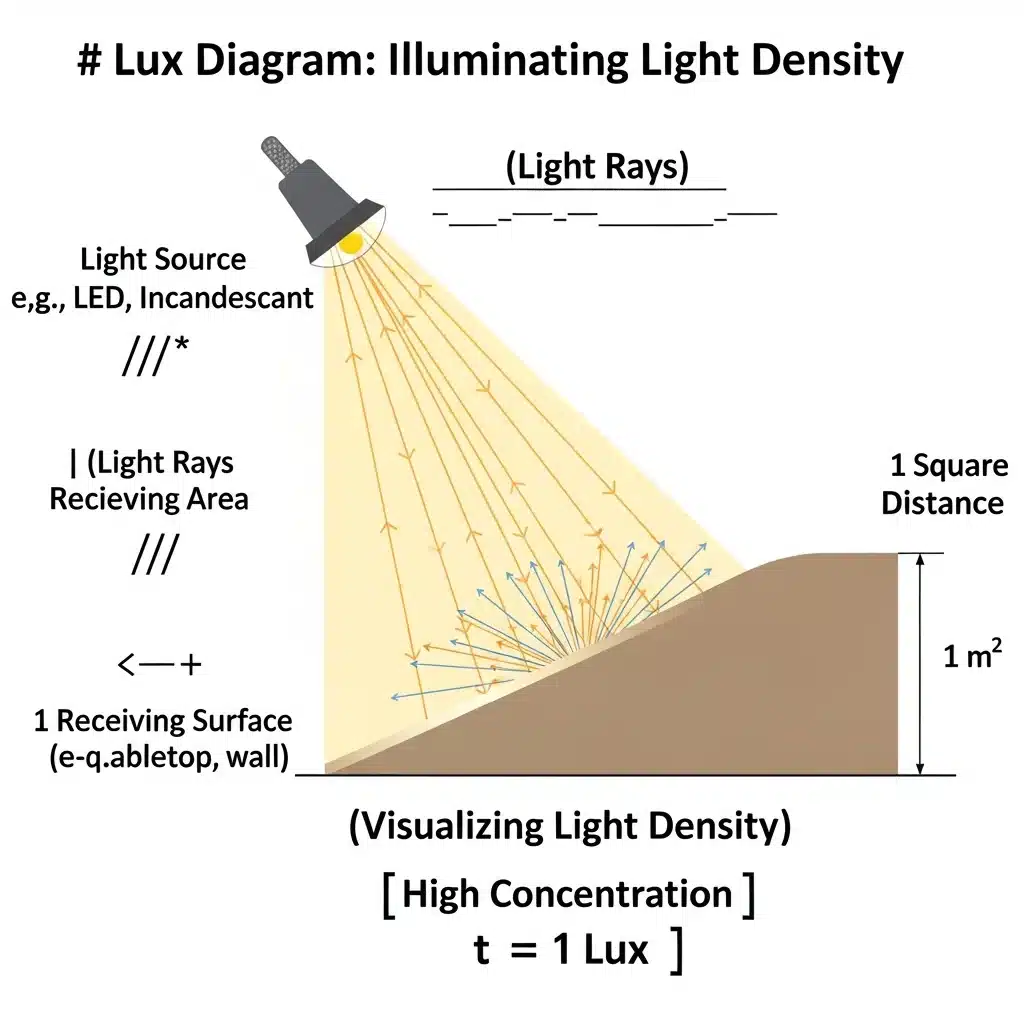
To understand what is lux in lighting, one must move beyond simple bulb wattage and delve into photometry—the science of measuring light as perceived by the human eye. Lux (symbol: lx) is the International System of Units (SI) derived unit of illuminance and luminous emittance. While distinct in application, both terms refer to the density of luminous flux incident upon a surface.
From an engineering perspective, what is lux level if not a measurement of intensity? It is defined as one lumen per square meter. Unlike radiometric units that measure total electromagnetic energy (Watts), lux is weighted according to the CIE luminosity function, which models the sensitivity of the standard human eye to different wavelengths. This ensures that the metric correlates directly with human visual perception of brightness.
Mathematically, illumination lux is the quotient of the luminous flux incident on an element of the surface by the area of that element. The fundamental formula for calculating illuminance ($E_v$) is:
$$ E_v = \frac{\Phi_v}{A} $$
Where:
Therefore, the dimensional relationship is expressed as:
$$ 1 \text{ lx} = 1 \frac{\text{lm}}{m^2} $$
This equation highlights that lux is a measure of concentration. If a light source emits 1,000 lumens and that light is focused entirely onto a surface area of 1 square meter, the illuminance is 1,000 lux. However, if that same 1,000 lumens is spread over 10 square meters, the lux in light measurement drops to 100 lux. This distinction is critical in lighting design; high lumen output at the source does not guarantee high lux levels at the working plane if the beam angle is too wide or the distance is too great.
The primary confusion in lighting specification lies in distinguishing between the source output and the received light.
For a point source of light, the illuminance on a surface perpendicular to the direction of the light follows the inverse square law. This physical law dictates that the lux level is inversely proportional to the square of the distance from the source.
$$ E = \frac{I}{d^2} $$
Where:
This implies that doubling the distance between the fixture and the surface reduces the lux level to one-quarter of its original value, not one-half. Consequently, industrial and office lighting plans must meticulously account for ceiling height and fixture suspension levels to maintain the required standard lux levels at the desk or machinery height.

To accurately assess workplace illumination, one must move beyond simple bulb wattage and understand the physics of photometry. The lux value ($E_v$) represents illuminance, or luminous flux density. It is strictly defined as the amount of luminous flux incident per unit area. While lumens quantify the total light output emitted by a source in all directions, the lux level quantifies the intensity of that light once it arrives at a specific surface.
Mathematically, the relationship between the total luminous flux ($\Phi_v$, measured in Lumens) and the area ($A$, measured in square meters) is expressed as:
$$ E_v = \frac{\Phi_v}{A} $$
Where:
Consequently, one Lux is equivalent to one Lumen per square meter ($1 \text{ lx} = 1 \text{ lm}/m^2$). This equation highlights a critical engineering principle: the lux value of light is inversely proportional to the area over which it is spread. A 1,000-lumen LED fixture focusing its output onto a $1m^2$ desk results in a reading of 1,000 lux. If that same light is dispersed over $10m^2$, the illuminance drops to just 100 lux, likely rendering the space insufficient for precision tasks.
In practical engineering applications, the lux level is rarely uniform and is heavily influenced by distance and angular alignment.
The Inverse Square Law
For a point source of light, the intensity decreases exponentially as the distance from the source increases. This is governed by the Inverse Square Law. If we consider the Luminous Intensity ($I_v$, measured in Candelas), the calculation for illuminance at a distance ($d$) is:
$$ E_v = \frac{I_v}{d^2} $$
This means that doubling the distance between the light fixture and the working plane reduces the light lux intensity to one-quarter of its original value. Engineers must account for ceiling height variations; a high-bay warehouse requires significantly more powerful fixtures than a standard office to achieve the same lux reading at floor level.
Lambert’s Cosine Law
Furthermore, the lux value is maximized when the light strikes the surface perpendicularly (at a $90^\circ$ angle). When light hits a surface at an angle, the same amount of luminous flux is spread over a larger elliptical area, reducing density. The illuminance on a surface tilted at an angle $\theta$ relative to the normal is calculated as:
$$ E_{\theta} = E_{max} \cos(\theta) $$
Where $E_{max}$ is the illuminance at normal incidence. This highlights why directional task lighting is superior to general ambient lighting for high-detail work; it allows the user to manipulate the beam angle to maximize the lux value directly on the subject, minimizing geometric losses.
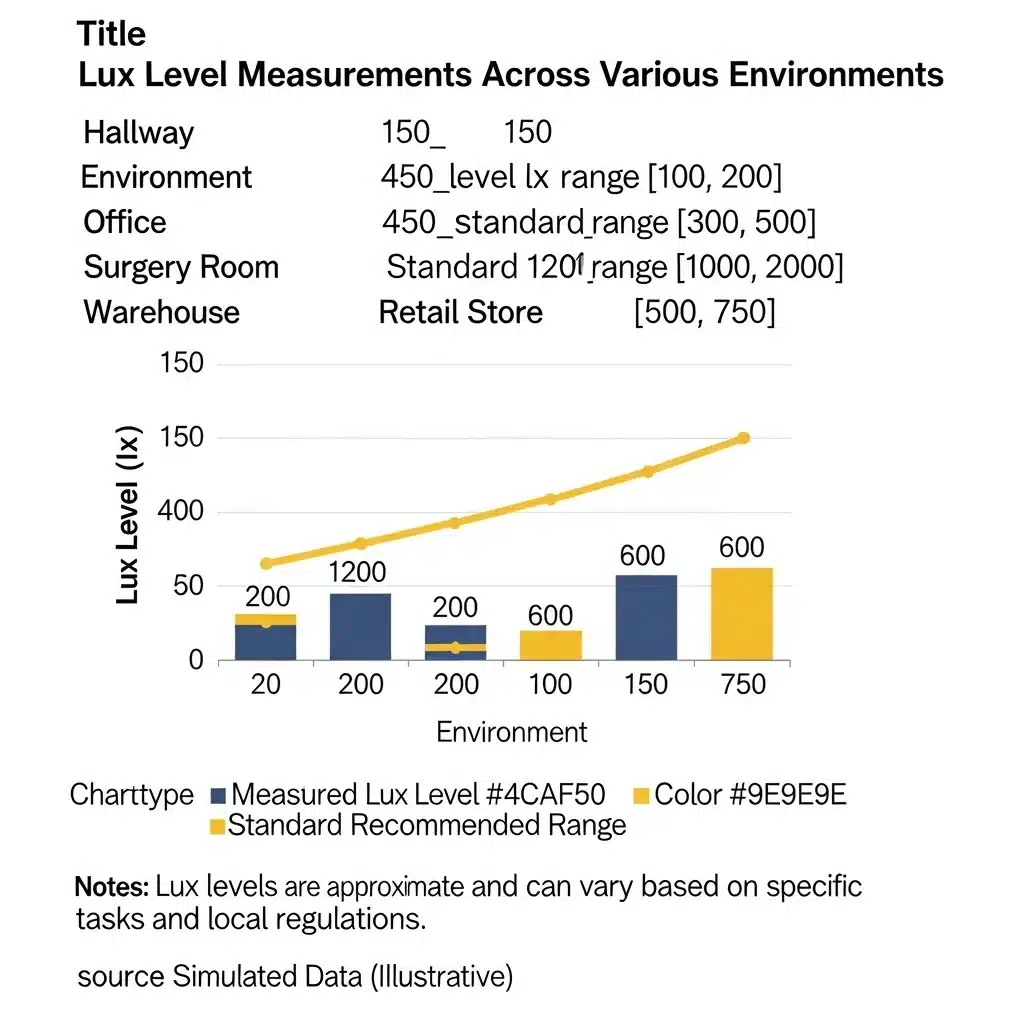
Establishing the correct lux level requirements is not merely a matter of visual preference; it is a calculation rooted in photometric physics and human physiology. Adhering to a recognized lux level standard ensures operational efficiency, visual comfort, and compliance with safety regulations such as ISO 8995, EN 12464-1 (common in Europe), or the IESNA Lighting Handbook (North America).
Illuminance ($E$), measured in Lux ($lx$), is defined as the luminous flux ($\Phi$) incident on a surface area ($A$). The fundamental relationship is expressed as:
$$ E = \frac{\Phi}{A} $$
Where $1 \text{ lx} = 1 \text{ lm} / \text{ m}^2$. However, simply achieving a specific average value is insufficient. Professional lighting design must also account for the Uniformity Ratio ($U_0$), defined as minimum illuminance divided by average illuminance ($E_{min} / \bar{E}$), to prevent visual fatigue caused by constant eye adaptation between bright and dark spots.
The following standard lux level chart categorizes lighting zones based on the complexity of the visual task, referencing maintained illuminance ($\bar{E}_m$)—the minimum average illuminance on the reference surface at the time maintenance is carried out.
| Zone / Activity Classification | Recommended Range (Lux) | Uniformity ($U_0$) | Typical Applications |
|---|---|---|---|
| Public & Circulation Areas | 100 - 150 lx | 0.40 | Corridors, stairways, elevators, bulk storage warehouses, loading bays. |
| Basic Working Areas | 200 - 300 lx | 0.40 - 0.60 | Archives, copy rooms, packing areas, reception desks, casual meeting rooms. |
| Standard Office / Industrial | 500 lx | 0.60 | General office work (typing, reading), PC work stations, general assembly, laboratories, retail sales floors. |
| Detailed Task Areas | 750 - 1,000 lx | 0.70 | Technical drawing, precision assembly, paint inspection, textile production, detailed mechanical workshops. |
| Precision Engineering | 1,500 - 2,000+ lx | 0.70 - 0.80 | Micro-electronics assembly, gem cutting, watchmaking, surgical procedures (local), very fine color inspection. |
When applying these lux level standards, engineers must distinguish between maintained illuminance and initial illuminance. Because light sources depreciate over time (Lumen Depreciation) and surfaces accumulate dirt (Luminaire Dirt Depreciation), lighting systems are typically designed with a Maintenance Factor ($MF$) in the calculation:
$$ E_{initial} = \frac{E_{maintained}}{MF} $$
For example, to satisfy lux level requirements of 500 Lux in an office with a maintenance factor of 0.8, the initial installation must deliver $500 / 0.8 = 625$ Lux.
While the chart above reflects optimal engineering best practices (aligned with IES and ISO), legal minimums can differ. For instance, OSHA Standard 1926.56 (USA) sets much lower absolute minimums for safety in construction areas (e.g., 5 foot-candles or approximately 55 Lux for general construction area lighting). However, relying solely on minimum safety mandates often results in suboptimal productivity. Therefore, facility managers should aim for the IES/ISO recommended levels listed in the standard lux level chart above to maximize human performance and error reduction.
Furthermore, for high-precision tasks (1,000+ Lux), general lighting is rarely sufficient. Localized task lighting is required to achieve the necessary intensity without over-lighting the surrounding environment, which would be energy-inefficient. In these scenarios, the Color Rendering Index (CRI) should also be considered, with a standard of $CRI > 80$ for offices and $CRI > 90$ for color-critical inspection zones.

Determining the recommended lux levels for offices requires a nuanced understanding of lighting dynamics, human physiology, and energy efficiency. While general illumination provides visibility, specific engineering standards—such as EN 12464-1 regarding "Light and lighting - Lighting of work places"—dictate precise illuminance values to mitigate eye strain and maximize cognitive performance.
The standard lux level for office environments, particularly for workstations involving writing, typing, reading, and data processing, is widely accepted as maintained illuminance ($\bar{E}_m$) of 500 Lux. This value represents a critical balance. It provides sufficient luminous flux for the human eye to resolve small details on paper documents (which rely on reflected light) without overpowering computer display units (VDU), which emit their own light. When office lux levels drop below this threshold, typically into the 300 Lux range, the ciliary muscles in the eye must work harder to focus, leading to rapid fatigue and potential Computer Vision Syndrome (CVS).
However, achieving the correct lux level in office design is not solely about hitting a target number on a photometer; it involves uniformity and glare control. A common engineering metric used is the Uniformity Ratio ($U_0$), defined as the ratio of minimum illuminance to average illuminance:
$$U_0 = \frac{E_{min}}{\bar{E}}$$
For a standard workstation, the uniformity should be $U_0 \geq 0.60$. This ensures that the transition between the immediate task area and the surrounding environment is not visually jarring, preventing the eye from constantly adapting to varying brightness levels. Furthermore, the Unified Glare Rating (UGR) must be considered alongside intensity. For standard office work, a UGR limit of $\leq 19$ is required to prevent direct or reflected glare that can wash out screens and reduce contrast sensitivity.
To implement efficient lighting lux levels for offices, engineers often utilize a layered lighting approach rather than flooding an entire floor plate with high-intensity light. This strategy distinguishes between:
It is also vital to distinguish between general clerical work and precision tasks. While 500 Lux is the baseline for administrative tasks, technical drawing stations or areas requiring minute color inspection often require 750 Lux or even 1000 Lux. Conversely, archives and copy rooms may operate efficiently at 300 Lux.
| Area / Task | Required Illuminance ($\bar{E}_m$) | Uniformity ($U_0$) | UGR Limit |
|---|---|---|---|
| Filing / Copying | 300 Lux | 0.40 | 19 |
| Writing / Typing / Reading | 500 Lux | 0.60 | 19 |
| Technical Drawing / Precision Work | 750 Lux | 0.70 | 16 |
By adhering to these recommended lux levels for offices, facility managers ensure compliance with occupational safety standards while optimizing the visual environment for sustained productivity.
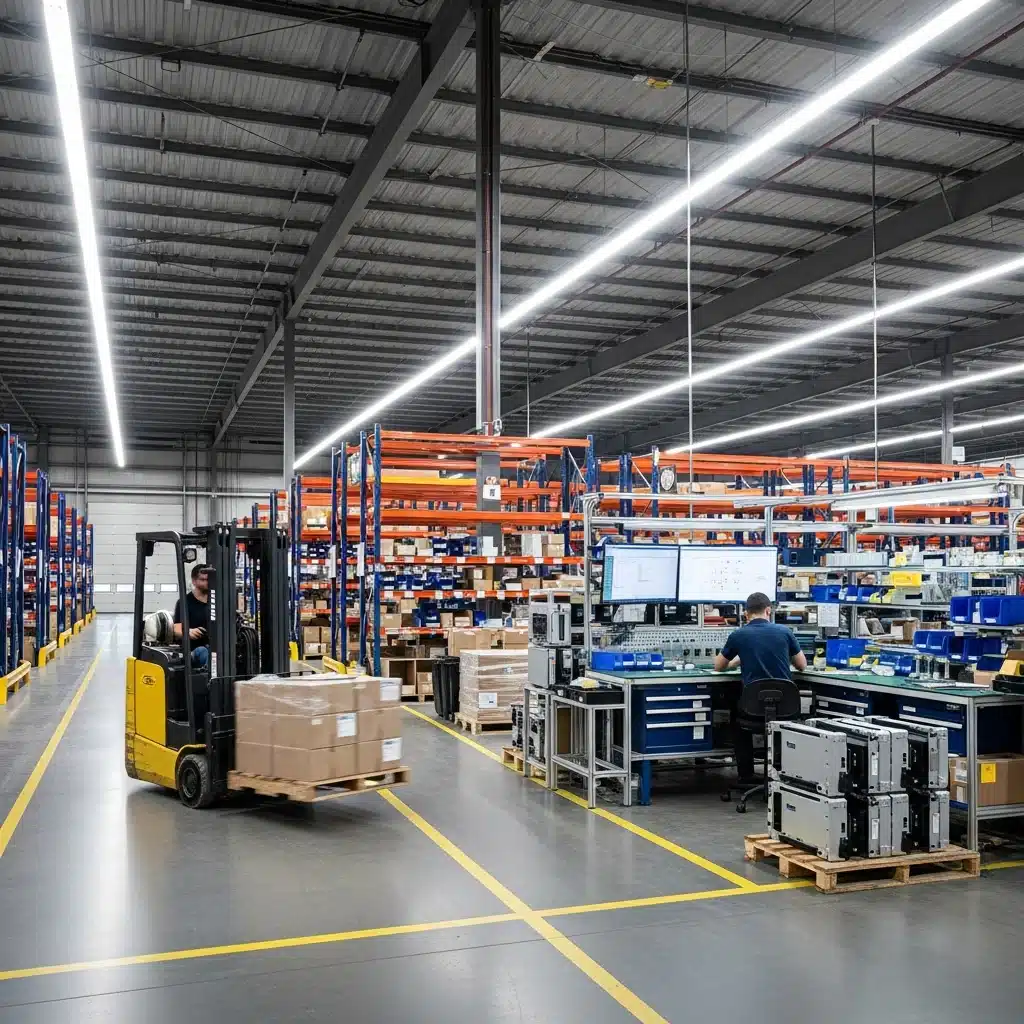
In industrial environments, illumination is a critical component of Occupational Health and Safety (OHS) rather than an aesthetic choice. Adherence to workplace lux level standards in industry is mandated to mitigate accident risks, reduce operator fatigue, and ensure product quality. Unlike commercial office spaces, industrial floors present high-risk variables—moving machinery, vehicular traffic (forklifts), and hazardous materials—that require precise lighting calculations and strict adherence to minimum thresholds.
A focal point in industrial lighting design is the 300 lux threshold. According to standards such as EN 12464-1 (Light and lighting - Lighting of work places), 300 lux is generally regarded as the baseline for continuously occupied areas where "moderately difficult" tasks are performed.
While transit areas or bulk storage may operate safely at lower levels, 300 lux is the inflection point where the human eye can comfortably distinguish contrast and detail for sustained periods without strain. Below this level, the risk of error in reading gauges, operating control panels, or identifying component defects increases significantly. For tasks involving rotating machinery, falling below this threshold can also exacerbate the stroboscopic effect, where moving parts appear stationary due to insufficient lighting frequency and intensity.
Industrial facilities are rarely uniform; therefore, the lighting design must be zoned based on visual complexity. The minimum lux level for working area requirements vary drastically depending on the precision of the task:
Warehousing and Loading Bays ($100 - 200 \text{ Lux}$):
In areas defined by movement and bulk storage, the primary goal is navigation and obstacle avoidance. A range of 150 lux is typically sufficient for reading large labels and safely operating forklifts. However, uniformity is key here to prevent "dazzle" when moving from dark aisles to bright loading docks.
General Assembly and Fabrication ($300 - 500 \text{ Lux}$):
For medium-detail work, such as rough machining, welding, or assembly of medium-sized components, the standard rises. Here, the focus shifts to the distinction of tools and materials. High Color Rendering Index (CRI) sources ($Ra \geq 80$) are recommended alongside high illuminance to ensure color-coded wires or safety labels are correctly identified.
Precision Engineering and Inspection ($750 - 1,000+ \text{ Lux}$):
Quality Assurance (QA) stations and fine electronic assembly require the highest intensity. At these levels, lighting must be positioned to minimize shadows. For ultra-precision work, local task lighting often supplements general lighting to achieve values exceeding 1,500 lux.
Meeting the average lux value is insufficient if the lighting distribution is patchy. Shadows create safety hazards. Engineers must calculate the Uniformity Ratio ($U_0$) to ensuring consistent visibility.
The uniformity of illuminance is defined as the ratio of the minimum illuminance to the average illuminance on a specified surface:
$$ U_0 = \frac{E_{min}}{E_{avg}} $$
Where:
For most industrial tasks, a $U_0$ of at least 0.60 is required, though precision tasks may demand a ratio closer to 0.70 or higher to eliminate contrast-induced visual fatigue. When auditing a facility, engineers measure these points using a grid pattern to ensure the minimum lux level for working area compliance is met not just in the center of the room, but at the periphery where accidents often occur.

Accurate verification of illuminance requires precise instrumentation and adherence to photometric protocols. Relying on visual estimation or uncalibrated smartphone applications often yields erroneous data due to the lack of proper cosine correction and spectral filtering. To ensure compliance with OSHA, EN 12464, or IESNA standards, a systematic lighting audit using a calibrated illuminance meter (Lux meter) is required.
For professional audits, the Lux meter must utilize a silicon photodiode sensor equipped with two critical physical filters:
1. Photopic Correction Filter: This aligns the sensor's spectral responsiveness with the CIE standard observer luminosity function ($V(\lambda)$). It ensures the meter "sees" brightness as the human eye does, peaking at 555 nm (green-yellow light) and attenuating blue and red wavelengths.
2. Cosine Correction Diffuser: Illuminance follows the Lambert’s Cosine Law, where the light intensity is proportional to the cosine of the angle of incidence. The meter must account for light hitting the sensor from oblique angles, not just the vertical source.
$$ E_{\theta} = E_{n} \cos \theta $$
Where $E_{\theta}$ is the illuminance at angle $\theta$, and $E_{n}$ is the illuminance from the normal (perpendicular).
Measurements must be taken at the specific height where the visual task is performed, technically defined as the "working plane."
To prevent localized hotspots or shadows from skewing data, engineers employ the Grid Method. The room is divided into a matrix of square measurement points. The number of points ($N$) required for a sufficient Room Index is often calculated based on the room dimensions, but a general rule of thumb for rectangular spaces is to space points at intervals of $0.5m$ to $1.0m$ depending on the required precision.
When conducting the audit, ensure the lighting system has been active for at least 15 minutes to reach thermal stabilization, particularly for fluorescent or high-intensity discharge (HID) fixtures. LED sources stabilize faster but still benefit from a warm-up period.
Once the grid data is collected, the Average Illuminance ($\bar{E}$) is calculated using the summation of all points divided by the total number of points:
$$ \bar{E} = \frac{\sum_{i=1}^{n} E_i}{n} $$
However, an average value can hide significant lighting defects. A room might average 500 Lux, but if corners drop to 100 Lux while the center is 900 Lux, the environment will cause visual fatigue. Therefore, you must calculate the Uniformity Ratio ($U_0$).
$$ U_0 = \frac{E_{min}}{\bar{E}} $$
Where $E_{min}$ is the lowest recorded value in the grid.
If $U_0$ falls below these thresholds, the audit identifies "dark spots" which require supplemental task lighting or a re-configuration of the overhead lighting layout. Conversely, if specific grid points register significantly higher than the target (e.g., >1000 Lux for general office work), the area is over-lit, indicating wasted energy and potential glare issues.
Adhering to standard lux levels is often viewed as a sunk operational cost, but a rigorous analysis reveals it as a capital investment with a quantifiable Internal Rate of Return (IRR). For facility managers and engineers, the objective is to decouple illuminance ($E_v$, measured in lux) from power consumption ($P$, measured in watts). This decoupling allows an organization to achieve recommended workplace standards (e.g., 500 lux for offices) while simultaneously reducing operating expenses (OpEx).
The financial viability of upgrading to meet modern lux standards hinges on Luminous Efficacy ($\eta$), defined as the ratio of luminous flux to power:
$$ \eta = \frac{\Phi_v}{P} \quad [\text{lm/W}] $$
Where:
Legacy fluorescent T5 or T8 fixtures generally operate with a system efficacy of 80–90 lm/W (including ballast losses). In contrast, modern industrial LED fixtures frequently exceed $160 \text{ lm/W}$.
To maintain a specific lux level ($E$) over a target surface area ($A$), the required flux is $\Phi_v = E \times A$. Consequently, the power required is inversely proportional to the efficacy of the source. By doubling the efficacy through LED implementation, a facility can double the lux levels—moving from a dim 250 lux to a compliant 500 lux—without increasing the electrical load. In retrofit scenarios where lux levels are already sufficient, the energy savings delta ($\Delta P$) becomes significant:
$$ \text{Annual Savings} = \frac{(\Delta P_{total} \times t_{annual} \times R_{kWh})}{1000} $$
Where $t_{annual}$ represents operating hours and $R_{kWh}$ is the utility rate.
While energy savings offer a tangible payback period (often 18–24 months), the greatest return on investment lies in human capital. Engineering psychology and ergonomics data indicate that visual performance is a function of contrast sensitivity and visual acuity, both of which degrade significantly as lux levels drop below standard thresholds.
When the illuminance on a task plane falls below 300 lux, the human eye must increase accommodation effort. This strains the ciliary muscles, leading to asthenopia (eye strain) and fatigue. In industrial precision work (e.g., PCB assembly or machining), the relationship between illuminance and error rates is non-linear. Increasing lighting from 300 lux to 1000 lux can improve visual processing speeds by decreasing the retinal integration time required to perceive detail.
The financial implication is modeled through the "1-10-100" rule of facilities management, where energy costs (1) are dwarfed by rental/maintenance (10) and salary costs (100). A minor increase in lighting energy spend to achieve the optimal 500–750 lux range is negligible compared to a 1% gain in workforce productivity.
Finally, maintaining proper lux levels is a risk management strategy. In industrial environments, lighting is a critical component of safety compliance. The Occupational Safety and Health Administration (OSHA) and equivalent bodies (such as the HSE in the UK) cite inadequate lighting as a contributing factor in "slip, trip, and fall" accidents.
Furthermore, inadequate lighting can obscure safety signage and machinery hazards. The cost of a single safety violation fine or worker's compensation claim frequently exceeds the capital expenditure required to install a compliant, high-lux lighting system. Therefore, meeting the EN 12464 or IESNA standards is not merely a design choice; it is a requisite baseline for operational safety and legal insulation.
