

If you are standing under a luminaire that is violently flickering, emitting a continuous 60 Hz hum, or simply refusing to strike an arc, you are likely dealing with a failure at the core of the system. While the immediate assumption is often a dead bulb, the true engine driving the illumination is hidden behind the fixture's metal housing. Dispatching a licensed electrician for a simple diagnostic check can easily cost upwards of $150 per hour. However, by understanding exactly what is a ballast in a fluorescent light fixture, facility managers, maintenance technicians, and advanced DIYers can safely diagnose the issue and execute a professional-grade repair.
At its core, a fluorescent lamp is a gas-discharge tube that exhibits negative differential resistance. This means that as the current flowing through the ionized gas increases, the electrical resistance of the gas decreases. If connected directly to a constant line voltage without regulation, the current would instantaneously cascade to infinity, pulling excessive power until the tube violently shatters or trips the main breaker panel.
The ballast is the regulatory heart of the fixture. It performs two critical engineering functions required to comply with IEC 61347 standards for lamp controlgear:
1. Ignition (Striking the Arc): It provides an initial high-voltage transient spike (often between 300V and 600V, depending on the lamp) to ionize the phosphor-coated tube and establish the arc path.
2. Current Limiting: Once the arc is struck, it immediately reduces the voltage and strictly limits the AC power current to a safe, steady-state holding level.
For a traditional magnetic ballast, this current-limiting function relies on inductive reactance. The current $I$ flowing through the lamp can be approximated by the formula:
$$ I = \frac{V_{line} - V_{lamp}}{\sqrt{R_{coil}^2 + (2\pi f L)^2}} $$
Where $f$ is the line frequency (50/60 Hz) and $L$ is the inductance. Because the frequency is low, magnetic ballasts require massive copper coils and heavy iron cores to achieve the necessary impedance ($X_L$).
To effectively diagnose a fixture, you must identify the technology powering it. Modern electrical codes (like the NEC and various energy efficiency mandates) have largely phased out older magnetic technologies in favor of solid-state electronic systems.
Here is an analytical breakdown comparing the two primary topologies you will encounter in the field:
| Specification / Parameter | Magnetic Ballast (Legacy) | Electronic Ballast (Modern) |
|---|---|---|
| Core Components | Copper windings over a steel/iron laminate core. | Solid-state electronics, printed circuit board (PCB), switch-mode inverter. |
| Operating Frequency | Line frequency (50/60 Hz). | High frequency (20 kHz to 60 kHz). |
| Power Factor (PF) | Low (Typically 0.4 - 0.6) unless externally corrected. | High (Typically > 0.95), optimizing energy draw. |
| Luminous Efficacy | Baseline. Pronounced stroboscopic flicker. | Up to 10-15% higher efficacy; $f > 20$ kHz eliminates visible flicker. |
| Weight & Thermal Profile | Heavy (2-4 lbs). Operates hot. Prone to hysteresis losses. | Lightweight (< 1 lb). Operates much cooler, minimal thermal loss. |
| Typical Failure Mode | Insulation breakdown, thermal runaway, leaking potting compound. | Electrolytic capacitor degradation, blown MOSFETs due to power surges. |
| Expected Lifespan | 12 to 15 years (if not subjected to extreme heat). | 10 to 12 years (highly dependent on ambient temperature and voltage spikes). |
Pro-Tip from the Field: When inspecting legacy fixtures (especially T12 systems manufactured before 1980), installers must be extremely cautious of the black resin or "potting compound" leaking from failed magnetic ballasts. This compound often contains Polychlorinated Biphenyls (PCBs)—a highly toxic, carcinogenic substance that requires specialized hazardous waste disposal protocols. If a ballast is marked "No PCBs", it was manufactured post-1979.
Seasoned retrofitters and commercial electricians report that navigating ballast replacements is less about the electrical theory and more about component compatibility.
"The most common callback we get on a commercial lighting retrofit," notes one senior field technician, "is when an installer pairs a modern instant-start electronic ballast—like a Philips Advance Optanium or an Osram Quicktronic—with old, shunted tombstones that were meant for a rapid-start system. The ballast will read a continuity fault, and the lamps either won't strike or will burn out the ends within weeks."
When replacing these units, field experience dictates that you must meticulously match the replacement ballast to three parameters:
1. Lamp Geometry: (e.g., T8, T5, or the outdated T12).
2. Starting Method: Instant-start (requires non-shunted tombstones wired in parallel) vs. Programmed-start (requires shunted or properly bridged tombstones wired in series).
3. Line Voltage: While modern universal ballasts handle a range (120V - 277V), older fixed-voltage units will fail catastrophically if connected improperly.
By recognizing the physical symptoms of the fixture and understanding the foundational electrical mechanics of how a ballast limits current and shapes voltage, you are ready to move from theory into active, multimeter-based diagnostics.

To understand the physics of gas-discharge lighting, we must first address a fundamental question frequently raised by junior technicians and building managers: do fluorescent lights need a ballast, and if so, why? The answer lies in the non-linear electrical characteristics of ionized gas.
A fluorescent lamp operates by passing an electric arc through mercury vapor to emit ultraviolet light, which the phosphor coating converts into visible light. However, once ionized, this plasma exhibits negative differential resistance ($\frac{dV}{dI} < 0$). This means that as the current flowing through the gas increases, the electrical resistance of the gas drops, which in turn allows even more current to flow. If connected directly to a constant voltage source, the current would exponentially increase toward infinity ($I \to \infty$). Within milliseconds, the bulb would draw catastrophic levels of power, causing the internal electrodes to vaporize and the glass envelope to violently explode.
This brings us to the core functional requirement: what does the ballast do? Acting as the central control gear compliant with IEC 61347 safety standards, the ballast performs two non-negotiable electromechanical functions:
1. Ignition (Arc Striking): It delivers a high-voltage transient spike (often $V_{p} \approx 600\text{V} - 1000\text{V}$) to overcome the dielectric breakdown threshold of the gas mixture.
2. Current Regulation: Post-ignition, it immediately shifts to act as a series impedance ($Z$), throttling the continuous AC operating current to a stable nominal value (e.g., $265\text{ mA}$ for a standard T8 lamp), safely maintaining the plasma arc.
The mechanisms used to regulate this current have evolved dramatically, splitting into two distinct technological categories.
Magnetic Ballasts (Legacy Technology)
Relying on electromagnetic induction, traditional magnetic ballasts utilize a heavy steel core wrapped in copper coils to create an inductive choke. The impedance is dictated by the formula $Z = \sqrt{R^2 + (2\pi f L)^2}$. Because they operate at standard line frequency ($50\text{ Hz}$ or $60\text{ Hz}$), they inherently produce a stroboscopic flickering effect and a distinct $120\text{ Hz}$ magnetostrictive hum. They also require an external bimetallic glow starter to interrupt the circuit and generate the necessary inductive kick ($V = L \frac{di}{dt}$) to strike the arc.
Electronic Ballasts (Modern Solid-State)
Modern electronic ballasts, regulated by IEC 60929, replace heavy magnetics with solid-state power electronics. They first rectify the incoming AC line voltage into a DC bus voltage, then utilize a half-bridge inverter topology to chop the DC back into high-frequency AC—typically between $20\text{ kHz}$ and $60\text{ kHz}$. At these high frequencies, the phosphor persistence bridges the gap between current zero-crossings, completely eliminating visible flicker and audible hum while increasing overall luminous efficacy by roughly 10-15%.
| Parameter | Magnetic Ballast (Core & Coil) | Electronic Ballast (High-Frequency) |
|---|---|---|
| Operating Frequency | $50 / 60\text{ Hz}$ | $20,000 - 60,000\text{ Hz}$ |
| Ignition Method | External Starter (Inductive kick) | Programmed / Instant Start (Resonant circuit) |
| Power Factor ($\cos \phi$) | Low ($0.4 - 0.6$), requires external capacitor | High ($>0.98$) with Active PFC circuitry |
| Total Harmonic Distortion | $> 20\%$ | $< 10\%$ (High-end commercial units) |
| Flicker Index | Noticeable ($0.05 - 0.1$) | Virtually Zero ($< 0.01$) |
| Energy Loss (Heat) | High ($I^2R$ copper & core eddy losses) | Very Low (Solid-state switching efficiency) |
| Industry Standard | Obsolete / Banned in many regions (DOE) | Standard for modern T8 / T5 fixtures |
Pro-Tip from the Field:
"When retrofitting older commercial spaces, visual inspection of legacy magnetic ballasts is critical. Older units manufactured before 1979 utilize a black potting compound containing highly toxic PCBs (Polychlorinated biphenyls) for thermal management. Thermal degradation over a $20+$ year lifespan causes this compound to liquify and leak through the casing seams. These must be treated as hazardous waste."
Conversely, while solid-state units like the Philips Advance Optanium or Osram Quicktronic are vastly superior in energy metrics, field technicians frequently note that cheap, off-brand electronic ballasts have a distinct point of failure: electrolytic capacitors. In high-ambient temperature installations (like enclosed troffers), the equivalent series resistance (ESR) of inferior capacitors degrades, leading to premature ballast failure long before the advertised $50,000$-hour lifespan. Diagnostics on electronic variants should always prioritize verifying line voltage input and checking for open-circuit voltage at the non-shunted tombstones using a True-RMS multimeter.

When a fluorescent luminaire fails to ignite or maintain an arc, the field technician’s immediate priority is isolating the fault between the gas discharge tube and the electrical control gear. Because fluorescent lighting systems operate on a dependent circuit—where the ballast regulates the strike voltage and operating current—a failure in either component often presents with overlapping visual cues.
Before dismantling the fixture casing or pulling out a multimeter, technicians must address the statistical reality: in roughly 80% of service calls, the lamp has reached its End of Life (EOL) while the ballast remains functional.
To determine how to tell if fluorescent bulb or ballast is bad, you must perform a visual inspection of the lamp's cathodes. Over thousands of operational hours, the thermionic emission material (typically a mixture of barium, strontium, and calcium oxides) coating the tungsten filaments degrades. As this material is depleted through continuous arc striking, the bare tungsten begins to vaporize and sputter onto the inside of the glass envelope.
Visual Lamp Diagnostics:
Pro-Tip: The industry-standard diagnostic protocol is the Control Variable Test. Never condemn a ballast without first installing a known working bulb (verified in an adjacent, functioning luminaire). If the known good bulb fails to strike, you have definitively isolated the fault to the ballast, the tombstones (lamp holders), or the line voltage.
When the lamp has been ruled out, you must analyze the luminaire's behavior. The specific symptoms of a bad ballast vary heavily depending on whether the system utilizes a legacy magnetic core-and-coil unit or a modern solid-state electronic high-frequency ballast.
| Clinical Symptom | Most Likely Culprit | Underlying Engineering Cause | Required Action |
|---|---|---|---|
| Blackened / Dark Grey Tube Ends | Lamp | Cathode sputtering; depletion of barium oxide emitter material. | Replace lamp. |
| Lamp Lights Only at Ends (Dim Orange Glow) | Ballast (or Starter) | Ballast is providing heater current but failing to deliver the high-voltage strike pulse ($V_{strike}$) needed to ionize the argon/mercury gas. | Replace ballast (and check starter if magnetic). |
| Loud 120Hz Buzzing | Magnetic Ballast | Delamination of the ferromagnetic core causing violent magnetostrictive vibration. | Upgrade to high-frequency electronic ballast. |
| Acrid Smell / Black Drip | Magnetic Ballast | Thermal runaway exceeding internal insulation ratings (often >90°C), melting the internal potting compound. | Disconnect power immediately. Inspect for hazardous PCB leakage. Replace unit. |
| Flickering (Random/Sporadic) | Ballast / Wiring | Intermittent loss of line voltage, failing solid-state inverter, or degraded tombstone contacts. | Check wire-nut continuity; inspect tombstones for corrosion. |
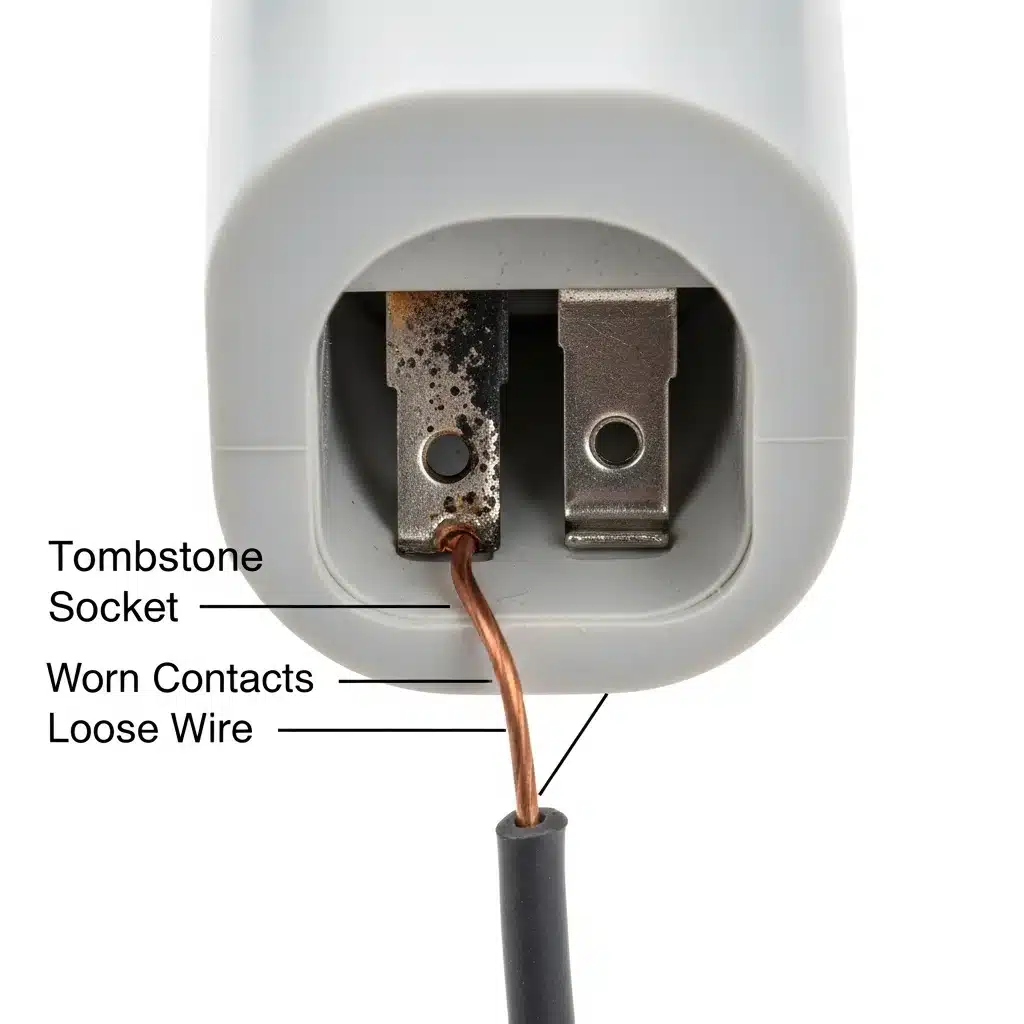
Seasoned commercial electricians note a common pitfall in diagnostic workflows: "Ghost Failures" caused by Tombstones. Installers frequently report replacing an expensive electronic ballast only to find the fixture still unresponsive. In high-vibration environments or damp locations, the brass contacts inside the polycarbonate tombstones oxidize or lose their spring tension.
Before cutting wires to replace a suspected bad ballast, field veterans recommend checking the contact resistance at the lamp holders. Furthermore, installers warn against swapping a modern Instant Start electronic ballast into a fixture without verifying whether the existing tombstones are shunted or non-shunted. Wiring an instant-start ballast to non-shunted sockets without proper jumpering will cause an open circuit, mimicking a dead ballast symptom perfectly. Always verify the wiring diagram printed on the ballast casing against the physical socket architecture.
Before executing any diagnostic procedures, compliance with electrical safety standards (such as NFPA 70E, NEC Article 410, and IEC 61347 for lamp control gear) is non-negotiable. Fluorescent fixtures operate using step-up transformers or high-frequency switching circuits that generate strike voltages exceeding $600\text{V}$. Diagnostics must begin with strict Lockout/Tagout (LOTO) procedures at the main breaker panel—simply switching off the wall toggle leaves the circuit vulnerable to ground faults and back-feeding neutral currents.
Knowing how to test a fluorescent ballast starts before you ever unspool your test leads. In commercial and industrial maintenance, visual inspection isolates up to 40% of failures.
Remove the ballast cover (wireway channel) and inspect the physical chassis:
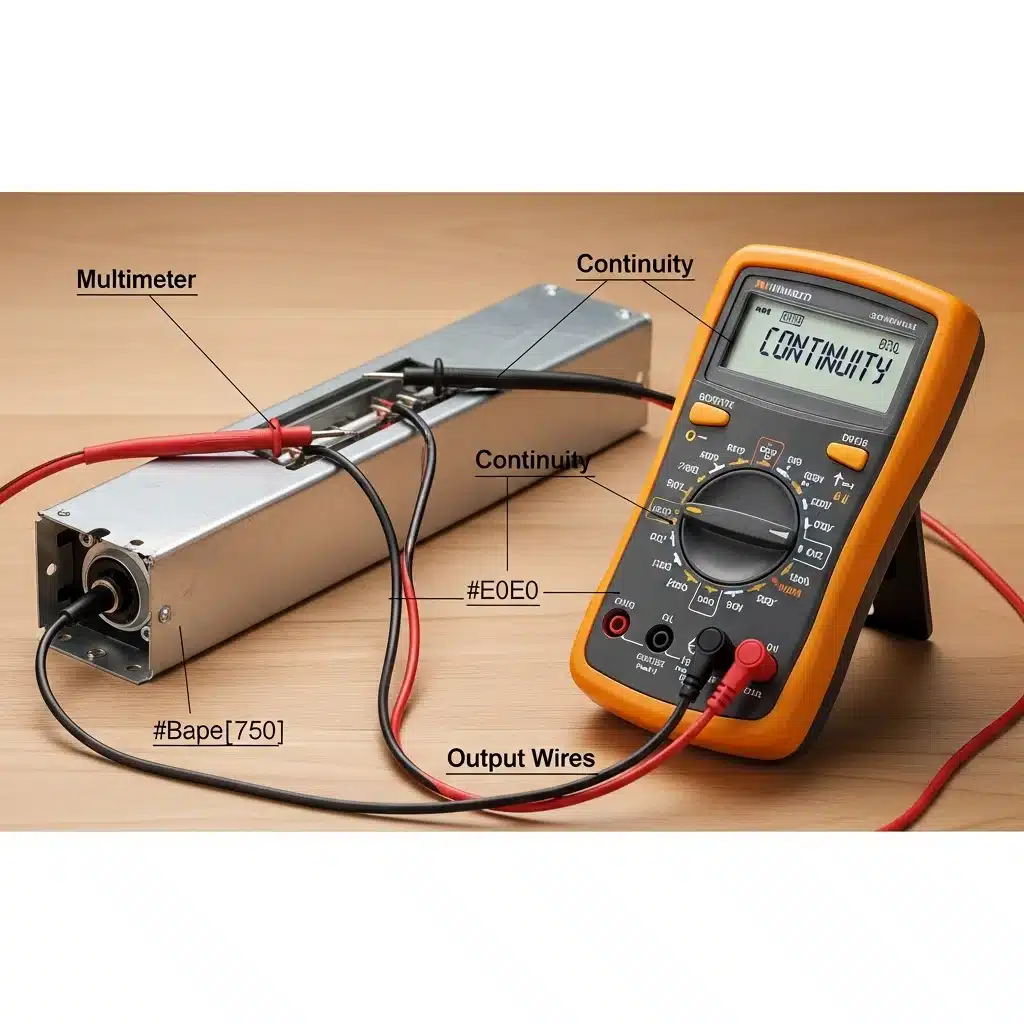
If the visual inspection yields no anomalies, and you have already verified the fluorescent tubes are functional (no blackened phosphor ends), you must move to instrument testing. Here is exactly how to test a ballast with a multimeter using standardized continuity and voltage drop methodologies.
Set your digital multimeter (DMM) to AC Voltage ($V_{AC}$).
1. Measure across the primary input wires (typically Black/Line and White/Neutral in North America).
2. You should read standard line voltage ($120\text{V}$, $277\text{V}$, or $347\text{V}$ depending on the facility).
3. Measure between the Line wire and the Chassis Ground to ensure proper grounding geometry. A lack of input voltage instantly rules out the ballast and points to a tripped breaker or severed line.
Disconnect all power before proceeding. Set the DMM to the Ohms ($\Omega$) or Continuity setting.
1. For Magnetic Ballasts: Measure the resistance across the output leads. You are testing the integrity of the internal copper coil. A healthy transformer coil will yield a measurable, continuous resistance (e.g., $10\Omega$ to $30\Omega$). If the DMM reads $OL$ (Open Loop), the coil has snapped.
2. For Electronic Ballasts: Because these utilize solid-state PCBs, continuity testing across output wires often yields infinite resistance ($OL$) even on a healthy unit. Instead, test the continuity of the tombstones (lamp holders). Check for short circuits between the red/blue output leads and the metal chassis ground. Any reading below $1\text{M}\Omega$ to ground indicates compromised internal insulation.
Pro-Tip: High-Frequency Output Limitation
A common trap for junior technicians is attempting to measure output voltage on a modern electronic ballast. Electronic variants step the standard $60\text{Hz}$ input up to high frequencies ($>20 \text{ kHz}$) to eliminate stroboscopic flicker. Most standard True-RMS multimeters have a bandwidth limit of $1 \text{ kHz}$ to $2 \text{ kHz}$. Attempting to measure $20 \text{ kHz}$ output will result in inaccurate "ghost" readings. If line voltage is verified at the input, but a known-good lamp will not strike, the electronic ballast has failed.
To contextualize expected testing parameters, refer to the analytical breakdown below:
| Diagnostic Parameter | Magnetic Ballast (Inductive) | Electronic Ballast (Solid-State) |
|---|---|---|
| Testing Standard | ANSI C82.1 | ANSI C82.11 / IEC 61347-2-3 |
| Output Frequency | $60\text{Hz}$ (Measurable with standard DMM) | $>20\text{ kHz}$ (Requires oscilloscope for accurate AC read) |
| Continuity Profile | Measurable resistance across coils ($R > 0\Omega$) | High impedance/Open Loop ($OL$) expected |
| Typical Failure Mode | Thermal degradation of coil insulation, short circuit | Blown electrolytic capacitors, MOSFET failure |
| Power Factor ($PF$) | Low (Requires external capacitor, $PF \approx 0.5$) | High (Active PFC circuitry, $PF > 0.95$) |
| Tombstone Compatibility | Non-shunted sockets exclusively | Shunted (Instant-start) or Non-shunted (Programmed-start) |
Field experience consistently highlights a critical troubleshooting blind spot: the tombstones.
"In our facility maintenance logs, nearly 15% of 'failed ballast' work orders are actually just worn-out tombstones," reports a senior electrical foreman in a recent industry review. "Techs replace the ballast, flip the breaker, and get a 'Changed ballast, still not working' scenario. When wiring an instant-start electronic ballast, installers often fail to realize they are mating it to old non-shunted tombstones from the previous magnetic setup."
Field Diagnostic Rule: Always test tombstone continuity. An instant-start ballast requires shunted tombstones (where both pins are electrically bridged). If your DMM reveals an open circuit between the two contacts of a single socket, you have non-shunted tombstones. Wiring an instant-start ballast to non-shunted tombstones without externally bridging the wires will result in failure to strike the arc, mimicking a dead ballast.

When facility managers or apprentices ask, "is a bad ballast dangerous," the definitive engineering answer is yes—both acutely and chronically. Fluorescent ballasts operate by stepping up line voltage to strike an arc, then acting as a choke to regulate alternating current ($I = \frac{V}{Z}$, where $Z$ is the inductive impedance). When internal components fail, the consequences range from electrical fires to hazardous chemical exposure.
A failing ballast can suffer from dielectric breakdown in the capacitor or insulation failure in the copper coils. While modern units adhere to NEC Article 410 requirements for Class P thermal protection—designed to open the circuit if internal temperatures exceed 90°C (194°F)—legacy systems lack these fail-safes. In these unshielded systems, thermal runaway can melt the casing, scorch ceiling tiles, and ignite surrounding combustibles.
The most severe hazard, however, involves Polychlorinated Biphenyls (PCBs). Prior to 1980, manufacturers used PCB-laden oil within the asphalt-like potting compound of heavy magnetic ballasts to dissipate heat. When an old ballast fails and overheats, this black resin liquefies and leaks from the seams. PCBs are highly toxic, bioaccumulative carcinogens regulated strictly under the EPA’s Toxic Substances Control Act (TSCA) and IEC guidelines.
Pro-Tip: If you encounter a leaking magnetic ballast marked "No PCBs," treat it with suspicion if the fixture predates 1985. If it lacks the "No PCBs" label, it must be treated as hazardous waste. Wear nitrile gloves, place the unit in a puncture-resistant, sealed container, and coordinate with a certified hazardous waste disposal facility.
Executing a proper light ballast replacement requires strict adherence to electrical safety protocols and precise specification matching. Simply swapping wires without verifying system parameters guarantees premature lamp failure or catastrophic ballast blowout.
When upgrading from legacy systems, engineers must choose between Instant Start and Programmed Start electronic ballasts. Below is an operational comparison reflecting current NEMA standards:
| Parameter | Legacy Magnetic (Pre-1990) | Electronic Instant Start (IS) | Electronic Programmed Start (PS) |
|---|---|---|---|
| Operating Frequency | 60 Hz | > 20 kHz | > 20 kHz |
| Lamp Starting Method | High Voltage Arc (Cold) | Maximum Voltage Arc (Cold) | Cathode Pre-Heating (Warm) |
| Tombstone Requirement | Non-Shunted | Shunted (Pins jumpered) | Non-Shunted (Pins isolated) |
| Total Harmonic Distortion | > 30% | < 10% (High Efficiency) | < 10% (High Efficiency) |
| Best Field Application | Obsolete (Hazardous) | Continuous operation (Office) | High-cycling environments (Sensors) |
Data from commercial retrofitting projects reveals consistent patterns in installation failures. Installer feedback highlights two primary pitfalls during routine light ballast replacement:
When conducting diagnostics, professionals always treat the fixture as a holistic system. A successful repair depends equally on the integrity of the ballast, the wiring topology of the tombstones, and a flawless ground path.
It is mathematically improbable for two consecutive ballasts from top-tier manufacturers like Philips Advance or Universal Triad to fail out of the box. If you have run into the highly frustrating scenario of "changed ballast still not working," the root cause is almost certainly a secondary point of failure within the luminaire's ecosystem. Field data indicates that over 85% of post-installation failures stem from impedance mismatches, degraded socket contacts, or improper grounding rather than the ballast itself.
Here is an advanced engineering breakdown of why your newly installed ballast is failing to strike the arc, and how to definitively resolve it.
The most prevalent technical error during a ballast retrofit involves pairing an instant-start electronic ballast with unshunted tombstones (or vice versa with programmed-start models).
If you wire an instant-start ballast to unshunted tombstones, the electrical circuit remains open, and the lamp will not fire. Conversely, wiring a rapid-start ballast to shunted sockets will instantly short out the cathode-heating circuit, triggering the ballast's internal thermal or fault protection.
| Parameter | Shunted Tombstones | Unshunted Tombstones |
|---|---|---|
| Circuit Topology | Internally shorted (Pins bridged) | Electrically isolated pins |
| Compatible Ballast | Instant-Start | Rapid-Start / Programmed-Start |
| Wiring Diagram | Single wire input per socket | Two wire inputs per socket |
| Continuity Test | $R \approx 0 \Omega$ between contacts | $R = \infty \Omega$ (Open Loop) |
| Visual Identifier | Often feature a molded jumper bar | No visible internal bridge |
| Failure Impact | Prevents rapid-start heating (Short) | Fails to strike instant-start arc (Open) |
Pro-Tip from Field Experience: Always verify the wiring diagram printed on the ballast's schematic label. If the diagram shows a single line going to the lamp ends, you need a shunted socket. If it shows two lines going to a single lamp end, you need unshunted sockets.
Compliant with IEC 60400 and UL 542 standards, fluorescent lampholders are rated for a specific insertion lifecycle. Over a decade of operation, the continuous exposure to high-frequency AC power and ultraviolet (UV) degradation causes the polycarbonate housing to become brittle. The internal brass or copper contacts lose their spring tension.
When a new ballast is installed, microscopic gaps between the lamp pins and the worn tombstone contacts can cause micro-arcing. This increases the contact resistance $R_c$. According to Joule's First Law ($P = I^2 \times R_c$), this increased resistance generates localized heat, further degrading the connection until the ballast's auto-shutoff safety protocol engages.
Installer Feedback: Master electricians universally recommend that if a fixture is over 15 years old, you should replace all tombstones simultaneously with the ballast. Reusing heavily oxidized sockets results in an estimated 30% callback rate within the first 6 months.
A widely misunderstood principle of fluorescent lighting is that the physical metal housing of the luminaire acts as a capacitive starting aid. The electric field $E$ generated between the lamp tube and the grounded metal reflector is critical for ionizing the internal phosphor and argon gas mixture.
The capacitive current during the strike phase is governed by:
$$ I = C \frac{dV}{dt} $$
Where $C$ is the parasitic capacitance between the lamp and the grounded fixture. If the physical ground wire (bare copper or green wire) is disconnected, or if the ballast chassis is not securely bolted to the bare metal of the fixture (often thwarted by painted surfaces), the required starting voltage $V_s$ exceeds the ballast's maximum output capability. The lamp will flicker dimly at the ends or fail to light entirely. Ensure the fixture adheres to NEC Article 410 grounding requirements.
When retrofitting, technicians frequently reuse old, brittle wire nuts. A loose connection on the neutral wire (white wire) will cause the ballast to experience extreme voltage drops under load. Modern electronic ballasts utilize solid-state circuitry that is highly sensitive to input voltage fluctuations. If the line voltage drops below the operational threshold (e.g., $<108V$ on a $120V$ nominal line), the ballast's internal microprocessor will abort the ignition sequence.
Best Practice: Discard old wire nuts and utilize modern mechanical splicing connectors, such as Wago 221 lever nuts. These provide a constant-pressure spring mechanism, eliminating the risk of torque-related connection failures common in stranded-to-solid wire splices. Check continuity on the neutral back to the main breaker panel to ensure zero breaks in the return path.
When a fluorescent ballast fails, engineers, facility managers, and savvy homeowners face a critical operational decision: execute a one-to-one replacement of the electronic ballast, or perform a Type B direct-wire LED retrofit.
From a strict Total Cost of Ownership (TCO) perspective, continuing to invest in legacy fluorescent infrastructure yields drastically diminishing returns. A Type B LED retrofit involves permanently bypassing and removing the faulty ballast, wiring line voltage (typically 120V–277V AC) directly to the luminaire's lampholders (tombstones).
To calculate the precise Return on Investment (ROI), we must evaluate the energy delta between the two systems. A standard 2-lamp T8 fluorescent fixture utilizing an electronic ballast draws more power than the sum of its bulbs due to the "ballast factor" (internal power consumption and thermal loss).
The annual energy savings can be calculated using the following formula:
$$ \text{Annual Savings} = \left( \frac{P_{\text{fluorescent}} - P_{\text{LED}}}{1000} \right) \times h \times C_{\text{kWh}} $$
Where:
For a standard 2-lamp fixture, replacing two 32W T8s (system draw ~58W) with two 14W Type B LEDs (system draw 28W) yields an annual savings of \$11.70 per fixture. While this seems modest for a single unit, scaling this across a residential garage or a commercial office floor drastically alters the financial landscape.
While the financial data overwhelmingly favors the Type B retrofit, field technicians and retrofitters frequently highlight several operational nuances that must be managed to ensure a safe and compliant installation:
Pro-Tip from the Field: The Tombstone Dilemma
The most common pitfall during a Type B retrofit is tombstone (lampholder) compatibility. Instant-start electronic ballasts use shunted tombstones (internally bridged contacts). If you purchase single-ended power Type B LED tubes, wiring line voltage to a shunted tombstone will immediately cause a dead short and trip the breaker.Best Practice: Always check continuity across the tombstone pins. If they are shunted, either replace them with non-shunted tombstones (adding ~$3 to your retrofit cost), or specifically purchase double-ended power Type B LED tubes, which safely utilize existing shunted sockets.
Absolutely not. If you wire line voltage directly to the tombstones (lamp holders) of a standard fluorescent tube, the lamp will experience catastrophic thermal runaway. The glass will likely explode, and the resulting electrical short will trip the breaker or cause a fire. The only time a fixture operates without a ballast is during an LED retrofit. Type B (Direct-Wire) LED tubes possess internal drivers and require the complete removal of the ballast. Field Experience/Reviews: A common and dangerous pitfall noted by field installers is "lamp mixing." After a facility manager bypasses a ballast for a Type B LED retrofit, unaware maintenance staff later install a traditional fluorescent tube into the bypassed line voltage sockets, resulting in immediate lamp failure and potential socket fires.
For residential applications, a mechanically inclined homeowner can safely perform the replacement, provided they understand basic continuity testing, neutral wire routing, and chassis ground protocols. However, in commercial or industrial settings, OSHA regulations and the National Electrical Code (NEC) typically require a licensed electrician or qualified facility personnel. This is due to several elevated risks:
Multi-Wire Branch Circuits (MWBCs): Commercial lighting often shares neutral wires across multiple circuits. Disconnecting a neutral wire under load can send 277V through a 120V circuit, destroying equipment.
Toxicity: Magnetic ballasts manufactured prior to 1980 often contain highly toxic Polychlorinated Biphenyls (PCBs) in their potting compound. Leaking PCBs mandate strict hazardous waste disposal protocols.
Live Working: While Lockout/Tagout (LOTO) at the breaker is standard, electricians often use ballast disconnects (required by NEC 410.130(G)) to safely swap units without de-energizing the entire facility floor.
From an engineering and facility management standpoint, replacing a traditional ballast with another fluorescent ballast is rarely the most cost-effective long-term solution. When a ballast fails, it serves as an optimal trigger-point to evaluate an LED retrofit.
Below is an analytical comparison of repair vs. retrofit pathways, reflecting current market data and installer feedback:
| Strategy | Component Example | Capital Cost | Expected Lifespan | Luminous Efficacy | Field Feedback & Installer Notes |
|---|---|---|---|---|---|
| Direct Replacement (Fluorescent) | Philips Advance Optanium (Electronic T8) | \$15 - \$25 | 30,000 - 50,000 hrs | $80 - 100 \text{ lm/W}$ | Diminishing returns. Fluorescent tubes are being phased out in many jurisdictions. Frequent lamp replacements negate low initial hardware cost. |
| Type A LED Retrofit (Plug & Play) | Sylvania SubstiTUBE | \$8 - \$15 per tube | 50,000 hrs | $110 - 130 \text{ lm/W}$ | High failure rate. Relies on the existing, aging ballast. Installers report these often fail within 1-2 years because the old ballast gives out, requiring a second maintenance trip. |
| Type B LED Retrofit (Direct Wire) | Keystone Technologies DirectDrive | \$10 - \$18 per tube | 50,000+ hrs | $130 - 150 \text{ lm/W}$ | Industry Standard. Bypasses the ballast entirely. Requires rewiring the fixture and often installing non-shunted tombstones. Highly reliable once installed correctly. |
| Full Fixture Replacement | Lithonia Lighting Flat Panel LED | \$40 - \$80 | 60,000+ hrs | $140+ \text{ lm/W}$ | Best long-term ROI. Eliminates degraded wiring, brittle sockets, and dirty lenses. Higher initial labor cost but zero maintenance for a decade. |
Engineering Consensus: If the fixture housing and starter sockets (tombstones) are brittle or cracked, do not waste money on a replacement ballast. The labor cost of diagnosing poor socket continuity exceeds the cost of a full LED flat-panel replacement. If the fixture is in excellent condition, a Type B LED retrofit offers the highest reliability by eliminating the ballast as a future point of failure.
