
The electrification paradigms of the early to mid-twentieth century were engineered around a fundamentally different set of physical assumptions than those governing modern electrical codes. Residential branch circuits were predominantly deployed as strictly two-wire configurations—comprising a single ungrounded phase conductor and a grounded neutral return. Governed by early iterations of the National Electrical Code (NEC) and pre-dating modern international standards like IEC 60364-4-41 or standard ПУЭ (Rules for Electrical Installation) mandates for TN-S grounding systems, these legacy topologies entirely omitted the Equipment Grounding Conductor (EGC).
This architectural choice was historically validated by the era's dominant load profiles. Early household electrical demand was almost exclusively characterized by linear, resistive loads, primarily tungsten-filament incandescent lighting and rudimentary electro-mechanical appliances. For a purely resistive load, the impedance $Z$ is simply the resistance $R$, and the current is perfectly in phase with the voltage, yielding a power factor $\cos(\phi) = 1.0$. The predictable, linear current draw governed by Ohm's Law ($I_{rms} = \frac{V_{rms}}{R}$) meant that the primary engineering focus was mitigating thermal overload via basic overcurrent protection devices (OCPDs), rather than managing complex fault paths or transient surges.
The proliferation of Switched-Mode Power Supplies (SMPS), solid-state LED drivers, and microprocessor-controlled smart home infrastructure has catastrophically stressed these legacy two-wire systems. Modern non-linear loads rely on full-wave bridge rectifiers and high-capacity electrolytic capacitors to smooth AC into stable DC voltage.
When an LED driver is energized, the discharged bulk capacitor appears to the alternating current mains as a momentary short circuit. The instantaneous inrush current is governed by the derivative of voltage over time, mathematically expressed as $I(t) = C \frac{dV}{dt}$. This dynamic creates capacitive inrush currents that can exceed 250 times the steady-state operational current. Legacy thermal-magnetic breakers, calibrated for the slow thermal ramp-up of incandescent filaments, frequently suffer from nuisance magnetic tripping when subjected to these localized micro-surges.
Furthermore, deploying modern electronic infrastructure into outlets without ground introduces severe vulnerabilities at both the equipment and life-safety levels. Modern devices utilize Metal Oxide Varistors (MOVs) and Y-class capacitors to shunt destructive transient overvoltages and filter Electromagnetic Interference (EMI). These components mathematically require a low-impedance path to earth to function. In a two-wire ungrounded system, transient energy has no dissipation vector, resulting in the energy reflecting back into the sensitive logic boards, causing dielectric breakdown and catastrophic component failure.
To quantify the incompatibility of modern loads with ungrounded mid-century infrastructure, the following table compares key electrical parameters:
| Load Classification | Electrical Characteristic | Peak Inrush Current Factor | Grounding Dependency | Consequence in Ungrounded Systems |
|---|---|---|---|---|
| Legacy Incandescent (60W) | Linear, purely resistive ($\cos(\phi) = 1$) | ~10-15x (thermal filament ramp) | None. Operates solely on Phase/Neutral differential. | Zero impact on operational lifespan. Relying solely on double-insulation for safety. |
| Modern LED Luminaire (Driver) | Non-linear, highly capacitive, high THD | ~100-250x (capacitor charging) | Moderate. Relies on EGC for EMI/RFI filtering and MOV surge shunting. | Drastically reduced lifespan due to transient voltage damage; MOVs rendered entirely inert. |
| Smart Automation Hub/Switch | Complex SMPS with embedded RF logic | ~40-60x | Critical. EGC often used as a reference point or standby current return (pre-NEC 404.2(C)). | Loss of RF signal integrity, fatal logic board failure during minor grid surges, potential chassis energization. |
Pro-Tip from the Field:
"One of the most expensive mistakes we see in high-end residential retrofits is the assumption that swapping a legacy switch or receptacle with a premium smart device—like a Lutron Caséta or Leviton Decora Smart—is a plug-and-play operation. When installers attempt to force smart dimmers into ungrounded boxes, they often try to 'bootleg' the required neutral connection onto a dead-end metallic BX armor that acts as a high-impedance floating ground.Installer Feedback: This reliably results in two things: erratic ghost-switching due to RF interference (since the Y-capacitors can't dump noise), and a high risk of welding the internal solid-state TRIAC closed during the first minor utility voltage spike. If you don't have a verified, sub-1-ohm path to earth, installing complex microprocessors is an engineering failure waiting to happen."
Engineers and integrators must approach two-wire infrastructure not merely as an older standard, but as an electrically hostile environment for contemporary solid-state devices. Validating the grounding topology is the mandatory precursor to any modern lighting upgrade.
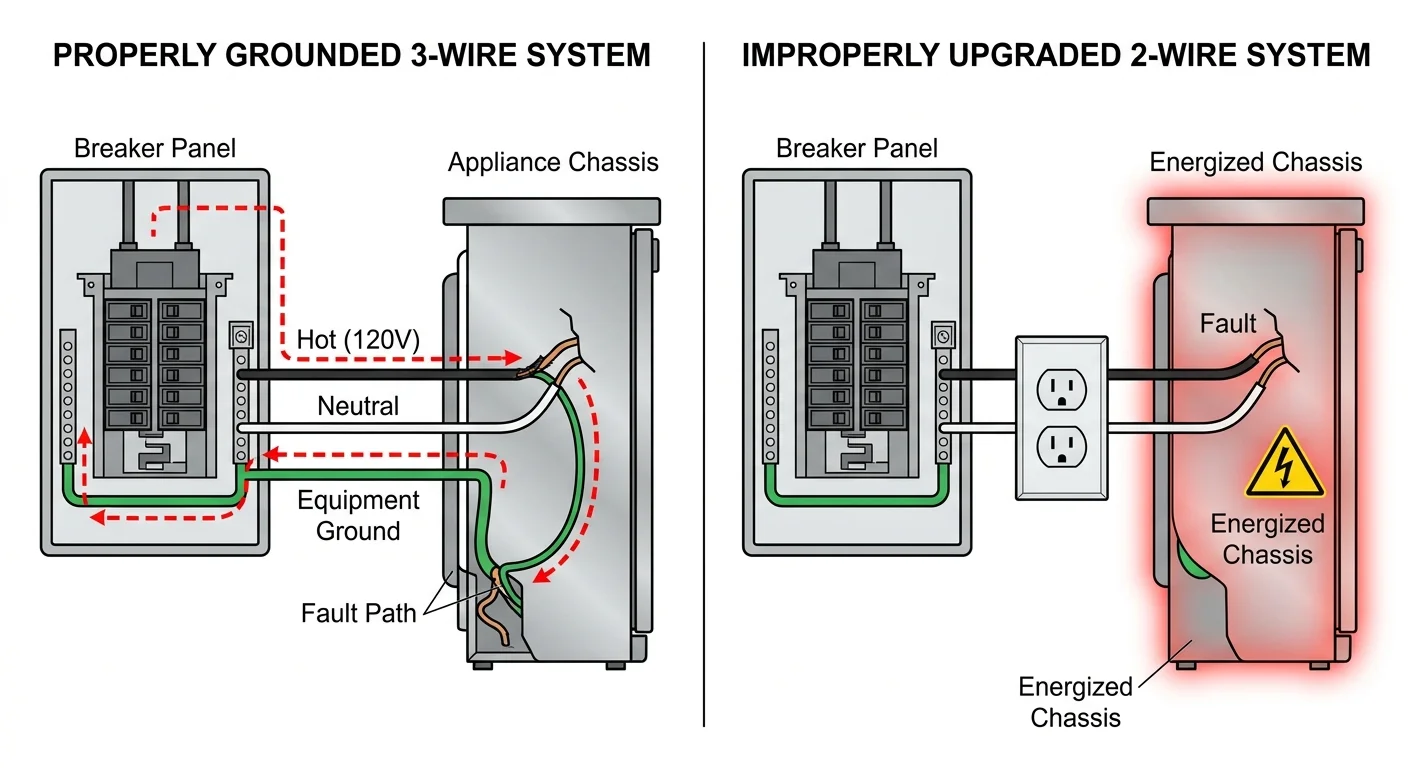
The fundamental prerequisite for determining how to ground outlets in an old house is mastering the topological physics of electrical fault currents. Grounding is not merely a path to earth; it is the engineering establishment of a low-impedance, zero-sequence equipotential plane designed to clear faults instantaneously. Legacy two-wire systems fail inherently at this task, lacking the requisite conductive geometry to safely manage unintended current deviations.
Under normal operating conditions, the branch circuit forms a closed, highly predictable loop. However, when insulation degradation or mechanical failure causes the ungrounded (hot) conductor to energize a metallic chassis, a ground fault occurs. The ability of the Overcurrent Protection Device (OCPD) to clear this fault relies entirely on the earth fault loop impedance ($Z_s$).
The prospective fault current ($I_f$) is dictated by Ohm’s Law for alternating current:
$$I_f = \frac{U_0}{Z_s}$$
Where $U_0$ is the nominal phase-to-earth voltage (typically 120V in residential US systems) and $Z_s$ is the total impedance of the fault loop. For a standard 15A or 20A thermal-magnetic circuit breaker to trip in its instantaneous magnetic region (typically within 0.016 seconds, or one AC cycle), $I_f$ must be roughly 5 to 10 times the rated continuous current. A dedicated Equipment Grounding Conductor (EGC) ensures $Z_s$ remains in the milliohm range, guaranteeing a massive current spike that violently opens the breaker contacts.
When technicians blindly swap two-prong receptacles for three-prong NEMA 5-15R devices without addressing the infrastructure, they create an "isolated" or "floating" ground. This is a severe life-safety hazard. If a fault energizes the connected equipment chassis, $Z_s$ approaches infinity, preventing the breaker from tripping. The chassis silently sits at 120V potential.
If a human touches this chassis while physically grounded, they act as a parallel resistor. Assuming a worst-case human body impedance ($R_b$) of $1,000 \, \Omega$ (dry skin limits per IEC 60479-1), the fault current passing through the body ($I_b$) is:
$$I_b = \frac{120\text{V}}{1,000 \, \Omega} = 120 \, \text{mA}$$
According to IEC 60479-1 AC-4.1, any current exceeding $30 \, \text{mA}$ crossing the human heart carries a high probability of inducing lethal ventricular fibrillation. The isolated ground weaponizes the metallic chassis, waiting for a human body to close the circuit.
Beyond human safety, the absence of an EGC functionally neutralizes downstream surge protection devices (SPDs). Solid-state LED drivers, smart hubs, and automated switches rely on Metal Oxide Varistors (MOVs) to shunt high-voltage transients (governed by IEEE C62.41 standards).
During a transient overvoltage event, the MOV transitions from a high-impedance state to a low-impedance state to clamp the spike. The energy dissipated ($W$) by the varistor is:
$$W = \int_{0}^{t_c} V_c(t) I_s(t) dt$$
Where $V_c(t)$ is the clamping voltage and $I_s(t)$ is the surge current over time $t_c$. Without a physical grounding conductor, the MOV cannot shunt $I_s(t)$ to the earth. The energy instead passes through the internal power supply, catastrophically rupturing the dielectric barriers of the connected microelectronics.
When evaluating how to retrofit these environments, engineers must weigh physical rewiring against compliant exceptions.
| Remediation Strategy | Impedance to Ground ($Z_s$) | Surge Protection (MOV) Capability | Life Safety (Shock Mitigation) | Material/Labor Cost | System Lifespan |
|---|---|---|---|---|---|
| New 12/2 NM-B Rewire (True Copper EGC) | $< 0.1 \, \Omega$ | Excellent. Full shunt capacity per IEEE C62.41. | High. Magnetic OCPD trip clears faults instantly. | Very High (requires wall incursions). | 50+ Years |
| Type AC Cable Armor (Existing) | $0.5 \, \Omega - 2.0 \, \Omega$ (Condition dependent) | Adequate. Dependent on mechanical connector tightness. | Moderate/High. Clears faults if bonding strip is intact. | Low (testing labor only). | Variable (rust/oxidation degrades $Z_s$) |
| GFCI Retrofit (No EGC) | $\infty$ (Isolated) | None. MOVs cannot dump transient energy. | High. Differential trip $< 6 \, \text{mA}$ prevents fibrillation. | Low (device swap only). | 10-15 Years (GFCI circuitry degradation) |
| Bootleg Ground (Code Violation) | N/A (Current returns on neutral) | False Positive. Energizes neutral bus under load. | Lethal. Broken neutrals will energize all appliance chassis. | N/A | Immediate Hazard |
Field Experience & Installer Feedback:
"One of the most dangerous and recurring pitfalls we encounter during diagnostic assessments in pre-1960s builds is the 'bootleg ground.' Unlicensed installers will jumper the neutral terminal to the ground screw on the receptacle to trick standard 3-light plug testers into showing 'Correct Wiring.' This satisfies home inspectors but is a catastrophic NEC 250.24(A)(5) violation. If the neutral ever opens upstream, the entire return current of the circuit instantly flows onto the metallic chassis of every plugged-in appliance. When evaluating how to ground outlets in an old house, engineers must meticulously trace and verify true continuity using specialized loop impedance testers (like the Megger LTW315 or Fluke 1664 FC), completely ignoring the deceptive readings of basic $15 neon shunt testers." — Lead Remediation Engineer, Mid-Century Electrification Retrofits

The physical execution of retrofitting mid-twentieth-century residential electrical infrastructure demands strict adherence to NEC 250 and NEC 406. Before addressing how to replace a two prong plug, a technician must perform a definitive metallurgical triage of the existing metallic cable armor to determine if an effective ground-fault current path ($Z_{fault}$) is natively present.
NEC 250.4(A)(5) and IEC 60364-4-41 mandate that a fault path must possess sufficiently low impedance to facilitate the instantaneous operation of the overcurrent protective device (OCPD). The legacy cable feeding the metallic flush-type box governs this capability.
| Cable Classification | Armor Construction & Ground Mechanism | Typical Fault Impedance ($Z_{fault}$) | Regulatory Status (NEC/UL) | Field Experience & Installer Feedback |
|---|---|---|---|---|
| Type BX (Legacy) | Spiral steel tape; No internal bonding strip. | High ($>1.5 \Omega$) | Non-Compliant for EGC. | Highly Dangerous. Installers note the armor acts as a high-resistance heating element during dead shorts, frequently failing to trip magnetic breaker solenoids before igniting structural fires. |
| Type AC (Armored) | Spiral steel/aluminum; 16 AWG Aluminum Bonding Strip in continuous contact with armor. | Low ($<0.5 \Omega$) | Compliant (Safe). | Excellent retrofit path. Installers emphasize that the aluminum strip must be back-wrapped against the armor at the connector bushing—never terminated to a grounding screw, as it will snap. |
| Type MC (Metal-Clad) | Interlocking metallic tape; Dedicated Copper EGC (Insulated or Bare). | Very Low ($<0.2 \Omega$) | Modern Standard. | Industry preferred. Easy termination; copper EGC natively handles the total short-circuit current: $I_{fault} = \frac{V_{line}}{Z_{source} + Z_{fault}}$. |
When a viable ground path is confirmed (e.g., via Type AC cable supplying a metallic box), upgrading to a standard NEMA 5-15R or 5-20R requires meticulous connection mechanics to guarantee long-term continuity. The procedural methodology for how to replace a two prong plug safely is as follows:
Pro-Tip: Always torque terminal screws to the manufacturer’s exact specification (typically 14-16 in-lbs). Under-torquing leads to thermal expansion/contraction failure, while over-torquing on legacy copper guarantees immediate mechanical shearing.
Architectural layouts lacking central overhead lighting frequently utilize split-switched (half-hot) receptacles. Upgrading these junctions introduces severe topological complexities, particularly when encountering a 2 black wires 2 white wires outlet no ground configuration inside a single-gang legacy box.
In this precise ungrounded scenario, the presence of four ungrounded/grounded conductors usually indicates a combined constant-power feed and a localized switch loop:
$120V_{AC}$ to the switched half of the receptacle. The second white wire is either tied into the neutral splice or, in older code cycles, acting as the un-reidentified hot feed up to the switch (a severe code violation today that must be phase-taped black).
To execute this split-switched upgrade using standard grounding-type receptacles:
1. Isolate the Phases: Use a multimeter continuity test to definitively identify which black conductor is the switch leg.
2. Break the Hot Bridge: Using heavy-duty diagonal cutters, snap and remove the metallic breakaway tab connecting the two brass (hot) terminal screws on the new receptacle. This electrically isolates the upper and lower sockets.
3. Maintain the Neutral Bridge: The tab on the silver (neutral) side must remain fully intact. Both the constant hot and the switched hot loads require a shared, unswitched return path to the panel to satisfy Kirchhoff’s Current Law ($\sum I_{in} = \sum I_{out}$).
4. Terminate: Land the constant black feed on the lower brass terminal and the switched black leg on the upper brass terminal. Land the neutral bundle on the silver terminal.
The GFCI Limitation in Split Topologies:
If the metallic box is entirely ungrounded (Type BX or cloth-jacketed Romex), NEC 406.4(D)(2)(c) dictates GFCI protection. However, a GFCI receptacle cannot be physically split. Its internal toroidal current transformer monitors the entire device monolithically. To achieve a split-switched, ungrounded configuration legally, the technician must install a Dual-Function AFCI/GFCI circuit breaker at the main service panel to protect the entire branch circuit upstream. Only then can a standard, tab-broken NEMA 5-15R be installed at the point of use, mandatorily labeled with "GFCI Protected" and "No Equipment Ground".

When evaluating legacy infrastructure, a persistent question from property owners and junior technicians is: can you replace two prong outlets with three when no equipment grounding conductor (EGC) exists? According to the National Electrical Code (NEC) Article 406.4(D)(2), the definitive engineering answer is yes, provided that rigid Ground-Fault Circuit Interrupter (GFCI) protocols are applied to mitigate the severe life-safety hazards of an ungrounded system.
To execute this architectural shift, engineers must understand exactly how to convert 2 prong to 3 prong outlet no ground using one of two compliant topological pathways:
1. Localized GFCI Integration [406.4(D)(2)(b)]: Replacing the legacy receptacle with a GFCI device. The faceplate must be permanently marked "No Equipment Ground".
2. Upstream GFCI Protection [406.4(D)(2)(c)]: Installing a GFCI circuit breaker or a primary GFCI receptacle at the head of the branch circuit, allowing the daisy-chaining of standard three-prong receptacles downstream. Every downstream receptacle must be marked "GFCI Protected" and "No Equipment Ground".
The life-safety mechanism of a GFCI relies entirely on Kirchhoff’s Current Law. The internal toroidal transformer continuously monitors the differential current ($\Delta I$) between the ungrounded and grounded conductors. A trip state is triggered when:
$$ \Delta I = \left| I_{hot} - I_{neutral} \right| \ge 5 \text{ mA} $$
Under UL 943 Class A specifications, the GFCI must clear this fault before human ventricular fibrillation can occur. The maximum allowable trip time ($t_{trip}$) in seconds is governed by the empirical formula relative to the fault current ($I_{fault}$) in milliamperes:
$$ t_{trip} \le \left( \frac{20}{I_{fault}} \right)^{1.43} $$
For a standard $5 \text{ mA}$ fault, the breaker will typically interrupt the circuit in under $25 \text{ ms}$, operating completely independently of a physical ground wire.
Modernizing receptacles often precedes the installation of solid-state LED luminaires. Unlike resistive incandescent filaments, LED drivers rely on electrolytic bulk capacitors. When a circuit is energized, these uncharged capacitors act as momentary short circuits, governed by:
$$ I_{inrush} = C \frac{dV}{dt} $$
While steady-state LED current ($I_{rms}$) might be $0.1 \text{ A}$, transient $I_{inrush}$ can spike to $250 \times I_{rms}$ (up to $25 \text{ A}$ per driver) for $1-2 \text{ ms}$.
Standard thermal-magnetic breakers feature a magnetic trip threshold ($I_{mag}$) typically calibrated at $5\times$ to $10\times$ the continuous rating. For a $15 \text{ A}$ legacy breaker:
$$ I_{mag_{min}} = 15 \text{ A} \times 5 = 75 \text{ A} $$
If four LED floor lamps are energized simultaneously on an upgraded split-switched receptacle, the cumulative $I_{inrush}$ ($\approx 100 \text{ A}$) mathematically exceeds $I_{mag_{min}}$, resulting in instantaneous nuisance tripping.
To properly execute these upgrades, hardware selection is critical. Below is a comparison of industry-standard solutions for mitigating ungrounded circuits.
| Hardware Solution | Specific Model Reference | Capital Cost | Installation Topology | Lifespan / MTBF | Engineering Pros & Cons |
|---|---|---|---|---|---|
| Local GFCI Receptacle | Leviton GFNT1 (15A) | ~$18 - $25 | Point-of-use replacement. | 10–15 Years (varies by surge exposure) | Pros: Simple retrofit; local reset capability. Cons: Bulky form factor crowds legacy 18 cu-in junction boxes. |
| Upstream GFCI Breaker | Square D QO-GFI | ~$55 - $75 | Main panel installation; protects entire branch. | 15–20 Years | Pros: Clears box space; protects all downstream non-grounded 3-prong outlets. Cons: Nuisance trips require a trip to the main panel. |
| Dual-Function AFCI/GFCI | Eaton BRCAF115 | ~$65 - $90 | Main panel; meets modern code for living spaces. | 12–15 Years | Pros: Unmatched safety; detects arcing in brittle legacy wire + ground faults. Cons: Highly sensitive to LED driver RF noise. |
PRO TIP: When utilizing the Upstream GFCI method via a receptacle, ensure the downstream standard three-prong receptacles are wired explicitly to the LOAD terminals of the primary GFCI. Splicing into the LINE side bypasses the toroidal sensor, leaving downstream outlets wholly unprotected—a lethal code violation.
Data aggregated from senior electrical contractors highlights recurring complexities when integrating modern controls into ungrounded legacy systems.

The theoretical frameworks of NEC 404.2(C) and 406.4(D)(2) frequently clash with the physical realities of mid-twentieth-century residential infrastructure. Master electricians and field technicians consistently report that retrofitting modern solid-state lighting and automation into legacy two-wire systems is not merely a compliance exercise, but a highly volatile integration challenge. The friction centers primarily around the systemic intolerance of smart electronics to high-impedance return paths and the widespread misinterpretation of diagnostic data by both apprentices and third-party home inspectors.
Field operations reveal significant technological limitations when integrating "no-neutral" smart switches—such as specific models within the Lutron Caséta or GE Enbrighten ecosystems—into legacy two-wire switch loops. To maintain microprocessor functions and wireless radio connectivity (Zigbee/Wi-Fi), these switches must draw a continuous standby current, typically $I_{standby} \approx 0.5 \text{ to } 2.5 \text{ mA}$.
When a neutral is unavailable, earlier iterations of these devices were designed to dump this leakage current onto the equipment grounding conductor. Installer feedback highlights a catastrophic flaw in this approach when applied to legacy structures: if the existing grounding path relies on oxidized Type BX armor, the impedance is often too high to effectively sink the standby current. The resulting voltage drop across the switch's internal power supply leads to "ghosting" (LED fixtures faintly glowing when off), erratic radio connectivity, or continuous reboot cycles. As enforced by NEC 404.2(C), the mandate to provide a dedicated neutral at switch locations effectively neutralizes this hazard, but field crews note that pulling a new 14/3 Southwire Romex® cable to satisfy this requirement frequently escalates a simple switch swap into a multi-thousand-dollar structural rewire.
Perhaps the most pervasive operational headache reported by electrical contractors involves post-installation validation on ungrounded GFCI upgrades. The standard three-light plug tester (e.g., Klein RT210 or Ideal 61-501) is structurally incapable of correctly diagnosing a legally executed NEC 406.4(D)(2)(b) upgrade.
A standard plug tester relies on internal neon lamps or LEDs bridging the Hot-Neutral and Hot-Ground pins. In a GFCI-upgraded ungrounded receptacle, the ground pin is intentionally isolated. Consequently, the tester will reliably illuminate only the Hot-Neutral indicator, displaying an "Open Ground" configuration. To a layperson or an under-equipped home inspector, this falsely signals a failed or dangerous installation.
Furthermore, the external "Test" button on these devices utilizes a shunt resistor to simulate a fault. According to Ohm's Law ($I = \frac{V}{R}$), a tester equipped with a $15 \text{ k}\Omega$ shunt resistor connected across $120\text{ V}$ attempts to pull an $8 \text{ mA}$ fault current:
$$I_{test} = \frac{120\text{ V}}{15,000 \Omega} = 0.008\text{ A} \ (8\text{ mA})$$
Because the ground pin is isolated, the return path resistance approaches infinity ($R \to \infty$), resulting in zero fault current flowing through the shunt. The external tester will fail to trip the GFCI, leading to erroneous defect reports. Validation must strictly be performed using the GFCI’s internal mechanical test button, which internally bypasses the toroidal sensor.
Professional verification of ungrounded or ambiguously grounded circuits requires metrology that exceeds the capabilities of basic continuity testers. Compliance with standards such as IEC 60364-6 (Verification of Electrical Installations) demands precise impedance measurements.
| Diagnostic Tool Class | Representative Model | Measurement Mechanism & Physics | Field Efficacy on Legacy Systems | Capital Cost |
|---|---|---|---|---|
| Standard Plug Tester | Klein RT210 | Voltage presence via neon lamps bridging Hot/Neutral/Ground. | Poor. Yields false "Open Ground" on legal GFCI upgrades; fails to trip ungrounded GFCIs. | ~$15 |
| TRMS Digital Multimeter | Fluke 117 | High-impedance voltage measurement ($>10 \text{ M}\Omega$). | Moderate. Excellent for verifying line voltage ($V_{RMS}$), but high impedance can read "phantom" voltages on floating BX armor, falsely indicating a valid ground. | ~$200 |
| Advanced Circuit Analyzer | Ideal SureTest 61-164 | Injects high transient currents to measure voltage drop and calculate line impedance. | High. Identifies high-resistance splices and accurately measures true GFCI trip time (ms) and trip current (mA) where grounds exist. | ~$400 |
| Ground Loop Impedance Tester | Megger LTW315 | Actively measures actual loop impedance ($Z_s$) without tripping upstream RCDs/GFCIs. | Ultimate. The only definitive way to prove legacy Type AC armor can safely clear a dead-short fault under IEC 61557 standards. | ~$1,200 |
Synthesized field reports from master electricians highlight several critical, often undocumented realities when upgrading legacy lighting circuits:
Pro-Tip from the Field: When diagnosing legacy metallic boxes with a Fluke multimeter, never trust a simple $120\text{V}$ reading between Hot and the box chassis. A heavily corroded BX connector acts as a high-resistance semiconductor. It will pass enough voltage to register on a $10 \text{ M}\Omega$ meter but will instantly choke under a $15\text{A}$ fault load, turning the wall cavity into a thermal hazard. Always validate the fault path with a low-impedance tester or dedicated ground loop analyzer.
When navigating NEC 406.4(D)(2) compliance for legacy ungrounded infrastructure, engineers and project managers face a stark bifurcation in capital allocation. The decision between executing a localized, device-level GFCI retrofit and a comprehensive structural branch circuit rewire is not merely a calculation of immediate labor and material costs. It requires a probabilistic Return on Investment (ROI) analysis that accounts for the hidden, unmitigated risks to high-value solid-state infrastructure.
From a strict Capital Expenditure (CapEx) perspective, utilizing the GFCI exception is aggressively cost-optimized. High-grade, self-testing GFCI receptacles (such as the Leviton SmartlockPro or Hubbell Autoguard series) retail between $15 and $30 per device. When leveraging an upstream protection topology—installing a single GFCI at the home run to protect downstream standard receptacles—the hardware costs for an entire room rarely exceed $50.
Assuming professional labor rates of $90–$150 per hour, a skilled technician utilizing modern splicing hardware like Wago 221 Lever-Nuts can retrofit an entire branch circuit in under two hours. Total micro-economic impact: $200 to $350 per circuit.
Conversely, pulling modern 12/2 or 14/2 NM-B (Romex) or MC Cable to establish a true Equipment Grounding Conductor (EGC) introduces profound macro-economic costs. Structural rewiring demands localized demolition, navigating historic fire blocks, and bypassing lath-and-plaster. The electrical labor is frequently dwarfed by collateral trades: drywall patching, mudding, and painting. Depending on topological complexity, rewiring costs average $3,000 to $10,000+ per zone.
The financial viability of the localized GFCI upgrade collapses when analyzing the Expected Value of Loss (EVL) of connected equipment. As established, GFCI devices provide life safety but zero surge protection. Metal Oxide Varistors (MOVs) inside standard surge protectors and premium LED drivers absolutely require a physical earth pathway to shunt destructive transient overvoltages.
Without an EGC, a single grid switching event or localized lightning strike can bypass inert surge strips, instantaneously destroying high-value connected loads. A modern residential workstation, localized server rack, and a unified smart lighting ecosystem (e.g., Lutron RadioRA 3 processors, Philips Hue bridges, and phase-adaptive dimmer modules) can easily represent $10,000 to $25,000 of vulnerable silicon.
To quantify this mathematically, we calculate the financial viability of a full rewire using a probabilistic EVL model over a 10-year operational lifecycle:
$$ EVL_{ungrounded} = \sum_{t=1}^{10} \left[ P(Surge_t) \times V(Equipment_t) \right] $$
Where $P(Surge)$ is the historical probability of a transient voltage event exceeding the dielectric breakdown threshold of the equipment, and $V(Equipment)$ is the replacement value of the unprotected silicon. The ROI of a structural rewire can therefore be expressed as:
$$ ROI_{rewire} = \frac{(CapEx_{GFCI} + EVL_{ungrounded}) - CapEx_{rewire}}{CapEx_{rewire}} \times 100\% $$
If the connected load includes sensitive microprocessors or high-end LED arrays, the $EVL_{ungrounded}$ dramatically overshadows the initial CapEx savings of a GFCI retrofit, making structural rewiring the only fiscally defensible engineering choice.
| Parameter | Localized GFCI Upgrades (NEC 406.4(D)(2)) | Full Structural Rewire (NM-B / MC Cable) |
|---|---|---|
| Initial CapEx / Circuit | $200 – $400 (Labor + Materials) | $3,000 – $10,000+ (Includes collateral trades) |
| Life-Safety Compliance | Yes (Achieves NEC shock protection mandates) | Yes (Inherent low-impedance fault clearing) |
| Equipment Surge Protection | Zero. MOVs are rendered completely inert. | Optimal. Unrestricted shunting to earth ground. |
| Smart Switch Compatibility | Severely limited (Relies on NEC 404.2(C) exceptions) | Infinite (Dedicated neutrals and true grounds provided) |
| Structural Impact | Minimal (Confined to device junction boxes) | Severe (Wall channel destruction, plaster remediation) |
| 10-Year ROI Profile | Negative if protecting high-value silicon | Highly Positive via avoided equipment attrition |
Pro-Tip from the Field:
"When proposing solutions to clients, do not frame the ungrounded GFCI upgrade as 'making the outlet safe for electronics.' It is legally critical to explicitly state that this method only prevents human electrocution. If a client intends to plug a $4,000 OLED television or an expensive Ketra lighting array into a 'No Equipment Ground' circuit, you must formally disclaim liability for transient voltage damage in the contract."
Electrical contractors routinely highlight a severe expectation gap regarding ungrounded GFCI upgrades. Field feedback indicates that callbacks are disproportionately high on circuits upgraded via NEC 406.4(D)(2).
Q: From a strict regulatory and engineering standpoint, exactly how to replace 2 prong outlet with 3 prong safely when no equipment grounding conductor (EGC) is present?
Executing this upgrade legally requires exploiting the Ground-Fault Circuit Interrupter (GFCI) exception codified in NEC 406.4(D)(2)(b) & (c), or international equivalents such as IEC 60364-4-41 (Protection against electric shock). Because a GFCI monitors the differential current via a toroidal transformer rather than relying on an EGC to clear faults, it can safely interrupt a ground fault even on a two-wire system.
The governing mathematical principle for the GFCI's internal logic is the continuous monitoring of Kirchhoff's Current Law, tripping when the residual operating current ($I_{\Delta}$) exceeds the life-safety threshold:
$$I_{\Delta} = \left| I_{\text{Line}} - I_{\text{Neutral}} \right| \ge 4\text{ to }6\text{ mA}$$
To perform the retrofit, isolate the primary ungrounded "hot" and grounded "neutral" conductors. Terminate these strictly to the LINE terminals of a commercial-grade GFCI, such as the Leviton SmartlockPro or Hubbell Autoguard. If standard three-prong NEMA 5-15R receptacles are to be daisy-chained downstream, they must be fed exclusively from the GFCI’s LOAD terminals. Crucially, an artificial ground wire must never be run between the downstream devices. All resulting three-prong interfaces must be permanently marked with "No Equipment Ground" (and "GFCI Protected" for downstream nodes).
Q: Can the equipment ground wire be completely omitted without consequence if GFCI protection is provided?
It can be safely omitted for human life safety, but it is catastrophically detrimental to equipment survival. Modern solid-state lighting drivers and computing equipment rely heavily on Metal Oxide Varistors (MOVs) for transient voltage surge suppression (TVSS). An MOV shunts excess transient energy to the earth via the EGC. The energy dissipation capability ($E$) of a surge protector in Joules is dictated by the capacitive elements and clamping voltage, but inherently relies on a low-impedance ground path:
$$E = \frac{1}{2} C V_{c}^2$$
Without an EGC, the MOV cannot function. The surge energy is instead forced through the connected appliance’s delicate microprocessors, frequently resulting in dielectric breakdown. Upgrading to a three-prong GFCI provides no protection against these transients.
Q: What are the primary equipment topologies for executing these upgrades, and how do they compare in the field?
When engineering a retrofit strategy, technicians typically select between localized GFCI receptacles, upstream GFCI breakers, or dual-function AFCI/GFCI devices.
| Retrofit Topology | Typical Component Model | Est. Material Cost / Unit | Lifespan (MTBF) | Surge (MOV) Support? | NEC Code Compliance |
|---|---|---|---|---|---|
| Localized GFCI Receptacle | Legrand Pass & Seymour GFCI | \$18 - \$25 | 10–12 Years | No (Isolated) | 406.4(D)(2)(b) |
| Upstream GFCI Breaker | Square D QO 15A GFCI Breaker | \$50 - \$65 | 15–20 Years | No (Isolated) | 406.4(D)(2)(c) |
| Dual AFCI/GFCI Receptacle | Leviton Dual Function AFTR1-W | \$35 - \$45 | 10–15 Years | No (Isolated) | 406.4(D)(2)(b) + 210.12 |
Installer Feedback & Field Experience:
"When evaluating how to replace 2 prong outlet with 3 prong in mid-century homes (1940s-1960s), the legacy copper is often highly oxidized and brittle. Field technicians overwhelmingly advise against utilizing standard side-wire screw terminals directly on old wire. Instead, best practice involves splicing the legacy solid wire to a stranded copper pigtail using Wago 221 Lever-Nuts, which provide a gas-tight, constant-pressure connection. Furthermore, installing localized GFCI receptacles in shallow 12-cubic-inch metal legacy boxes frequently leads to internal shorting against the metal enclosure. We highly recommend utilizing upstream Square D or Eaton GFCI circuit breakers at the panel; this allows the use of shallower, standard NEMA 5-15R receptacles in the wall boxes, significantly reducing mechanical stress on brittle conductors."
Q: What are the legal constraints and liability implications of a DIY conversion versus professional integration?
A pervasive, illegal DIY practice is the "bootleg ground"—installing a three-prong receptacle and looping a jumper wire between the neutral terminal and the grounding screw. This explicitly violates NEC 250.24(A)(5). It turns the metallic chassis of any connected appliance into a current-carrying conductor. If the upstream neutral connection loosens or fails, the chassis assumes full line voltage ($120\text{V}$), creating an immediate, unmitigated shock hazard.
Professionally executed upgrades rely on verified testing. Standard three-light plug testers are useless on GFCI-exempted circuits because they require an active EGC to shunt their internal $5\text{ mA}$ test load. Professional integrators validate these installations using precision impedance meters like the Fluke 1664 FC Multifunction Installation Tester to confirm trip time and verify that no stray voltage exists on metallic enclosures, thereby mitigating liability and ensuring compliance with local municipal permitting authorities.
