
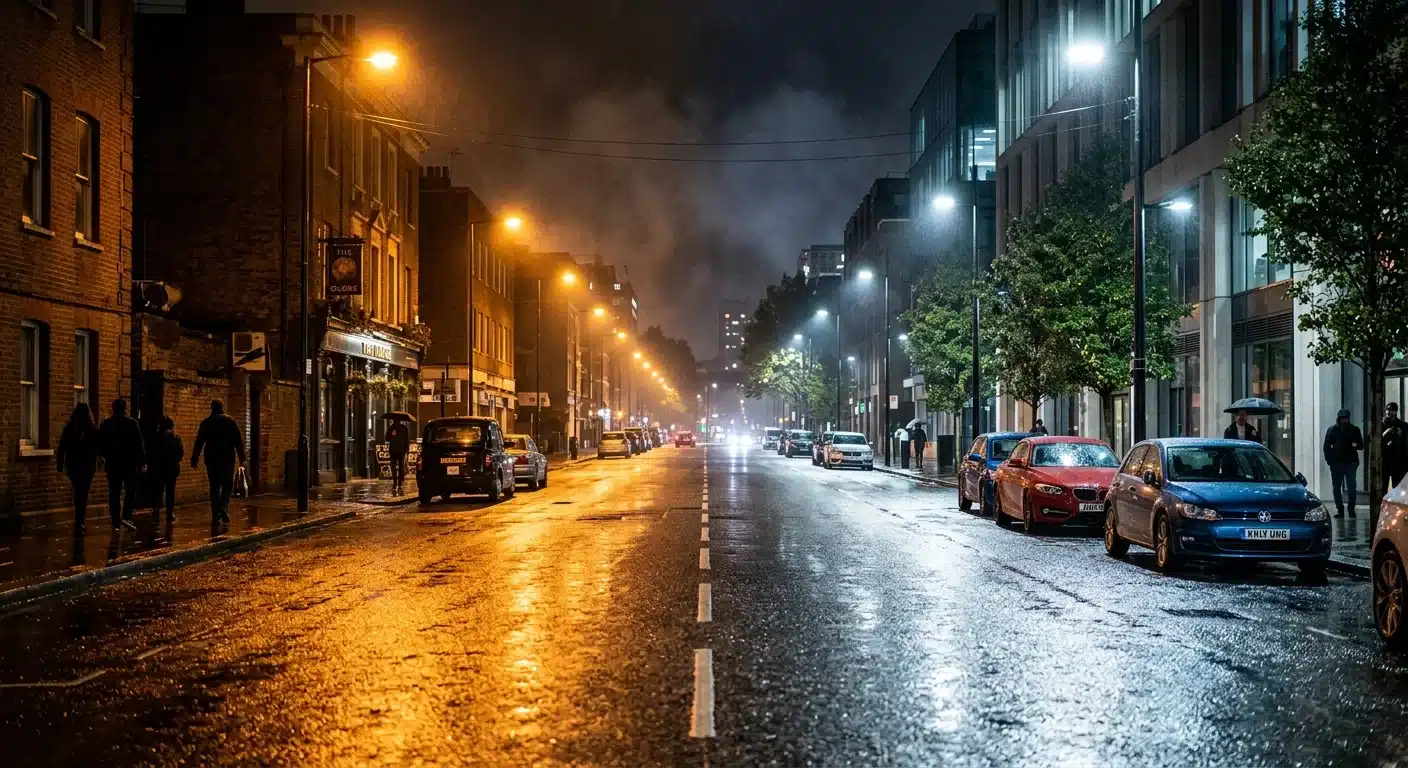
Street lighting constitutes a foundational element of municipal infrastructure, serving as a critical determinant of urban mobility, public safety, and municipal operating budgets. Historically, high-intensity discharge (HID) lamps, specifically the high-pressure sodium street light (HPS), dictated the global landscape of roadway illumination. The fundamental physics of sodium lighting rely on the electrical excitation of a sodium-mercury amalgam within an aluminum oxide arc tube. While this technology established the baseline for 20th-century roadway networks—characterized by its nostalgic, monochromatic amber emission peaking at $\lambda \approx 589 \text{ nm}$—it is thermodynamically crippled by extreme thermal waste, omnidirectional optical scattering, and an abysmal Color Rendering Index ($CRI \approx 20-30$).
The advent of solid-state optoelectronics has catalyzed a non-negotiable paradigm shift. Driven by stringent global climate mandates—such as the massive municipal decarbonization targets set by the European Bank for Reconstruction and Development (EBRD) Green Cities program—civil engineers are systematically abandoning arc-discharge tubes in favor of Light-Emitting Diodes (LEDs). This transition from legacy HPS to LED is not merely a component swap; it is a fundamental architectural overhaul of the municipal grid from high-voltage reactive AC loads to highly regulated, low-voltage DC solid-state systems.
To understand the engineering delta between these paradigms, a comparative analysis of their baseline operational mechanics is essential.
| Engineering Parameter | Legacy High-Pressure Sodium (HPS) | Modern Solid-State LED |
|---|---|---|
| Luminous Generation | Gaseous Arc Discharge (Plasma) | Semiconductor Electroluminescence |
| System Efficacy ($\eta = \frac{\Phi}{P}$) | 80 – 110 lm/W (Bare lamp, pre-optical loss) | 140 – 200+ lm/W (Absolute luminaire output) |
| Power Factor ($\cos \phi$) | $\approx 0.85$ (High reactive power penalty) | $\ge 0.95$ (Grid-stabilized) |
| Optical Distribution | Omnidirectional ($360^\circ$); requires bulky reflectors | Highly directional point source; TIR secondary optics |
| Color Rendering (CRI) | 20 – 40 (Severe visual distortion) | 70 – 90+ (High acuity, mesopic enhancement) |
| Start-up / Restrike Time | 5 – 10 minutes (Thermal warm-up required) | Instantaneous ($< 10 \text{ ms}$) |
Modern municipal retrofits must comply with a matrix of international standards that legacy fixtures frequently fail to meet. Modern LED deployments are designed to strictly satisfy ANSI/IES RP-8-21 (Recommended Practice for Design and Maintenance of Roadway and Parking Facility Lighting) and IEC 60598-2-3 (Particular requirements for luminaires for road and street lighting).
Unlike HPS fixtures, which degrade in lumen output by up to 30% within 15,000 hours (necessitating aggressive maintenance schedules), top-tier LED arrays from manufacturers like Cree Lighting or Schréder achieve L70/B10 > 100,000 hours. This means that after 100,000 hours of operation, 90% of the luminaires will still retain at least 70% of their initial luminous flux, fundamentally redefining municipal OPEX calculations.
Pro-Tip: EPA and Wind Load Engineering
When replacing aerodynamically sloped HPS "cobra head" fixtures (e.g., legacy GE M-400) with modern, flat-panel LED luminaires, structural engineers must recalculate the Effective Projected Area (EPA). Flat LED panels can drastically alter the wind shear coefficients ($C_d$) on existing light poles. Failing to verify that the existing pole's wind load capacity meets the new fixture's EPA—especially in coastal zones prone to cyclonic winds—can result in catastrophic pole fatigue and sheer failure at the baseplate.
Data aggregated from municipal electrical contractors executing large-scale retrofits highlights several critical field realities.
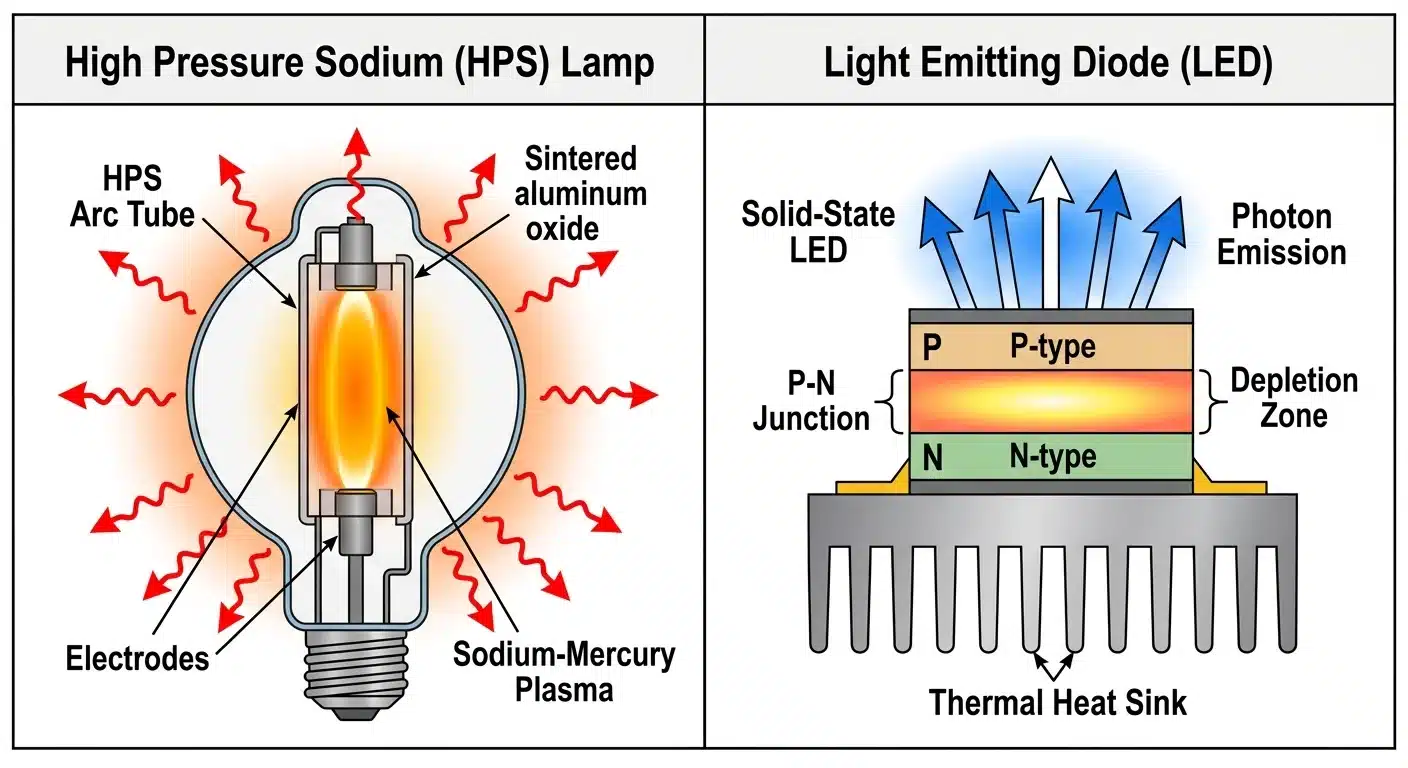
The fundamental engineering divergence in the led vs high pressure sodium debate is rooted in the distinct quantum mechanical and thermodynamic processes each utilizes to generate photons. Understanding these mechanics is critical for lighting engineers tasked with optimizing municipal grid loads, specifying thermal management protocols, and adhering to international photometric standards such as IEC 60598-2-3 (Luminaires for road and street lighting).
At the core of a traditional sodium vapor street light lies a highly pressurized arc tube, typically constructed from sintered aluminum oxide ($Al_2O_3$) to withstand the extreme chemical reactivity of hot sodium plasma. The arc tube contains an amalgam of elemental sodium and mercury, doped with a Penning mixture (usually xenon or an argon-neon blend) to facilitate initial ignition.
The photon generation process relies on intense electrical excitation:
1. Ignition: A magnetic ballast and electronic igniter deliver a high-voltage pulse (typically 2.5 kV to 4.5 kV) to ionize the starter gas.
2. Plasma Formation: As the starter gas ionizes, the internal temperature rapidly escalates, vaporizing the mercury and subsequently the sodium into a high-pressure plasma state.
3. Photon Emission: Free electrons accelerate through the plasma, colliding inelastically with vaporized sodium atoms. This excites valence electrons to higher energy orbitals. Upon returning to their ground state, these electrons emit photons, dominated by the characteristic sodium D-lines at 589.0 nm and 589.6 nm.
This mechanism is inherently constrained by extreme thermodynamic inefficiency. To maintain the requisite vapor pressure, the arc tube must operate at temperatures exceeding 1,000°C. Consequently, 60% to 70% of the consumed electrical energy is dissipated entirely as wasted infrared (IR) radiation and conductive heat. The luminaire housing must be engineered to withstand this immense thermal load, necessitating heavy borosilicate glass lenses and bulky aluminum chassis that degrade optical efficiency.
Modern Light-Emitting Diodes bypass the volatile plasma phase entirely, relying instead on solid-state electroluminescence. The illumination engine of a modern street light is a semiconductor diode, typically fabricated from Indium Gallium Nitride (InGaN) epitaxially grown on a sapphire or silicon carbide substrate.
When a tightly regulated direct current (DC) is applied, electrons from the n-type semiconductor and electron-holes from the p-type semiconductor are forced into the active depletion region (the quantum well). As electrons and holes recombine, they transition across the energy bandgap ($E_g$). The energy differential is released directly as a photon. The wavelength ($\lambda$) of the emitted photon is determined precisely by the bandgap energy, expressed mathematically by the Planck-Einstein relation:
$$ \lambda = \frac{hc}{E_g} $$
(Where $h$ is Planck's constant, $c$ is the speed of light, and $E_g$ is the semiconductor bandgap in electron-volts).
To achieve broad-spectrum white light suitable for roadway visibility (complying with standards like GOST R 54350-2015 or IES RP-8-18), the core blue emission of the InGaN diode (~450 nm) strikes a yttrium aluminum garnet (YAG) phosphor coating, inducing a secondary broadband yellow emission via Stokes shift. This direct energy conversion allows modern LEDs to bypass the thermal constraints of gas-discharge, converting over 95% of electron flow directly into visible light, with minimal forward-radiated heat.
| Parameter | High-Pressure Sodium (HPS) | Light-Emitting Diode (LED) |
|---|---|---|
| Photon Generation Method | Gas-arc discharge (plasma ionization) | Solid-state electroluminescence |
| Typical Luminous Efficacy | 80 – 120 lm/W | 150 – 210 lm/W |
| Thermodynamic Loss | 60% – 70% (Omnidirectional IR heat) | < 5% (Conducted via heat sinks, zero IR) |
| System Power Factor ($\cos \phi$) | ~0.85 (High reactive power penalty) | >0.95 (Highly efficient active PFC) |
| Ignition / Restrike Time | 5 – 10 minutes warm-up / restrike | Instantaneous (Sub-millisecond) |
| Governing Standards | IEC 60662 | IEC 62717, IES LM-80 |
| Optical Distribution | Omnidirectional (Requires 360° reflectors) | Unidirectional (TIR optical lenses) |
Pro-Tip for Municipal Retrofits: When transitioning infrastructure, electrical engineers must account for the shift in failure modes. An HPS system fails thermally and mechanically (arc tube blackening, ballast capacitor failure), while an LED system fails electronically (driver component degradation from grid transients).
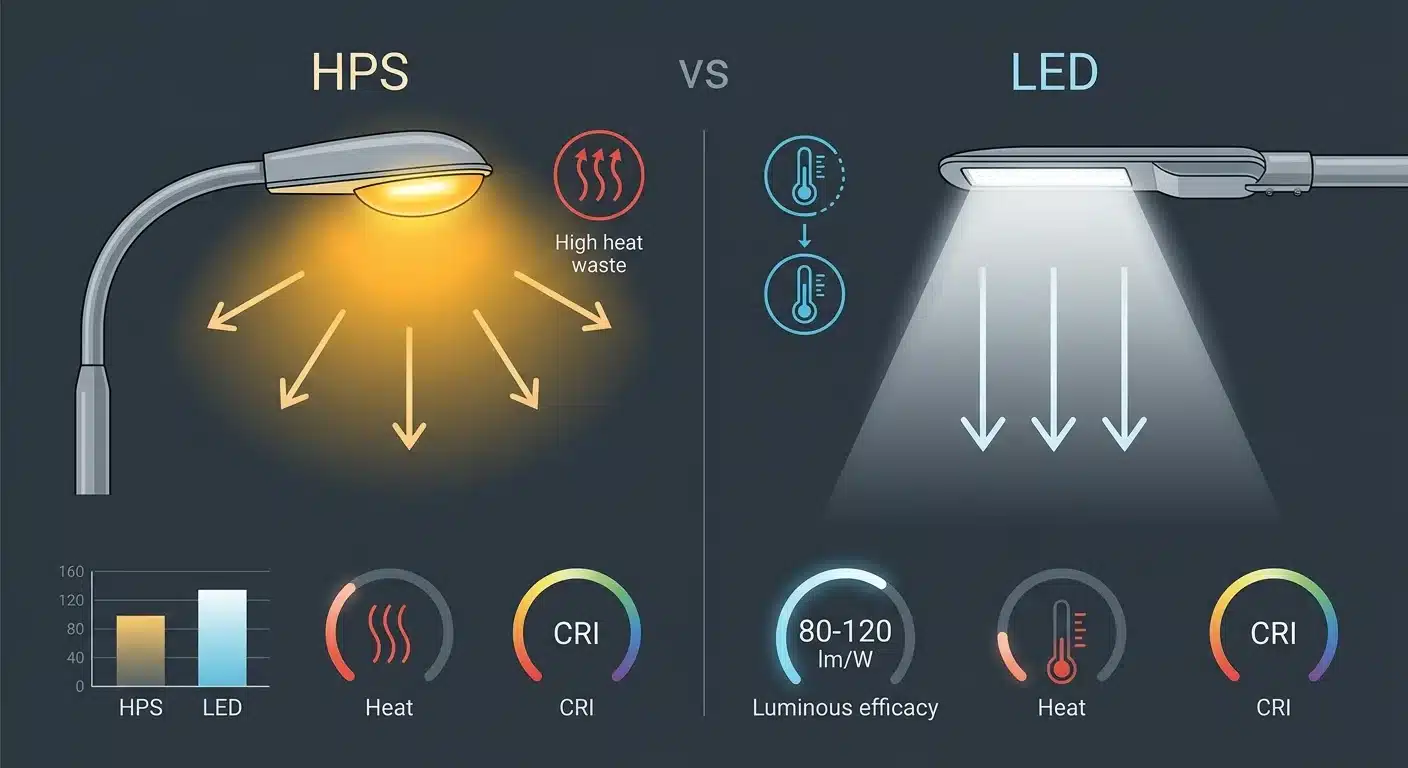
The fundamental divergence in the operational physics of high pressure sodium lights vs led street lighting systems dictates profoundly different approaches to municipal grid integration, photometric planning, and thermal management. Transitioning from gaseous arc discharge to solid-state electroluminescence requires a rigorous evaluation of both luminaire optical performance and the underlying electrical architecture governing grid interactions.
The superiority of LED optoelectronics over legacy HPS systems lies in the transition from omnidirectional, narrowband radiators to directional, broadband point sources. The thermodynamic limitations of the sodium vapor arc discharge result in massive thermal dissipation, restricting HPS luminous efficacy to 80–120 lm/W. Furthermore, HPS emits a highly constrained Spectral Power Distribution (SPD) concentrated in the 560–610 nm range (yellow/amber). This yields an abysmal Color Rendering Index (CRI) of 20–40, actively impairing object recognition.
Conversely, solid-state LED arrays boast absolute luminous efficacies exceeding 150–200 lm/W. By utilizing specific phosphor coatings over blue pump diodes, LEDs deliver broadband white light with CRIs exceeding 70. This broad spectrum is critical for mesopic vision—the combination of photopic (cone-based) and scotopic (rod-based) vision dominant in low-light environments.
| Performance Metric | High-Pressure Sodium (HPS) | Light-Emitting Diode (LED) | Engineering Impact |
|---|---|---|---|
| Light Generation | Arc discharge in metallic vapor | Solid-state semiconductor | Eliminates fragile glass tubes and volatile gases. |
| Thermodynamic Efficiency | 80 – 120 lm/W (~65% wasted as heat) | 150 – 200 lm/W (<5% thermal waste) | Massive reduction in localized baseline power demand. |
| Spectral Profile (SPD) | Narrowband Amber (560–610 nm) | Broadband White (Custom CCT, 3000K recommended) | Drastic improvement in contrast and cognitive visual recognition. |
| Color Rendering Index | 20 – 40 (Severely distorted) | 70+ (High fidelity) | Essential for security cameras and pedestrian safety. |
| Mesopic Vision Performance | Inferior (Low scotopic stimulation) | Superior (High scotopic stimulation) | Allows for lower overall lumen outputs while achieving higher perceived brightness. |
Evaluating high pressure sodium lights vs led energy consumption requires analyzing the complete circuit load, not merely the nominal wattage of the light source.
Traditional HPS fixtures rely on magnetic ballasts and high-voltage igniters to sustain the plasma arc. These components introduce significant parasitic power losses. For example, a nominal 400W HPS lamp typically draws between 430W and 460W from the grid. Furthermore, standard magnetic ballasts operate with a poor power factor (PF $\approx 0.85$). This introduces high reactive power ($Q$) into the grid network, calculated as $Q = \sqrt{S^2 - P^2}$ (where $S$ is apparent power and $P$ is active power). Under regulations such as ПУЭ (Rules for Electrical Installation) or GOST 32144-2013, excessive reactive power necessitates the installation of costly compensation capacitors at substations to prevent grid instability and transformer overheating.
Modern LED luminaires utilize solid-state Switch-Mode Power Supplies (SMPS), commonly referred to as drivers. High-tier drivers—such as those manufactured by Mean Well or Inventronics—incorporate active Power Factor Correction (PFC), achieving a PF $\ge 0.95$ and maintaining Total Harmonic Distortion (THD) below 10%, strictly complying with IEC 61000-3-2 standards for harmonic current emissions.
When analyzing sodium lights vs led on a circuit level, a 400W HPS drawing 450W at a 0.85 PF presents an apparent power load of $S = 450 / 0.85 = 529 \text{ VA}$. Its functional equivalent, a 150W LED drawing 155W at a 0.98 PF, presents an apparent power load of just $S = 155 / 0.98 = 158 \text{ VA}$. This massive 70% reduction in apparent load allows engineers to vastly increase the number of fixtures on a single municipal circuit breaker while simultaneously extending the lifespan of aging underground cables.
While laboratory data heavily favors solid-state lighting, field deployments reveal critical engineering realities that installers must manage.
Pro-Tip for Municipal Procurement: Never specify an LED street light without an independent, sacrificially replaceable Surge Protection Device (SPD). Mandate a minimum 10kV / 10kA rated SPD (complying with IEC 61643-11 Class II or III). Field data confirms that integrating a dedicated SPD reduces driver failure rates in high-storm regions from 12% annually to less than 0.5%, protecting the ROI model of the entire retrofit project.
The transition of municipal lighting infrastructure necessitates rigorous adherence to international toxicological, photometric, and photobiological standards. Engineers must navigate a complex matrix of regulations—ranging from IEC 62471 (Photobiological Safety) to the EPA’s RCRA and regional guidelines like ПУЭ (Rules for Electrical Installation) and GOST R IEC 60598-1—to ensure deployments do not inadvertently generate new environmental or public health crises.
Evaluating the ecological footprint requires contrasting the volatile neurotoxic hazard of traditional HID sources with the dense metallurgical realities of modern electronics. Legacy HPS lamps depend on elemental mercury ($Hg$) to sustain their internal arc. If ruptured, they release mercury vapor, creating an acute occupational hazard where localized concentrations can easily exceed the OSHA Permissible Exposure Limit (PEL) of $100\ \mu g/m^3$.
Conversely, modern solid-state fixtures completely eliminate mercury, but they introduce a significant e-waste burden. High-power street LEDs utilize dense printed circuit boards (PCBs) and gallium-arsenide (GaAs) or indium-gallium-nitride (InGaN) semiconductors. When subjected to the Toxicity Characteristic Leaching Procedure (TCLP), pulverized LED matrices frequently leach heavy metals into simulated groundwater at rates exceeding hazardous thresholds:
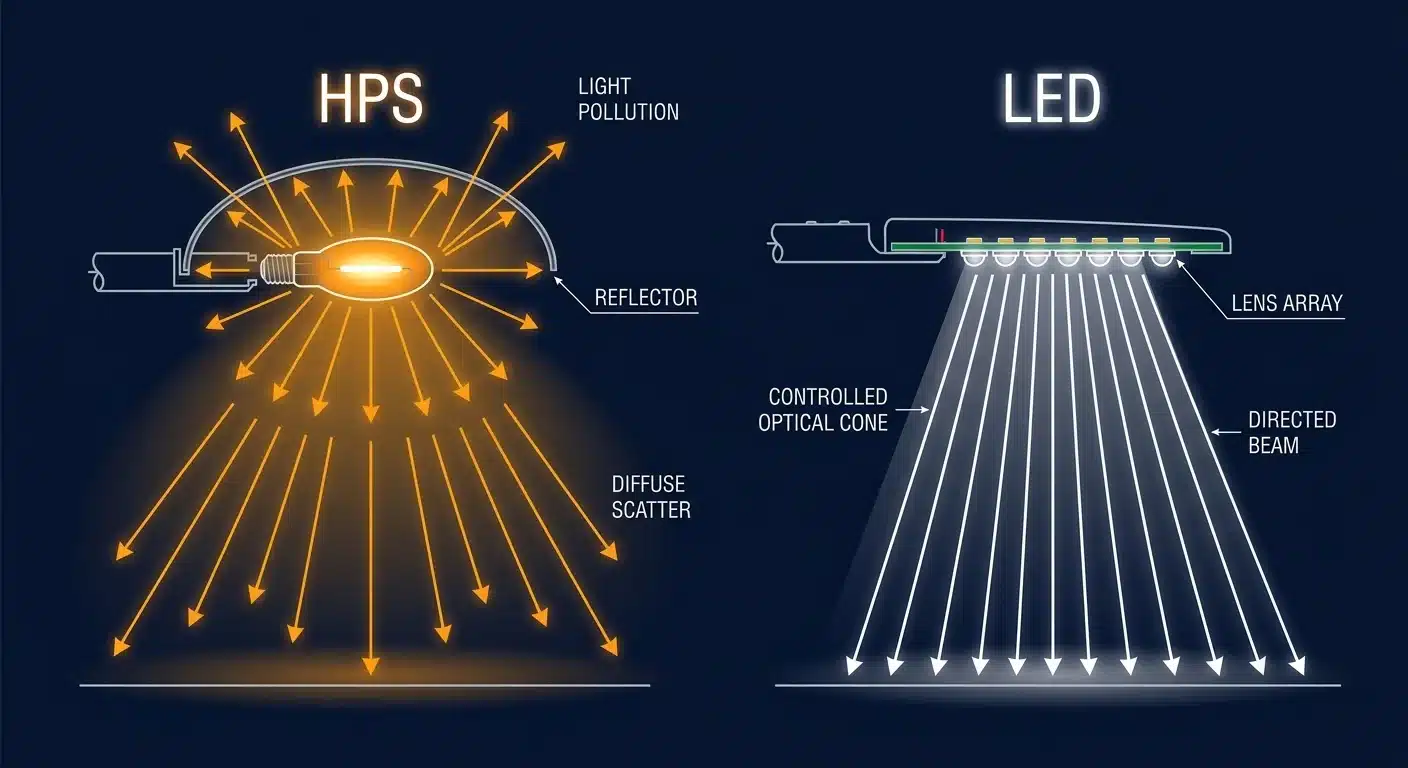
To achieve International Dark-Sky Association (IDA) compliance, engineers must strictly control luminaire uplight. The difference in photometric geometry between a sodium lamp vs led fixture is stark. An HPS arc tube is an omnidirectional, $4\pi$ steradian emitter. To direct light downward, it requires internal parabolic reflectors which suffer from trap losses and inevitably allow light to escape above the 90° horizontal plane (uplight).
LEDs, however, are inherent Lambertian point sources. By utilizing micro-molded secondary optics (such as PMMA or polycarbonate lenses), engineers can achieve an absolute zero-uplight (U0) rating under the IESNA TM-15-11 BUG (Backlight, Uplight, Glare) classification system.
When evaluating the atmospheric light pollution of sodium lamps vs led arrays, the impact of uplight elimination is easily modeled. Assuming an atmospheric Rayleigh scattering coefficient where intensity $I$ is inversely proportional to the fourth power of the wavelength ($\lambda$):
$$ I \propto \frac{1}{\lambda^4} $$
While the shorter wavelengths of LEDs scatter more easily, mathematically eliminating the upward flux fraction ($\Phi_{up} = 0$) completely negates this scattering path for distant observers. Calculations show that retrofitting a standard HPS cobra-head ($\Phi_{up} \approx 5\%$) to a full-cutoff LED ($\Phi_{up} = 0\%$) reduces a municipality’s contribution to distant skyglow by over 95%, overpowering the wavelength penalty.
The Spectral Power Distribution (SPD) of the light source directly intersects with human endocrinology. The human eye’s intrinsically photosensitive retinal ganglion cells (ipRGCs) are heavily stimulated by short-wavelength light, peaking at approximately $480\ nm$. Standard 4000K or 5000K LEDs emit a massive spike at precisely $\sim 460-465\ nm$, triggering melanopsin activation and severely suppressing nocturnal melatonin secretion.
To prevent circadian disruption, the American Medical Association (AMA) mandates the use of LEDs with a Correlated Color Temperature (CCT) of 3000K or warmer. Modern LED manufacturers (such as Cree Lighting and Philips Lumileds) utilize advanced YAG:Ce phosphor coatings to absorb this blue peak and re-emit it as longer-wavelength (warmer) light. The thermodynamic penalty for specifying a 3000K fixture over a 4000K fixture has dropped to a mere $3\%$ to $5\%$ efficacy loss—a negligible energy cost for a profound biological safeguard.
| Engineering Metric | High-Pressure Sodium (HPS) | Modern LED (3000K, Full Cutoff) |
|---|---|---|
| Primary Toxin Risk | Volatile Mercury ($Hg$) vapor | Solid-state heavy metals ($Pb, As, Cu$) |
| Disposal Protocol | Specialized hazmat vapor containment | TCLP-tested e-waste / PCB recycling |
| Optical Geometry | Omnidirectional ($4\pi$ steradians) | Lambertian / Highly Directional |
| IESNA Uplight Rating | Typically U2 to U3 (Significant Skyglow) | U0 (Absolute zero upward flux) |
| Biological Impact | Minimal (Narrowband yellow/amber) | High risk at $\ge 4000K$; Safe at $\le 3000K$ |
Installer Feedback & Field Experience:
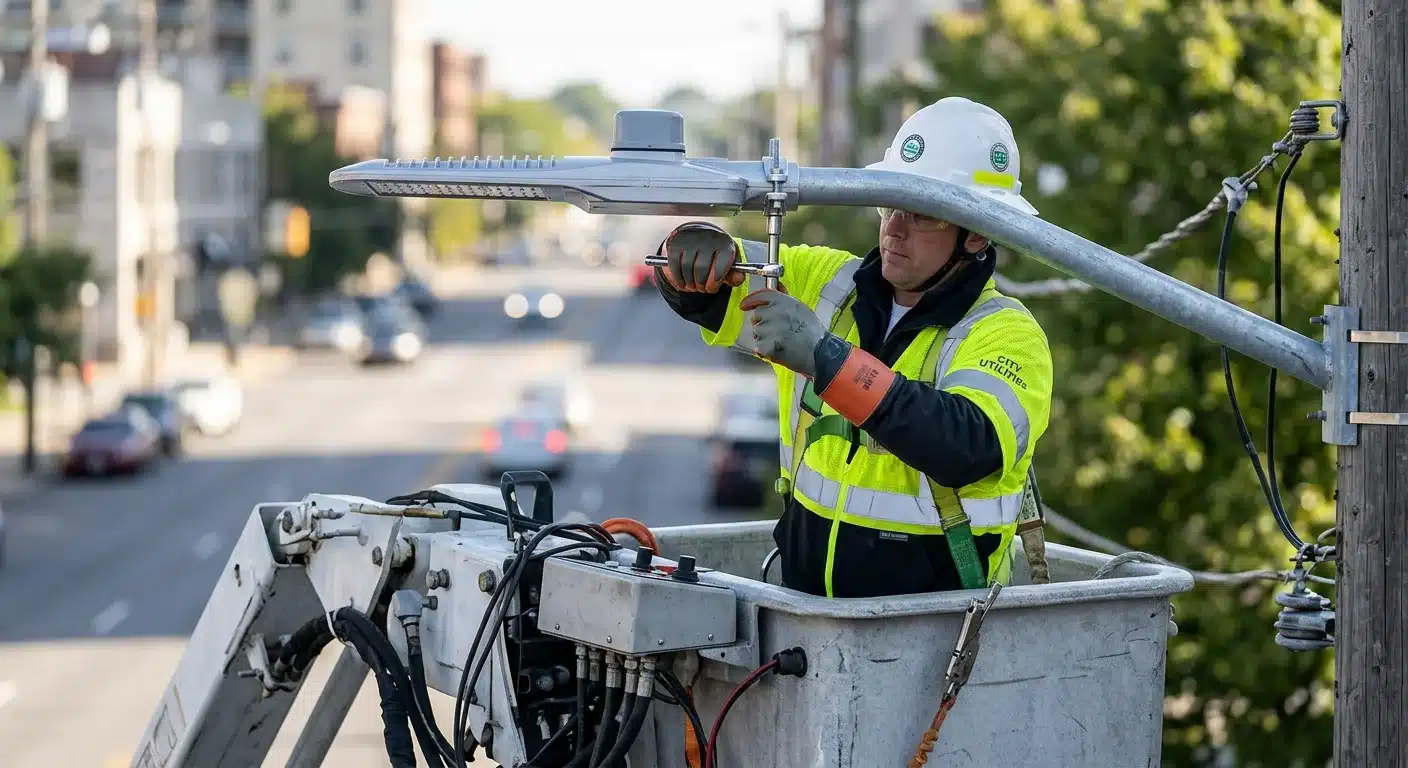
The operational reality of transitioning municipal lighting networks extends far beyond photometric laboratory data; it is fundamentally validated by the line crews and electrical engineers executing the retrofits. Field data and direct installer feedback regarding the shift from legacy sodium street lights to solid-state lighting reveal massive shifts in mechanical handling, maintenance procedures, and severe weather resilience.
When evaluating high pressure sodium vs led fixtures on the mast arm, municipal installers frequently highlight the drastic reduction in structural stress. Traditional HPS luminaires incorporate massive core-and-coil magnetic ballasts and oversized reflectors to manage omnidirectional arc discharge. This results in top-heavy fixtures that require substantial brute force during bucket-truck installations.
Modern LED chassis are fundamentally planar. By dissipating heat through integrated, aerodynamic aluminum or polymeric fins, LED fixtures maintain a significantly lower profile. Field crews report that this sleeker form factor directly reduces the Effective Projected Area (EPA). The aerodynamic drag force exerted on a lighting pole is calculated as:
$$F_w = \frac{1}{2} \rho v^2 C_d A$$
Where $A$ is the EPA. By reducing $A$ and optimizing the drag coefficient ($C_d$), LED retrofits drastically lower the wind load transmission to the pole base, reducing metal fatigue in high-wind corridors. Installers note that this lower windage often allows municipalities to reuse existing legacy poles that would otherwise fail modern structural compliance audits.
The maintenance cadence for legacy HPS systems is historically grueling. When a sodium lamp fails to ignite, crews must troubleshoot a complex, multi-point failure matrix: the high-voltage igniter, the magnetic ballast, the capacitor, or the arc tube itself.
Conversely, LED architectures consolidate power conversion into a single, highly regulated Direct Current (DC) driver. Installer reviews overwhelmingly favor the modularity of modern LED systems. Leading manufacturers integrate Zhaga or NEMA 7-pin sockets and tool-less quick-disconnect latches. If a driver fails due to transient voltage spikes, a technician can physically unclip and swap the driver module in under three minutes, without stripping wires or violating the ПУЭ (Rules for Electrical Installation) protocols for active roadway work. Furthermore, smart LED drivers equipped with DALI-2 (Digital Addressable Lighting Interface) allow control rooms to remotely query the health of the driver, shifting municipal operations from reactive truck-rolls to proactive, targeted maintenance.
Deploying electronics in highly saline, humid environments—such as the massive upgrades in the coastal city of Batumi, Georgia—presents catastrophic failure risks for standard metal-halide and HPS housings. Standard die-cast aluminum oxidizes rapidly under salt spray, and typical IP65 seals degrade, allowing moisture ingress.
In such extreme climates, engineering adaptation mandates the abandonment of standard metals in favor of advanced marine-grade materials. To prevent complete system degradation, high-end coastal LED deployments utilize S7 technical reinforced polymer and T5 transparent thermo-polymer chassis. These materials are totally immune to galvanic and atmospheric corrosion.
Crucially, installer feedback from coastal deployments underscores the life-saving nature of IP66+ total hermetic sealing combined with Class II+ anti-electrocution architecture. In flood-prone regions where coastal surges routinely submerge pole bases, standard conductive metal poles carrying 220V/240V AC to legacy ballasts present a lethal shock hazard to pedestrians. Utilizing polymeric structures that meet stringent IEC 60598-1 and GOST R 54350-2015 standards provides a massive dielectric barrier (surpassing 22,000V dielectric strength), effectively neutralizing electrocution risks even amidst severe coastal inundation.
| Engineering Parameter | Legacy High-Pressure Sodium (HPS) | Marine-Grade Polymeric LED | Field Impact & Installer Feedback |
|---|---|---|---|
| Power Conditioning | Magnetic Ballast + HV Igniter | Solid-State DC Driver (DALI-2) | LED allows 3-minute tool-less swaps; HPS requires complex multi-point rewiring. |
| Ingress Protection | Typically IP54 to IP65 | IP66+ (Total Enclosure) | LED prevents driver shorting in coastal squalls; HPS accumulates internal condensation. |
| Structural Material | Die-cast Aluminum (Standard Paint) | S7 Reinforced Polymer | Polymeric LED immune to salt-spray pitting; HPS requires continuous rust scraping/painting. |
| Electrical Safety | Class I (Requires strict earth grounding) | Class II+ (Dielectric > 22kV) | Class II+ eliminates pedestrian electrocution risks in severe Batumi-style coastal flooding. |
| Impact Resistance | IK08 (Glass bulb shattering risk) | IK10+ (>50 Joules) | LED withstands flying storm debris; eliminates hazardous mercury/glass cleanup for crews. |
Pro-Tip for Municipal Engineers: When drafting tender specifications for coastal retrofits, do not accept standard "corrosion-resistant paint" claims. Explicitly mandate ISO 12944 C5-M (Marine) certification for any metallic brackets, and require Class II+ electrical isolation for the entire luminaire housing to immunize the municipality against liability from flood-induced electrocution events.

Evaluating the fiscal impact of municipal street lighting requires moving beyond raw procurement costs and adopting a rigorous Lifecycle Cost Analysis (LCCA). When analyzing hps vs led street lights, the financial paradigm shifts from a model dominated by continuous operational and maintenance expenditures (OPEX) to one focused on initial capital expenditure (CAPEX) optimized for long-term yield.
The fundamental LCCA equation for a municipal lighting network over a designated lifecycle ($N$) evaluates the initial capital cost ($C_{ic}$) against the discounted sum of annual energy ($E_t$) and maintenance ($M_t$) costs, where $r$ is the discount rate:
$$ LCCA = C_{ic} + \sum_{t=1}^{N} \frac{E_t + M_t}{(1+r)^t} $$
The overwhelming ROI of LED retrofits is primarily driven by a 50% to 80% reduction in active electrical draw. A legacy 400W High-Pressure Sodium (HPS) fixture, factoring in ballast draw, consumes approximately 430W to 460W. To meet equivalent photometric parameters under standards like IEC 60598-2-3 or IES RP-8-18, an engineered LED luminaire requires only 130W to 160W.
Furthermore, standard HPS arc tubes exhibit catastrophic lumen depreciation, necessitating replacement every 15,000 to 24,000 hours (roughly 3 to 5 years). In contrast, modern LED arrays certified under LM-80/TM-21 protocols boast $L_{70}$ or $L_{80}$ lifespans exceeding 100,000 hours (up to 15 years of standard nocturnal operation). This eliminates an estimated four to five cyclical maintenance interventions per pole.
Based on a 15-year lifecycle ($N=15$), standard 4,000 annual operating hours, $0.12/kWh electricity rate, and a standardized $150 truck-roll cost per maintenance intervention.
| Financial / Technical Metric | 400W High-Pressure Sodium (HPS) | 150W Solid-State LED | Lifecycle Variance |
|---|---|---|---|
| System Power Draw | 440 Watts (incl. magnetic ballast) | 150 Watts (Solid-state driver) | -66% Energy Reduction |
| Estimated CAPEX (per luminaire) | $80 – $120 | $250 – $400 | +$220 Initial Capital |
| Annual Energy Consumption | 1,760 kWh | 600 kWh | 1,160 kWh Saved / yr |
| Annual Energy Cost | $211.20 | $72.00 | $139.20 Saved / yr | |
| Rated Lifespan | 24,000 Hours (Maximum) | >100,000 Hours ($L_{70}B_{10}$) | +76,000 Hours |
| 15-Year Maintenance Events | ~4-5 (Bulb/Igniter/Ballast swaps) | 0 (Excluding driver anomalies) | -$600 to -$750 Labor |
| Total 15-Year OPEX (Energy + Maint) | ~$3,918.00 | ~$1,080.00 | -$2,838.00 per pole |
When applied across a medium-sized municipality with 10,000 streetlights, the systemic OPEX savings quickly exceed $1.5 million annually. Consequently, real-world data from municipalities demonstrates a remarkably rapid aggregate ROI of exactly 3 to 5 years.
Installer Feedback & Field Experience:
Despite the rapid payback period, the upfront CAPEX of replacing tens of thousands of luminaires remains a prohibitive barrier for many municipalities. To bypass municipal bond issuance, cities increasingly utilize Contract Energy Management (EMC) agreements structured through specialized Energy Service Companies (ESCOs).
Under the EMC framework, the ESCO assumes 100% of the CAPEX required for the hardware and installation, executing the upgrade with zero upfront capital from the municipality. The ESCO is compensated by capturing a negotiated percentage (typically 70-80%) of the verified monthly energy savings over a contracted term (usually 7 to 10 years).
By leveraging EMC financing combined with the extreme thermodynamic efficiency of modern solid-state lighting, electrical planners can systematically overhaul deteriorating urban infrastructure while simultaneously generating localized budgetary surplus.
Q1: Why do some newly installed LEDs appear to cause more glare than legacy sodium lights, and how is this mitigated?
The perception of increased glare from LED retrofits stems from three interconnected engineering factors: luminance geometry, Spectral Power Distribution (SPD), and improper optical specification at legacy mounting heights.
Traditional High-Pressure Sodium (HPS) lamps emit light omnidirectionally from a large, diffused arc tube. Conversely, LEDs are highly directional, intense point sources. If bare SMD (Surface-Mounted Device) or COB (Chip-on-Board) arrays lack adequate secondary polymeric lensing, the intense surface luminance directly strikes the observer's retina, causing severe discomfort and disability glare.
Furthermore, first-generation LED deployments heavily favored "cool white" Correlated Color Temperatures (CCT) of 4000K to 5000K to maximize luminous efficacy. These SPDs feature a massive emission spike in the short-wavelength blue spectrum ($\approx 460-480$ nm). Because the human scotopic visual system is hyper-sensitive to blue light, Rayleigh scattering within the ocular media drastically amplifies perceived glare.
Engineering Mitigation: To resolve this, modern specifications must mandate a CCT of $\le 3000K$ and employ advanced secondary optics (e.g., injection-molded acrylic or polycarbonate lenses) that map the light precisely to standard IESNA distributions (Type II, III, or IV). Furthermore, engineers must rigorously evaluate the BUG (Backlight, Uplight, Glare) rating as per IESNA TM-15. If retrofitting on legacy poles with low mounting heights ($h < 6$ meters), wide-beam optics must be aggressively shielded. The illuminance ($E$) on the roadway follows the inverse-square law $E = \frac{I}{d^2} \cos \theta$; placing high-intensity directional point sources too low on unshielded fixtures drastically increases the angle of incidence ($\theta$) towards approaching drivers.
Q2: Can LED street lights be dynamically dimmed or automated for "Smart City" integration?
Absolutely. Unlike gaseous discharge lamps, which suffer severe lifespan degradation from cycling and require massive restrike times, solid-state LEDs feature instant-on and seamless dimming capabilities.
Integration relies on equipping the luminaire with a modern solid-state driver (e.g., Mean Well ELG/HLG series or Inventronics) that accepts a 0-10V analog or DALI-2 (Digital Addressable Lighting Interface, standardized under IEC 62386) digital control signal. The luminaire chassis is typically fitted with either a top-mounted NEMA 7-pin receptacle (ANSI C136.41) or a bottom-mounted Zhaga Book 18 socket. These standardized nodes allow municipalities to "plug and play" IoT sensors, including microwave motion detectors, photocells, and RF mesh networking nodes.
Pro-Tip: Utilizing an automated dimming profile based on traffic density can yield an exponential reduction in OPEX. If a 100W luminaire is dimmed to 50% capacity during off-peak hours (12:00 AM – 4:00 AM), the relationship between driver current and diode efficacy actually improves due to reduced thermal droop, often resulting in $>50\%$ energy savings during that window while extending the $L_{70}$ lumen maintenance life of the diode array.
Q3: Are legacy fixtures (HPS/MH) entirely obsolete?
For municipal and highway roadway illumination, HPS and Metal Halide (MH) are practically obsolete due to massive thermodynamic inefficiencies ($60\%+$ energy lost as heat), extremely poor Color Rendering Indexes (CRI $<40$), and high recurring maintenance labor costs. The presence of neurotoxic elemental mercury also complicates end-of-life disposal under modern environmental frameworks.
However, in hyper-niche industrial environments characterized by extreme ambient temperatures (e.g., steel foundries, specific heavy industrial perimeters exceeding $70^\circ C$), legacy magnetic-ballast HID systems may still be deployed. Solid-state LED drivers rely on electrolytic capacitors, which degrade exponentially under extreme heat ($L_{life} \propto 2^{- \frac{\Delta T}{10}}$). Unless utilizing exceptionally expensive, actively cooled, or remotely-driven LED architecture, heavy industrial engineers occasionally rely on legacy discharge lamps simply because they possess fewer heat-sensitive electronic failure points.
| Technical Parameter | High-Pressure Sodium (HPS) | Smart LED (DALI-2 / Zhaga Node) |
|---|---|---|
| Driver / Ballast Type | Magnetic/Electronic Ballast | Solid-State DC Driver |
| Luminous Efficacy | 80 – 120 lm/W | 150 – 200 lm/W |
| Power Factor (PF) | $\approx 0.85$ (High Reactive Power) | $> 0.95$ (Grid Stabilizing) |
| Start / Restrike Time | 5-10 minutes / 15 minutes | Instantaneous ($<0.1$ seconds) |
| Dimming Capability | Practically Non-Existent | $10\%$ to $100\%$ (Seamless via DALI) |
| Optical Control (Uplight) | High Scatter (Requires reflectors) | Precise Cutoff ($0\%$ Uplight achievable) |
| Typical Lifespan ($L_{70}$) | 15,000 – 24,000 Hours | $> 100,000$ Hours |
