
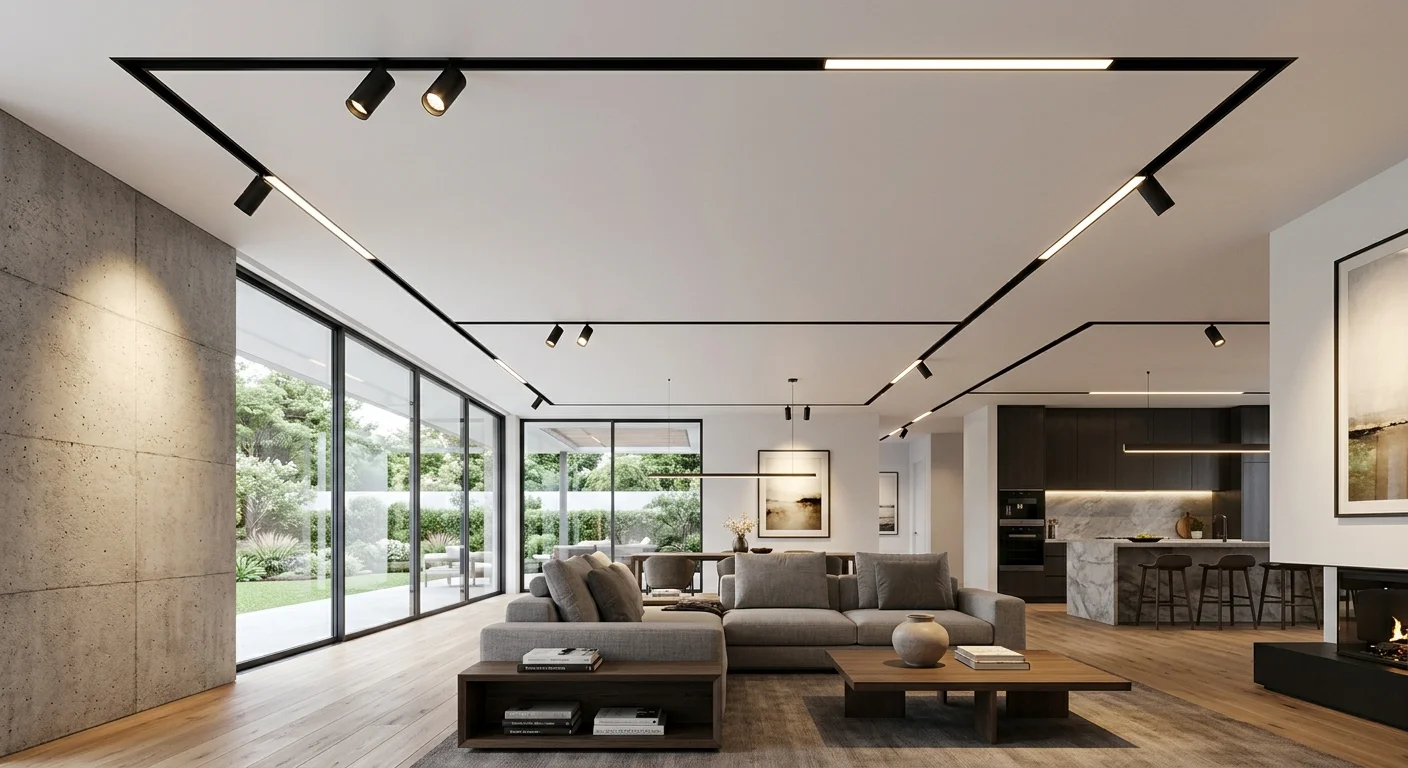
The evolution of residential interior architecture has precipitated a fundamental paradigm shift in photometric engineering. For decades, the standard approach to illuminating a residential living room relied heavily on static, centralized overhead fixtures, supplemented by inflexible grids of recessed downlights. However, as modern structural design leans increasingly toward adaptive, open-plan layouts with multi-functional living zones, these traditional static lighting models have proven technically and aesthetically inadequate. Central to resolving this complex architectural challenge is the deployment of adaptive, electrified track infrastructures.
Once relegated strictly to commercial art galleries, retail boutiques, and utilitarian industrial environments, track systems have undergone a profound engineering and design renaissance. Today, luxury track lighting has emerged as a premier, highly sophisticated solution for high-end residential environments. This transition is primarily driven by the system's unparalleled spatial flexibility, scalability, and ability to support human-centric lighting protocols aligned with the WELL Building Standard v2, which prioritizes precise visual comfort, high Color Rendering Index (CRI > 90), and stringent glare reduction.
The transition toward open-concept architecture creates a highly complex photometric calculation scenario. Lighting designers must adequately illuminate a vast, multi-functional footprint that simultaneously serves as a relaxation lounge, high-definition entertainment center, and remote workspace. Traditional lighting often results in a flat, uniform wash of light that lacks visual hierarchy, characterized by an uncontrolled distribution of luminous flux.
To establish proper zoning without physical partitions, engineers must calculate the total luminous flux required for the space and distribute it dynamically. The fundamental calculation for required room lumens is typically expressed as:
$$ \Phi_{total} = \frac{E_{target} \times A}{UF \times MF} $$
Where:
By integrating ambient, task, and accent lighting onto a single structural pathway, modern track systems allow for the precise, localized control of luminous flux, beam angles, and spatial focal points, efficiently optimizing the $UF$ without over-illuminating adjacent zones.
To understand the shift from static lighting to advanced track systems, we must analyze the electrical and physical parameters of the infrastructure. The following table contrasts standard recessed grids against modern line-voltage and cutting-edge 48V magnetic track ecosystems (compliant with IEC 60598-1 safety standards for luminaires).
| Specification / Parameter | Static Recessed Downlight Grid | Line-Voltage Track (H/J/L Standard) | 48V DC Magnetic Track Ecosystem |
|---|---|---|---|
| Power Delivery | 120V AC / 230V AC Direct | 120V AC / 230V AC Direct | 48V DC via Remote or Integrated Driver |
| Architectural Modularity | None (Fixed installation) | High (Mechanical clip insertion) | Extreme (Tool-free magnetic insertion) |
| Typical Lifespan (L70) | 35,000 - 50,000 Hours | 50,000 Hours | 50,000+ Hours (Superior thermal management) |
| Installation Cost (Est.) | Moderate ($50-$100 per node) | Low-Moderate ($30-$80 per linear foot) | Premium ($100-$250+ per linear foot) |
| Control Capabilities | Single Zone Phase-Dimming | Dual-Circuit Switching (e.g., J2 Standard) | Individual Addressability (DALI, Zigbee) |
| Structural Impact | High (Requires deep plenum space) | Minimal (Surface mounted) | Variable (Flangeless recessed requires blocking) |
Treating light as a fluid architectural material rather than a fixed utility allows engineers and designers to execute complex track lighting ideas on a unified circuit. This capability is paramount in luxury residential design, where a single track layout might simultaneously support wide-angle linear diffusers for ambient room washing and extremely narrow-beam (15°) framing projectors for accentuating fine art.
Pro-Tip for System Specification: When specifying a system for spaces with high or vaulted ceilings, strictly avoid proprietary systems with limited optical accessories. Specify ecosystems from gallery-grade manufacturers like ERCO or high-end residential innovators like WAC Lighting, which offer field-swappable asymmetric lenses and snoots to rigorously control glare angles from elevated mounting points.
While the theoretical advantages of track lighting are well-documented, real-world execution reveals critical nuances. Feedback from master electricians and lighting integrators consistently highlights the following field realities:
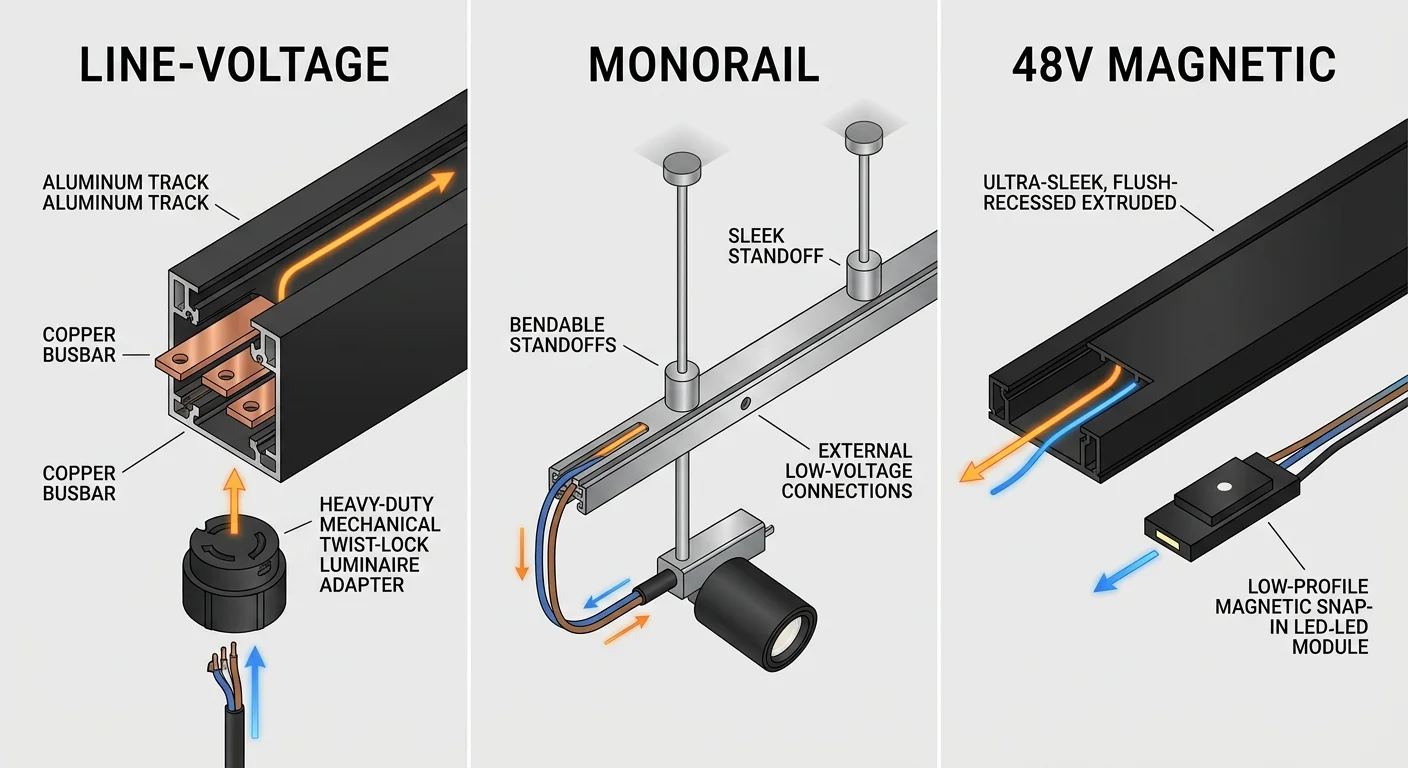
The specification of a residential track lighting infrastructure strictly dictates the electrical capabilities, optical performance, and future scalability of a space. Modern architectural lighting relies on three primary typologies, each governed by distinct electrical standards (such as NEC Article 410 for standard luminaires and Article 411 for low-voltage systems, alongside IEC 60598 global standards). Understanding the electromechanical differences between line-voltage configurations, flexible monorails, and 48V direct-current (DC) magnetic ecosystems is critical, particularly for professionals and homeowners evaluating viable track lighting replacement ideas during comprehensive renovations.
Operating directly on building mains (120V in North America, 230V in IEC-regulated regions), line-voltage tracks eliminate the need for remote step-down transformers. However, the market is aggressively fragmented into three proprietary standards, defined by the cross-sectional geometry of their internal copper busbars:
Pro-Tip: Never attempt to force a J-Type fixture into an H-Type track. While the physical housing dimensions often appear identical, the busbar alignment is distinct. Forcing fixtures compromises the grounding path, creating a severe fire hazard and violating NEC codes.
Monorail infrastructure operates primarily on a Class 2, 12V or 24V isolated circuit. Because the exposed rail acts as the conductor, the system must adhere to strict Safety Extra Low Voltage (SELV) regulations. The primary engineering constraint here is transformer sizing and load calculation. To prevent thermal overload on the magnetic or electronic step-down transformer, the total system load must strictly adhere to the 80% continuous load rule:
$$P_{total} \le 0.80 \times P_{transformer}$$
Where $P_{total}$ is the sum of all LED module wattages ($W$) and $P_{transformer}$ is the rated maximum output of the driver.
The 48V magnetic track system represents a paradigm shift, transitioning from mechanical twist-and-lock connections to neodymium-secured friction fits. Operating on an integrated or remote 48V DC constant-voltage driver, these systems provide completely toolless modularity.
However, DC distribution introduces complex voltage drop parameters across long linear runs. Engineers must calculate the voltage drop ($\Delta V$) to ensure the farthest luminaire does not experience a voltage dip below its operational threshold:
$$\Delta V = \frac{2 \cdot I \cdot \rho \cdot L}{A}$$
Where $I$ is total load current in Amperes, $\rho$ is the resistivity of the copper busbar, $L$ is the track length in meters, and $A$ is the cross-sectional area of the conductor. Exceeding a 5% voltage drop will cause noticeable dimming gradients or color temperature shifting in premium >90 CRI fixtures.
When specifying hardware or pitching track lighting replacement ideas to clients, the following matrix serves as an essential decision-making tool:
| Parameter | Line-Voltage (H/J/L) | Low-Voltage Monorail (12V/24V) | Magnetic System (48V DC) |
|---|---|---|---|
| Voltage Architecture | 120V / 230V AC | 12V / 24V AC/DC | 48V DC Constant Voltage |
| Modularity & Swap Speed | Low (Mechanical locking) | Medium (Threaded standoffs) | High (Tool-free magnetic insertion) |
| Dimming Protocol | TRIAC / ELV (Phase-cut) | ELV / 0-10V (via transformer) | DALI, 0-10V, Casambi, Zigbee |
| Installation Intrusiveness | Minimal (Direct ceiling mount) | Moderate (Requires transformer box) | High for Recessed (Requires drywall routing & remote driver) |
| Historical Precedent | Legacy Halogen $\rightarrow$ Modern LED | Halogen pendants $\rightarrow$ LED | Native LED/Smart Ecosystems |
| Best Application | Budget retrofits, concrete ceilings | Sculptural layouts, vaulted ceilings | High-end minimalist residential, smart home integration |
Field experience consistently highlights critical integration bottlenecks that look flawless on CAD drawings but fail during commissioning:
The transition from conceptual lighting design to physical infrastructure demands rigorous adherence to photometric standards (such as IEC 60598 and EN 12464-1) and precise spatial geometry. Applying track lighting across varied residential spaces requires highly specific, room-by-room architectural methodologies to resolve distinct physiological and functional demands.
Executing advanced living room track lighting ideas relies on establishing visual hierarchy and demarcating functional zones within open-plan spaces without utilizing physical partitions. The engineering standard for this application is the dual-circuit J-Type (Juno Standard) line-voltage track or an advanced 48V direct-current magnetic ecosystem (such as those from WAC Lighting).
By leveraging a two-circuit track architecture, engineers can overlay independent photometric layers on a single physical housing. Circuit A is typically assigned to generalized ambient fill, utilizing wide-beam ($>60^\circ$) linear diffusers or high-output wall washers targeting an average illuminance ($E_m$) of 150–200 lux. Circuit B handles high-contrast focal points—art accentuation and architectural highlights—employing narrow-beam ($15^\circ-25^\circ$) directional spots pushing target surfaces to 500+ lux to achieve the optimal 3:1 contrast ratio.
To determine the requisite luminous flux ($\Phi$) for a zoned living space, apply the standard zonal cavity formula:
$$ \Phi = \frac{E \times A}{CU \times LLF} $$
Where $E$ is the target illuminance (lux), $A$ is the zone area ($m^2$), $CU$ is the Coefficient of Utilization (typically 0.65 for medium-reflectance living rooms), and $LLF$ is the Light Loss Factor (usually 0.80 for modern LED chips).
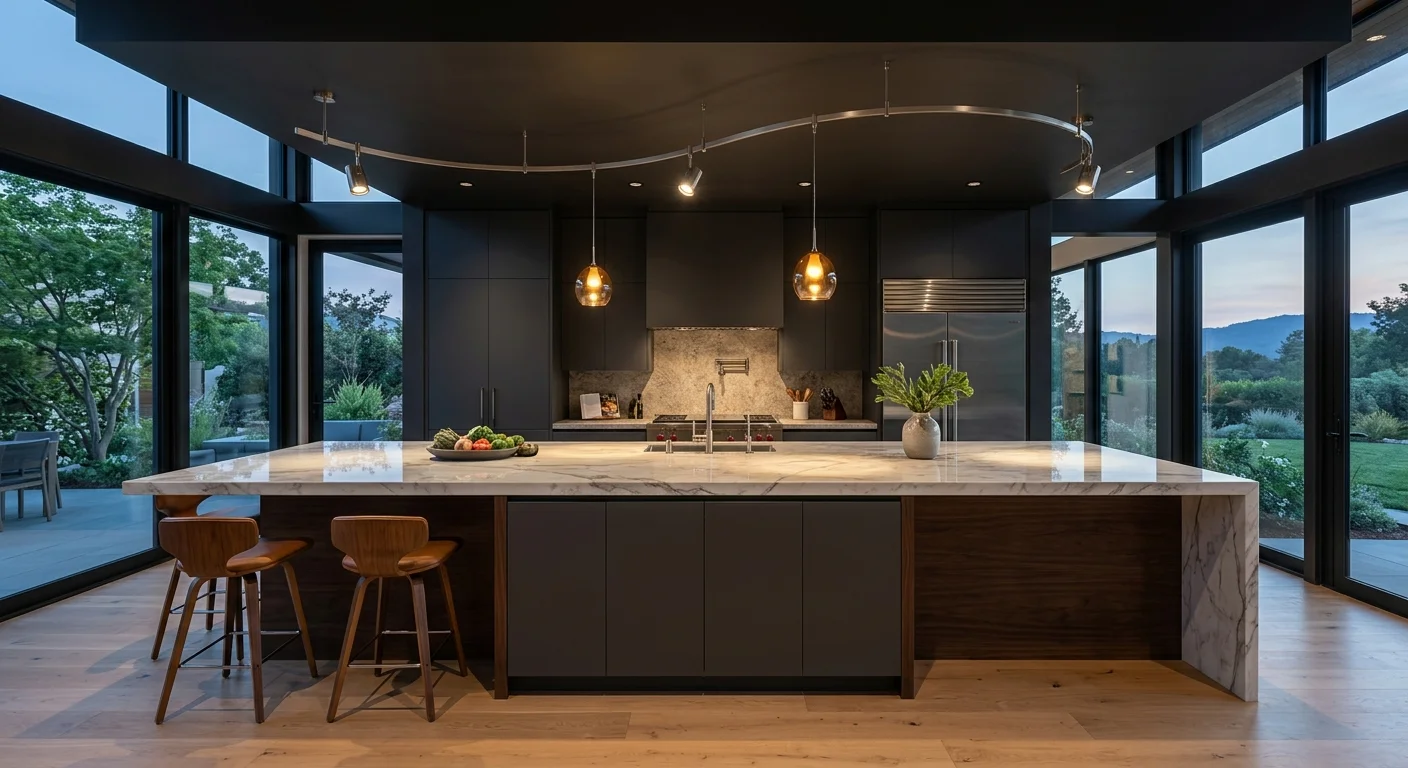
Implementing premium modern kitchen track lighting ideas shifts the engineering focus toward architectural integration and vertical plane illumination. Over curved islands and high-end culinary prep stations, rigid linear tracks fail to follow the organic geometries of the architecture. The precise technical solution is the low-voltage (12V or 24V) bendable monorail system (highly refined by brands like Tech Lighting).
These systems utilize hand-bendable alloy rails, dropped via rigid standoffs to exactly 30–36 inches above the countertop working plane. The integration of 24V infrastructure significantly mitigates voltage drop across extended curved runs, a critical electrical consideration modeled by:
$$ V_{drop} = \frac{2 \times L \times I \times \rho}{A_{wire}} $$
Where $L$ is the length of the run, $I$ is the total load current, $\rho$ is the resistivity of the internal copper bus, and $A_{wire}$ is the cross-sectional area. Maintaining $V_{drop} < 5\%$ ensures uniform lumen output and prevents localized thermal stress on the driver.
Specifying home office track lighting demands strict adherence to visual comfort paradigms, specifically dictated by the WELL Building Standard v2. The primary metric is the Unified Glare Rating (UGR), which must be maintained at $\text{UGR} < 19$ for spaces requiring intensive screen-based visual tasks.
Standard direct downlights cause specular reflection on monitors and intense ocular fatigue. The optimal technical layout involves mounting a 48V magnetic track strictly parallel to the desk orientation, offset laterally by 0.5–1.0 meters. Engineers must populate the track with deep-baffle, asymmetric wash lenses or snoot-equipped spot modules (exemplified by ERCO optics). This asymmetric distribution casts high-CRI ($>95$) light uniformly across the horizontal work plane at 500 lux, while physically shielding the LED diode from the occupant's direct line of sight.
| Application Parameter | Living Room (Multi-Circuit) | Kitchen (Monorail System) | Home Office (Asymmetric Magnetic) |
|---|---|---|---|
| System Typology | 120V Dual-Circuit J-Type | 24V Bendable Monorail | 48V Recessed Magnetic Track |
| Target Illuminance ($E_m$) | 150-300 lx (Ambient/Zoned) | 500-750 lx (Task Plane) | 500 lx (Task Plane) |
| Max Allowable UGR | $< 22$ (Relaxation) | $< 25$ (Active Prep) | $< 19$ (Visual Comfort Standard) |
| Optics Required | Narrow Spot ($25^\circ$) + Linear Diffuse | Medium Flood ($40^\circ$) + Pendants | Asymmetric Wash + Snooted Spot |
| Est. Component Cost/Meter | $80 - $120 / m | $150 - $250 / m | $200 - $350 / m |
| Driver Location | Integral to Track Heads | Remote (or Surface Canopy Step-Down) | Remote 48V Constant Voltage Driver |
Pro-Tip: When calculating total loads for 48V magnetic layouts, never exceed 80% of the remote LED driver’s maximum rated capacity (the standard derating rule) to guarantee thermal stability and ensure a lifespan exceeding 50,000 hours (L70).
Real-world integration frequently uncovers nuances overlooked in theoretical blueprints. Field feedback from certified NECA electricians highlights several critical implementation rules:

Mastering how to position track lighting in living room spaces requires moving beyond aesthetic intuition and strictly adhering to photometric geometry, IESNA (Illuminating Engineering Society of North America) guidelines, and IEC 60364 standards for low-voltage residential installations. A professional layout relies on precise calculations to establish a balanced visual hierarchy, ensuring spatial expansion without inducing specular glare or thermal overload.
The fundamental baseline for any layout requires calculating the total required luminous flux ($\Phi$). While IESNA defines generalized ambient living room targets between 10 and 20 foot-candles (approx. 100–200 Lux), modern multi-use spaces typically require a base target ($E$) of 350 Lux to comfortably support dynamic activities.
To determine the requisite fixture count, engineers must account for the physical room area ($A$) in square meters, adjusted by a Light Loss Factor ($LLF$) and a Coefficient of Utilization ($CU$) to compensate for wall reflectance and LED degradation:
$$ \Phi_{\text{total}} = \frac{E \times A}{CU \times LLF} $$
For a standard $20\text{ m}^2$ living room with dark hardwood floors and matte white walls (typical $CU = 0.65$, $LLF = 0.85$ for high-quality modules like those from ERCO Lighting):
$$ \Phi_{\text{total}} = \frac{350 \times 20}{0.65 \times 0.85} = \frac{7000}{0.5525} \approx 12,669 \text{ Lumens} $$
Dividing this by an average 800-lumen output per track head dictates a requirement of exactly 16 individually spaced fixtures to uniformly blanket the room.
When illuminating vertical surfaces—whether deploying asymmetrical wall-washers or pinpointing gallery art—the spatial distance from the track housing to the wall is critical. For standard 8- to 9-foot ceilings, the mounting track must be positioned at a lateral offset ranging from 18 to 40 inches from the wall.
This specific offset enables the strict application of the 30-Degree Rule. By targeting the center of an object (typically at an eye-level height of 60 to 65 inches) exactly $30^\circ$ from the vertical plane, the beam simultaneously avoids reflecting glare into the occupant's eyes and prevents exaggerated downward shadows from textured drywall. The required lateral distance ($D$) from the wall can be calculated using basic trigonometry against the vertical drop height ($H$) from the luminaire to the center of the focal point:
$$ D = H \times \tan(30^\circ) $$
If the track sits at 96 inches and the art center is at 60 inches, $H = 36$ inches. Therefore, $D = 36 \times 0.577 = 20.7$ inches. The track must be mounted exactly 20.7 inches from the wall to achieve the perfect photometric angle.
In residential high-rises featuring impenetrable post-tensioned concrete slabs or steeply pitched A-frame ceilings, standard overhead suspension is often structurally or aesthetically prohibited. In these restrictive scenarios, designers must leverage wall mounted track lighting ideas.
By securing low-profile line-voltage rails (such as the Halo or Juno standards) directly to the perimeter drywall at a height of 7.5 to 8 feet, the track acts as an architectural cornice. From a wall-mounted position, dual-circuit tracks can deploy narrow-beam uplights to graze vaulted ceilings—creating massive indirect ambient bounce light—while simultaneously utilizing directional spotlights angled downward to task-light reading chairs.
Selecting the correct optical lens and mounting strategy drastically alters the photometric performance of the system.
| Photometric Strategy | Ideal Optic / Beam Angle | Optimal Track-to-Wall Spacing | Fixture Spacing on Track | Target Illuminance (Task vs Ambient) | Primary Application |
|---|---|---|---|---|---|
| High-Contrast Art Accent | Narrow Spot ($15^\circ - 25^\circ$) | 18" - 24" (using $30^\circ$ formula) | Dictated by art width | 3:1 contrast ratio ($>50$ FC) | Illuminating specific canvases, gallery walls. |
| Broad Wall Washing | Asymmetric / Flood ($60^\circ+$) | $1.0\times$ to $1.5\times$ wall height | Exactly $0.5\times$ wall height | 20 - 30 FC | Visual spatial expansion; minimizing drywall flaws. |
| General Ambient | Linear Diffused / Wide Flood | Centralized or Continuous Perimeter | 2' - 4' apart | 10 - 20 FC | Establishing baseline room illumination. |
| Wall-Mounted Uplight | Medium Flood ($40^\circ$) | Mounted on wall (0" offset) | 3' - 5' apart | Indirect bounce calculation | Vaulted, exposed timber, or concrete ceilings. |
Installer Feedback & Field Experience:
Furthermore, when specifying cutting-edge 48V magnetic systems like WAC Lighting, precision is paramount; recessed aluminum channels must be blocked into the ceiling joists with 1/16-inch tolerance before drywall mudding. Miscalculating the spatial geometry during the rough-in phase permanently binds the homeowner to suboptimal beam angles, causing irreversible glare and thermal inefficiencies across the lifespan of the hardware.

Mastering residential illumination requires shifting from basic lumen delivery to precise photometric control. When evaluating how to make track lighting look good, the engineering consensus is clear: success hinges on concealing the physical infrastructure while simultaneously layering distinct optical modules on a unified circuit. This multi-layered approach satisfies both the biological requirements of the WELL Building Standard v2 (L02: Visual Lighting Design) and high-end architectural aesthetics.
To visually expand spatial perception, designers employ asymmetric wall washing. Rather than projecting conical beams that cause "scalloping," specialized track modules utilize complex reflector geometries or asymmetric PMMA lenses to distribute a uniform gradient of light. The mathematical spacing for flawless wall washing adheres to a strict setback-to-spacing ratio. If $H$ is the wall height, the optimal setback distance ($D_{setback}$) and fixture spacing ($S_{fixture}$) are typically calculated as:
$$D_{setback} \approx \frac{1}{3} H \quad \text{and} \quad S_{fixture} \approx D_{setback}$$
Conversely, fine art accentuation demands rigid focal isolation. To trigger the human eye's natural visual hierarchy, the illuminance on the canvas ($E_{target}$) must achieve a minimum 3:1 contrast ratio against the surrounding wall ($E_{ambient}$), expressed as:
$$\frac{E_{target}}{E_{ambient}} \ge 3$$
Achieving this ratio requires narrow-beam spotlights (15°–25°) with internal snoots or hex-cell louvers to eliminate off-angle glare. High-end fixtures from ERCO or WAC Lighting often integrate framing projectors equipped with mechanical shutters, allowing the beam to be shaped into precise quadrilaterals that conform exactly to the canvas dimensions.
A frequent architectural dilemma is how to deliver generalized room illumination without cluttering the ceiling plane. The advent of 48V DC magnetic systems resolves this by allowing continuous ambient track lighting modules to sit flush within the same channel as directional spotlights. These linear diffused modules utilize micro-prismatic covers to provide wide-angle, low-glare ($UGR < 19$) base illumination.
To bridge the vertical gap in high-volume spaces, integrating hanging fixtures is paramount. Contemporary track lighting pendants ideas involve utilizing magnetic pendant adapters to suspend decorative glass or machined-aluminum cylinders directly over kitchen islands or dining tables. This consolidates all structural wiring into a single architectural line.
Pro-Tip: To ensure the track infrastructure entirely disappears into the architecture, specify recessed plaster-in tracks (flangeless) painted to match the ceiling's exact RAL color code. This is the definitive answer to how to make track lighting look good in minimalist spaces.
| Module Typology | Photometric Goal | Beam Angle / Distribution | Efficacy (lm/W) | Est. Lifespan (L70) | Hardware Cost (Per Module) | Prime Application |
|---|---|---|---|---|---|---|
| Linear Diffused (Ambient) | Broad, shadowless base illumination | $100^\circ - 120^\circ$ (Lambertian) | $90 - 110$ | $50,000$ hrs | $80 - $150 $75 - 90$ $120 - $220 | Highlighting textured masonry, expanding compact rooms. |
| Adjustable Spot (Framing) | High-contrast accentuation (3:1) | $15^\circ - 30^\circ$ (Variable) | $60 - 80$ | $40,000$ hrs | $250 - $600 $40 - $90 | Dining tables, countertops, reading zones. |
Field engineers and integrators consistently report that while 48V magnetic systems offer unparalleled design freedom, they introduce unique electrical and mechanical challenges governed by IEC 60598-1 and local building codes.
Theoretical photometric layouts frequently encounter harsh realities once translated to the active job site. Field experience from master electricians and architectural lighting installers reveals that the long-term reliability of a track lighting ecosystem is dictated less by the luminaire itself and more by thermal management, driver quality, and the physical constraints of the mounting architecture.
The specification of surface-mounted versus embedded (recessed) 48V magnetic tracks radically alters the project timeline, labor costs, and long-term maintenance protocols.
Surface-Mounted and Suspended Systems:
Installers heavily favor surface-mounted systems (like traditional J-Type or surface-mounted 48V tracks) for retrofits and concrete ceiling applications. Installation is rapid, relying on standard toggle bolts or direct anchoring to ceiling joists. Field feedback highlights a singular, recurring pitfall: aligning multiple 8-foot aluminum extrusions perfectly straight across a structurally uneven drywall ceiling. Installers frequently utilize laser levels and specialized rigid track splices to prevent "snaking," but ceiling waviness can still telegraph through the straight line of the track.
Embedded (Mud-In) Magnetic Tracks:
Recessed magnetic tracks, such as those from WAC Lighting or Tech Lighting, provide the coveted "zero-clutter" architectural aesthetic but demand rigorous, multi-stage installation.
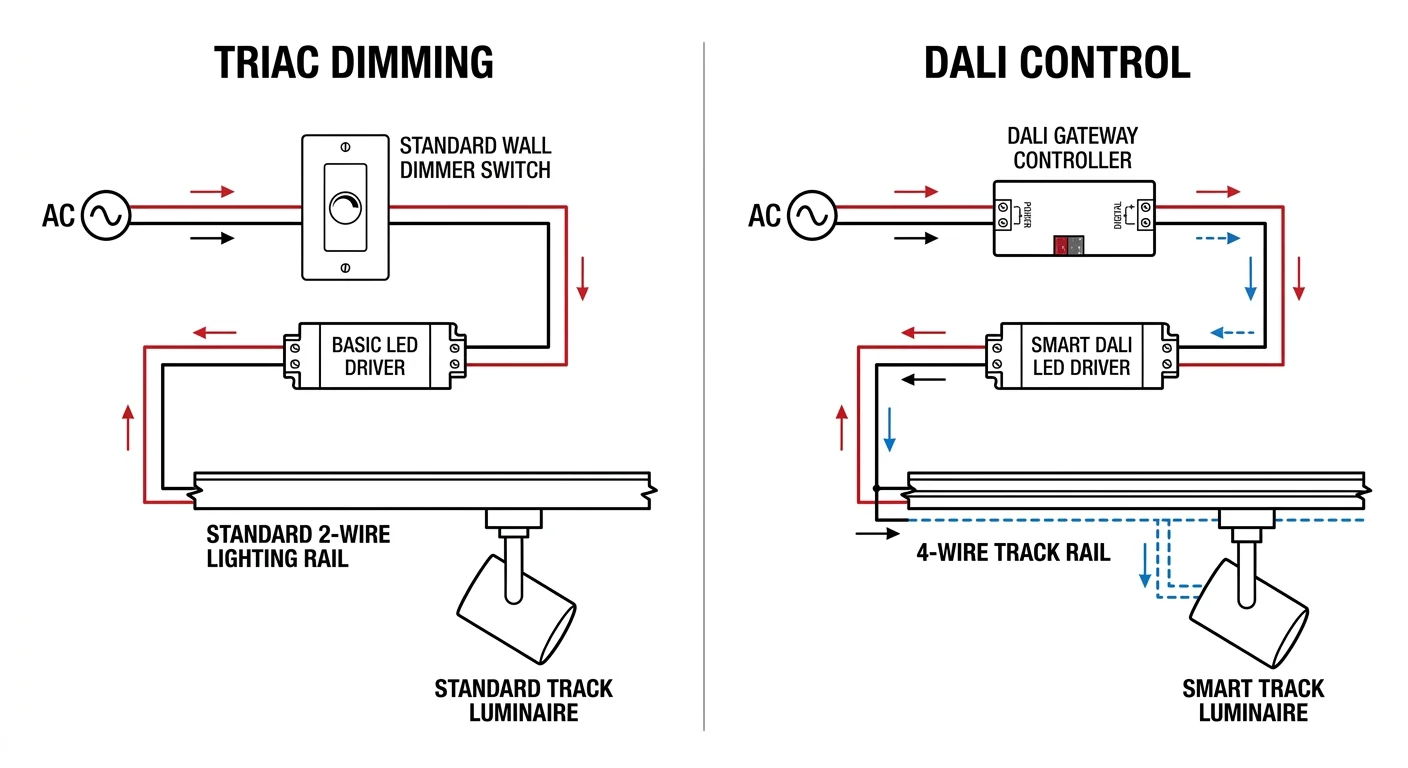
The integration of track lighting into modern smart ecosystems requires absolute precision in power delivery. The mismatch of dimming protocols is the leading cause of field callbacks, manifesting as audible driver humming, low-end "pop-on," or strobing. To comply with the IEEE 1789 standard for mitigating health risks from LED flicker, designers must strictly evaluate their control protocols.
TRIAC / Forward Phase (Legacy):
Traditional phase-cut dimmers operate by shearing off the leading or trailing edge of the AC voltage sine wave. While ubiquitous and cheap, TRIAC dimmers struggle with the low minimum load requirements of modern high-efficiency LEDs. Field installers consistently report that pushing TRIAC systems below 10% output frequently drops the current below the dimmer's required holding current ($I_H$), resulting in severe flickering.
DALI (Digital Addressable Lighting Interface - IEC 62386):
For luxury residential applications utilizing advanced ecosystems, DALI has become the gold standard. Unlike phase-cutting, DALI utilizes a two-wire data bus to send digital commands directly to the LED driver (e.g., an eldoLED or Lutron driver). The dimming curve in a DALI system is strictly defined by the logarithmic formula, ensuring smooth transitions matched to human eye perception:
$$ X(n) = 10^{\frac{n-1}{253} - 1} $$
(Where $X(n)$ is the normalized light output and $n$ is the dimming step from 1 to 254).
| Specification / Protocol | TRIAC / Forward Phase (Line Voltage) | DALI (IEC 62386 Digital Bus) |
|---|---|---|
| Control Mechanism | AC Waveform Clipping (Analog) | 2-Wire Digital Signal to Remote Driver |
| Dimming Floor | Typically limits out at 5% – 10% | True 0.1% to 1% (Deep Dimming) |
| Wiring Infrastructure | Standard 2-wire / 3-wire Romex | Requires dedicated 2-wire low-voltage control bus |
| Zoning Flexibility | Hardwired zones. Track circuits are fixed. | Software-defined. Individual heads can be addressed and grouped dynamically via app. |
| Smart Ecosystem Compatibility | Poor. Requires specialized smart wall switches. | Exceptional. Integrates seamlessly with advanced gateways (KNX, Control4). |
| Installer Feedback | "Prone to humming and flickering if the dimmer and integrated track head driver are mismatched." | "Bulletproof reliability and zero flicker, but the remote driver placement requires complex pre-planning." |
Pro-Tip from the Field: When specifying a 48V DC magnetic track system, always decouple the power supply from the track itself. Installers universally despise integrated track drivers because they act as thermal traps. By utilizing remote power supplies housed in well-ventilated, accessible utility panels, engineers dramatically lower the Case Temperature ($T_c$) of the driver. A reduction of just $10^\circ\text{C}$ in operating temperature can mathematically double the Mean Time Between Failures (MTBF) of the electrolytic capacitors within the driver, guaranteeing decades of reliable service.
The financial specification of an architectural track lighting system transcends simple material estimating; it requires a rigorous Total Cost of Ownership (TCO) analysis. Modern residential lighting represents a significant capital expenditure (CapEx), but when engineered correctly with high-efficacy LED modules and modular infrastructures, it yields substantial operational savings (OpEx) and directly inflates real estate valuation.
To quantify the long-term financial viability of these systems, electrical engineers and architectural planners must evaluate the lifecycle costs using a standardized economic model. The baseline TCO over a lifespan $n$ (typically evaluated at 15 years for architectural lighting) is calculated as:
$$ TCO = CapEx_{initial} + \sum_{t=1}^{n} \left( \frac{E_{t} \cdot C_{kWh} + M_{t}}{(1+r)^t} \right) $$
Where $E_t$ is annual energy consumption in kWh, $C_{kWh}$ is the local energy rate, $M_t$ is the modular replacement/maintenance cost, and $r$ is the discount rate.
The initial capital divergence between traditional 120V line-voltage systems and modern 48V direct-current (DC) magnetic ecosystems is steep. However, evaluating purely on upfront hardware costs ignores the deferred maintenance and retrofit advantages of modular magnetic tracks.
| Specification Parameter | Traditional Line-Voltage (e.g., Juno, Halo) | Premium 48V Magnetic (e.g., WAC Lighting, Oteshen) |
|---|---|---|
| Hardware CapEx (Est. per Linear Foot) | $15 – $35 (Track + Basic Heads) | $80 – $150 (Flangeless Track + Smart Modules + Drivers) |
| Installation Complexity & Labor Cost | Low. Direct 120V tie-in. Standard J-box. | Very High. Requires remote Class 2 drivers, blocking, Level 5 drywall mudding. |
| Energy Efficacy & Standards | Moderate (70-90 lm/W). Dimming compatibility requires matching phase-cut switches. | Exceptional (>100 lm/W). Native PWM dimming, Title 24 & ASHRAE 90.1 compliant. |
| Maintenance / Future-Proofing ($M_t$) | High structural barrier. Changing track requires drywall repair and hardwiring. | Zero structural barrier. Tool-free, hot-swappable magnetic modules. |
| Expected Lifespan (L70 Standard) | 25,000 – 35,000 Hours | 50,000+ Hours (Premium thermal management) |
Transitioning to a high-efficacy smart track system dramatically reduces OpEx. By integrating smart ecosystems (Philips Hue, DALI-2 controlled systems) with automated daylight harvesting and precise 1% dimming curves, the actual operational wattage is frequently 40-60% lower than the system's maximum connected load.
Pro-Tip: When calculating ROI for smart magnetic systems, factor in the elimination of standalone dimmer switches and complex multi-gang box wiring. Because control logic is handled digitally via the 48V track's integrated communication bus (or wireless mesh), electricians save significant time and copper wiring during the rough-in phase, offsetting some of the premium hardware costs.
Theoretical cost projections often miss critical on-site realities. Field feedback from integrators highlights several hidden financial pitfalls and engineering requirements that must be accounted for during the planning phase:
From an asset management perspective, architectural track lighting shifts the paradigm from "electrical utility" to "premium interior finish." Appraisers and high-end real estate agents consistently note that properties equipped with layered, high-CRI (>90) architectural lighting command higher market premiums. The ability to demonstrate a 48V magnetic system where a buyer can effortlessly rearrange art-framing projectors and tunable-white ambient diffusers provides a tangible, high-tech luxury selling point.
Furthermore, the modular future-proofing directly impacts the property's lifecycle cost. As interior design trends shift, the living room's lighting can be entirely overhauled by simply snapping in new magnetic modules—requiring zero demolition, zero electrical permits, and zero structural disruption. This capability represents the ultimate ROI for long-term property holders.
Expert FAQ on Residential Track Lighting
Deploying track lighting effectively requires shifting from a generic layout to a calculated, multi-zone photometric strategy. In modern living spaces, track systems operate optimally as a layered architectural tool to delineate functional zones without physical partitions.
To execute a professional layout, engineers utilize specific spatial geometry. When highlighting vertical surfaces or artwork, adherence to the 30-Degree Rule is mandatory to eliminate specular glare and cast shadows. The required lateral offset distance ($D$) from the wall to the track can be calculated based on the vertical drop ($H$) from the ceiling to the eye-level center of the target:
$$D = H \times \tan(30^\circ)$$
Application Best Practices:
The aesthetic viability of track lighting has entirely transcended the bulky, commercial stigmas of the 1980s. When specified correctly, modern systems act as high-end architectural features. The aesthetic success depends heavily on selecting the correct track typology and mounting profile for the room's interior design language.
For minimalist, Japandi, or ultra-modern aesthetics, 48V recessed magnetic tracks (e.g., from WAC Lighting or Nuordic) represent the pinnacle of luxury. Because the track is mudded directly into the drywall flush with the ceiling, the system has zero visual mass. For Mid-Century Modern or Industrial spaces, surface-mounted matte black H-Type or J-Type tracks with strict cylindrical heads complement exposed structural beams and organic textures. To ensure a premium look, designers must mandate LED modules with a CRI > 90 and a warm color temperature (2700K–3000K) to render furnishings and skin tones flawlessly.
Yes, provided the luminous flux is mathematically mapped to the room's dimensions. Track lighting is highly scalable and capable of exceeding the WELL Building Standard v2 recommendations for visual acuity.
To ensure sufficient brightness without inducing glare, lighting engineers calculate total required room lumens based on target illuminance (Lux). For a residential living room, the target is typically 350 Lux. The calculation is:
$$Total\ Luminous\ Flux\ (\Phi) = Area\ (m^2) \times 350\ Lux$$
If a $20m^2$ living room requires $7000$ lumens, and you select ERCO Lighting track heads outputting $700$ lumens each, exactly 10 heads are required. Distributing these heads evenly (spaced 2–3 feet apart) guarantees a uniform ambient layer that easily matches or surpasses traditional recessed downlighting.
When specifying equipment, engineers must weigh electrical infrastructure against aesthetic goals. Below is a comparative analysis of the three primary residential track typologies.
| Specification Parameter | Line-Voltage (120V H/J/L) | Low-Voltage Monorail (12V) | 48V Magnetic DC |
|---|---|---|---|
| Safety Standard | IEC 60598-1 (Class I) | GOST R IEC 60598-1 (Class III) | IEC 61347-2-13 (SELV) |
| Dimming Compatibility | Standard ELV/TRIAC | Electronic Low Voltage (ELV) | DALI, 0-10V, Smart (e.g., Philips Hue) |
| Modularity & Lenses | Fixed mechanical clips | Articulated standoffs, pendants | Tool-free magnetic snap-in |
| Est. Cost per Linear Meter | Low (\$30 - \$60) | Medium-High (\$80 - \$150) | Premium (\$150 - \$300+) |
| Typical Lifespan (Driver) | ~50,000 Hours (Internal) | ~40,000 Hours (External) | ~60,000 Hours (Remote) |
Field Experience & Installer Feedback:
