
As an Electrical Engineer specializing in horticultural lighting, I see a common pattern: indoor gardeners buying lights based on wattage or brightness (lumens) rather than the metrics that actually drive photosynthesis. Whether you are looking for grow lights for seedlings to jumpstart your spring garden or indoor plant lights for winter to save a prized Monstera, understanding the physics of light is non-negotiable.
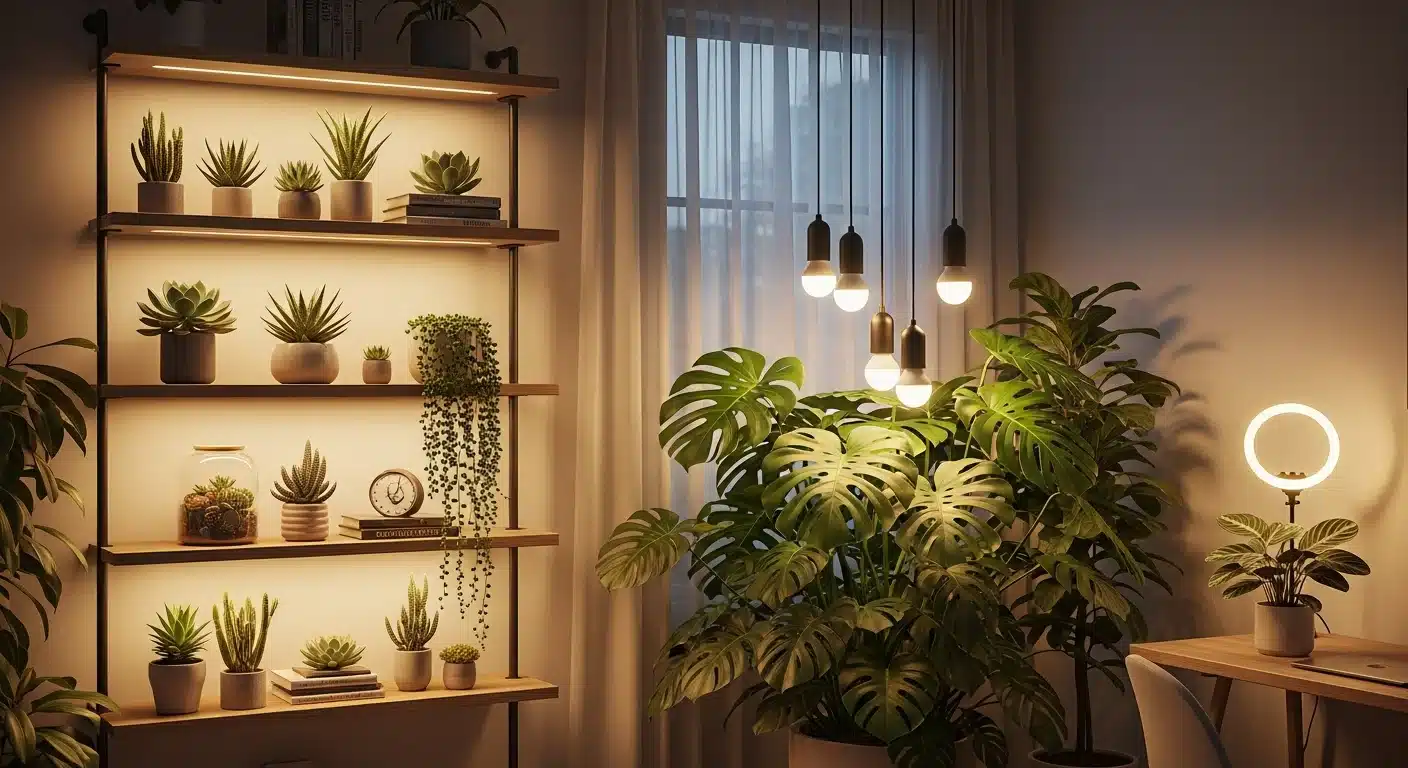
This guide moves beyond marketing fluff. We will explore full spectrum grow lights, the physics of photon flux, and how to select the best grow lights for indoor plants based on engineering standards and biological needs.
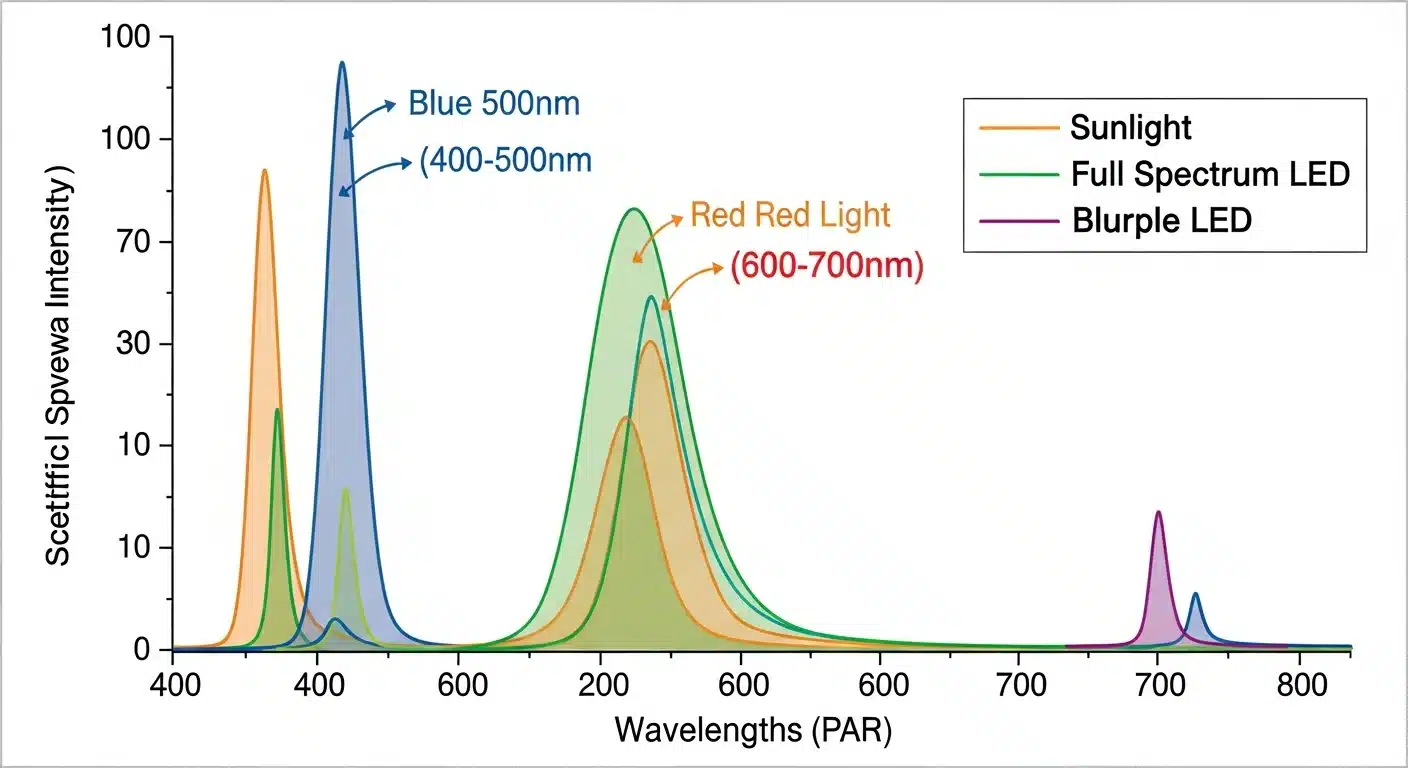
Historically, growers relied on blurple (blue/red) LEDs or hot HPS lamps. Today, modern LED grow lights utilize a "White-Light" full spectrum approach. But what does "Full Spectrum" actually mean in an engineering context?
It refers to a light source that covers the PAR (Photosynthetically Active Radiation) range from 400nm to 700nm, often supplemented by Far-Red and UV.
To mimic the sun effectively, grow light bulbs must balance specific wavelengths:
Stop looking at Lumens. Lumens measure how bright light appears to the human eye. Plants don't care about brightness; they care about photons. To evaluate the best led lights for hydroponics or simple houseplants, you must understand three acronyms.
This is not a unit of measurement but a defined range of light (400-700nm) that plants use.
Measured in $\mu mol/s$, PPF tells you the total amount of plant-usable light emitted by a fixture per second. Think of this as the "horsepower" of the light engine.
This is the most critical metric for the end-user. Measured in $\mu mol/m^2/s$, it tells you how many photons are actually landing on your plant canopy.
Target PPFD Ranges:
* Low Light (Succulents/Herbs/Shade Plants): $100\text{--}300 \; \mu mol/m^2/s$
* Vegetative Stage (Leafy Greens): $400\text{--}600 \; \mu mol/m^2/s$
* Flowering/Fruiting (Tomatoes/Cannabis): $600\text{--}1000+ \; \mu mol/m^2/s$
The form factor you choose dictates the application. A battery powered grow light with timer is convenient, but rarely packs the punch needed for fruiting vegetables. Here is an engineering breakdown of common fixture types.
For individual houseplants, a clamp grow light fixture paired with a high-quality PAR38 or A19 bulb is ideal. These utilize standard E26/E27 ceramic sockets. The key here is directional optics. Unlike a standard light bulb that sprays light 360 degrees, a good grow bulb has a 60-degree beam angle to focus photons downward.
A halo grow light is a ring-shaped light that stakes directly into the pot.
* Pros: Aesthetically pleasing, great for office desks, often USB powered.
* Cons: Usually low wattage (5W-10W).
* Best For: Maintaining low-light plants like Pothos or Snake Plants. Do not expect to grow tomatoes with a halo light.
Users frequently ask for a battery powered grow light with timer to avoid ugly cables.
* Engineering Reality Check: High-intensity LEDs consume significant power. A fixture delivering $500 \; \mu mol/m^2/s$ would drain a standard Li-ion battery in minutes.
* Use Case: Battery options are strictly for decorative, low-light maintenance or temporary display.
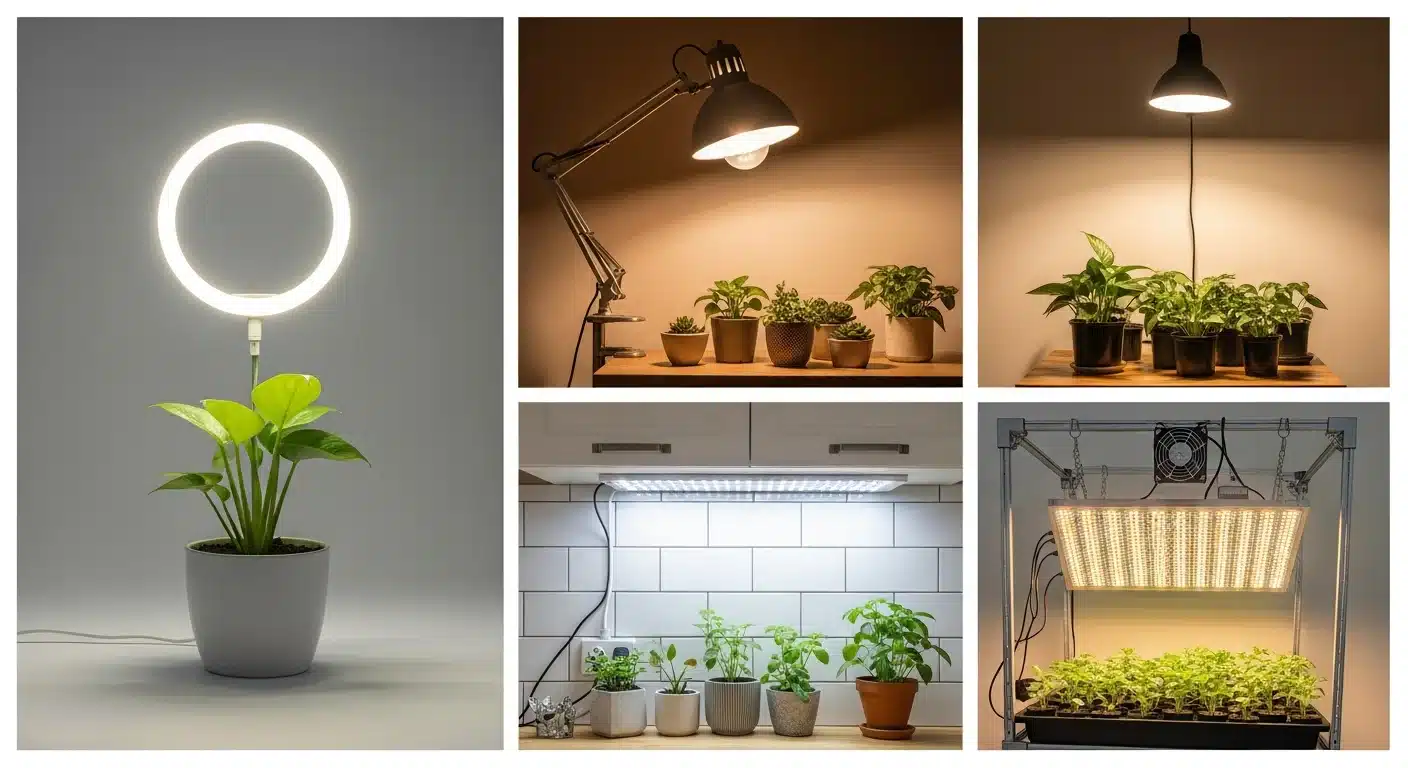
Hydroponic systems require high PPE (Photosynthetic Photon Efficacy). Look for fixtures using Samsung LM301B/H diodes and MeanWell drivers. These components ensure a PPE $>2.7 \; \mu mol/J$, meaning you get more light for less electricity—crucial when running 18 hours a day.
Different plants have evolved to thrive under different solar conditions. Your lighting setup must reflect this.
Seedlings are fragile. Too much heat will desiccate them; too little light makes them spindly.
* Recommendation: Wireless grow light strips or T5 LED tubes are perfect here.
* Placement: Keep lights 6-12 inches above the tray.
* Spectrum: Cool white (5000K-6500K) is preferred to promote compact root and stem growth.
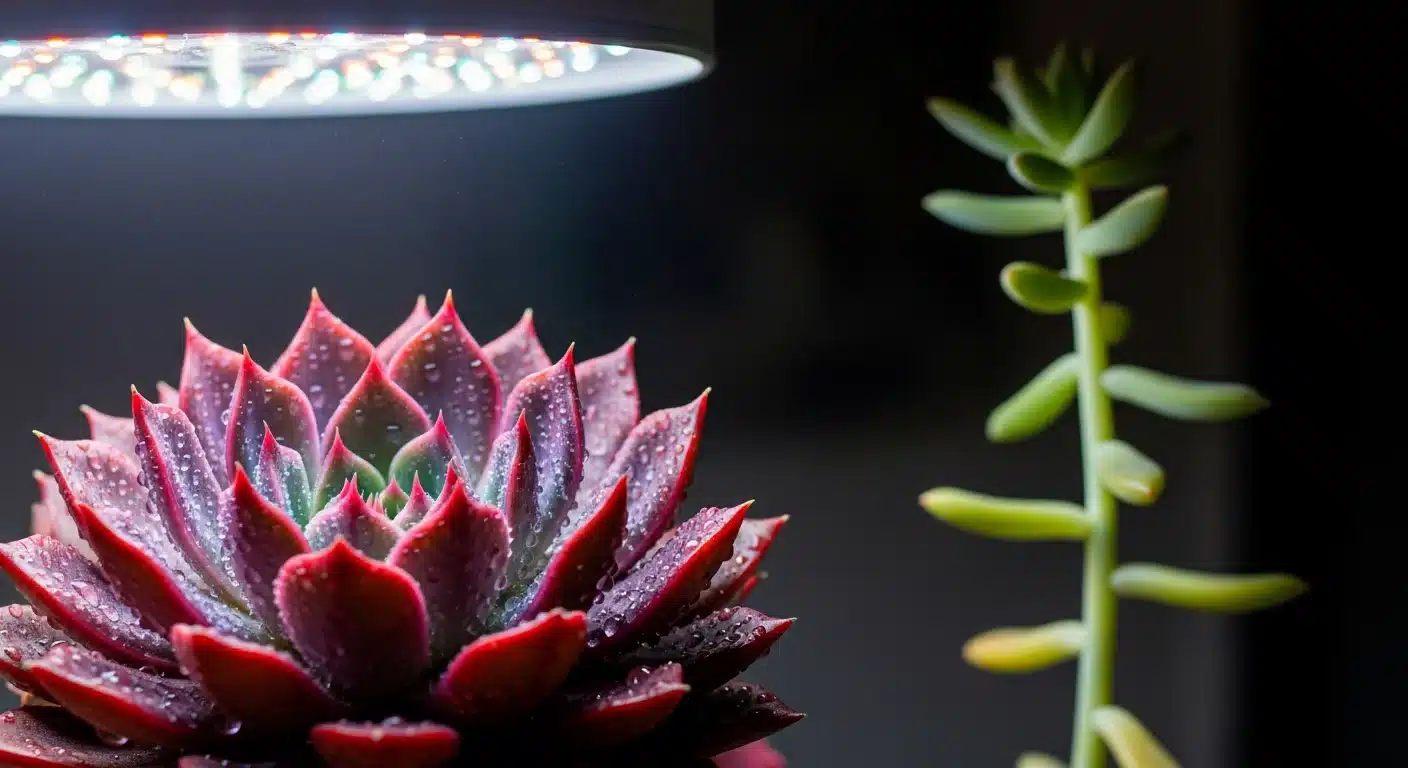
A succulent grow light needs to be intense. Succulents and cacti are high-DLI plants. If they don't get enough light, they lose their vibrant stress colors and turn green/leggy (etiolation).
* Target PPFD: $>300 \; \mu mol/m^2/s$.
* Fixture: High-output panels or focused spot bulbs.
For a kitchen garden, a small grow light might suffice for basil, but grow lights for vegetables (peppers, tomatoes) require full power.
* Requirement: Full spectrum with added Red (660nm) for flowering.
* Ingress Protection: If you are spraying water, ensure the light is IP65 rated.

Buying the light is step one. Placing it correctly is step two. The two physical laws governing this are the Inverse Square Law and the Daily Light Integral.
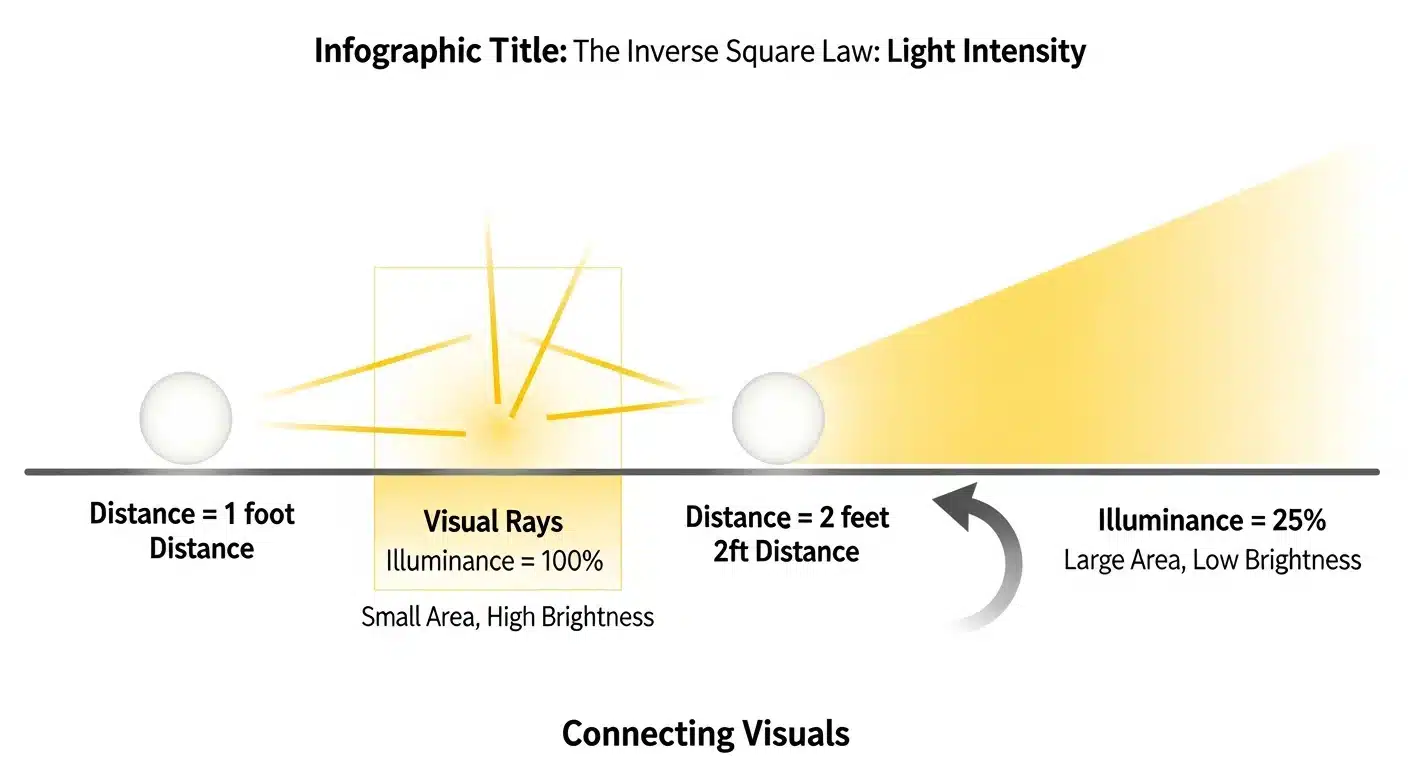
Light intensity drops off drastically as you move the source away. The intensity ($I$) is inversely proportional to the square of the distance ($d$):
$$ I = \frac{1}{d^2} $$
If you move your hanging grow lights from 1 foot to 2 feet above the canopy, your plants receive only 25% of the light, not 50%. This is why "stretching" occurs when lights are mounted too high on a ceiling.
The DLI is the total number of photons received in a day ($mol/m^2/d$). It combines intensity and duration.
$$ \text{DLI} = \frac{\text{PPFD} \cdot \text{Light Hours} \cdot 3600}{1,000,000} $$
The market is flooded with cheap grow lights. Are they worth it?
| Feature | Cheap Generic LEDs | Premium Horticultural LEDs |
|---|---|---|
| Diodes | Generic SMD 2835 (Low efficiency) | Samsung LM301B/H (High efficiency) |
| Driver | Resistive dropper (Generates heat) | MeanWell/Sosen (Digital regulation) |
| Spectrum | Often just Blue/Red (Blurple) | Full Spectrum + UV + IR |
| Heat Sink | Thin aluminum or plastic | Thick passive aluminum heat sink |
| Lifespan | ~10,000 Hours (Rapid decay) | >50,000 Hours (L90 Rating) |
Verdict: For simple winter maintenance, cheap options work. For actual growth and food production, invest in quality components.
Technically, yes, photosynthesis can occur under standard LEDs. However, standard household bulbs lack the intensity and specific spectral balance (PAR) required for vigorous growth. They are often insufficient for anything beyond low-light foliage plants.
This is a common marketing trick. A "1000W Equivalent" LED usually pulls only 100-150 true watts from the wall. Always check the actual power draw and the PPFD map, not the "equivalent" number.
Yes. Respiration occurs during the dark cycle. Running lights 24/7 can stress plants. Use a simple timer to provide 12-16 hours of light and 8-12 hours of darkness.
For grow lights for seedlings, maintain a distance of 6-12 inches if using low-wattage strips (20W). If using a high-power panel (100W+), keep it 24-30 inches away to prevent frying the tender tissues.
